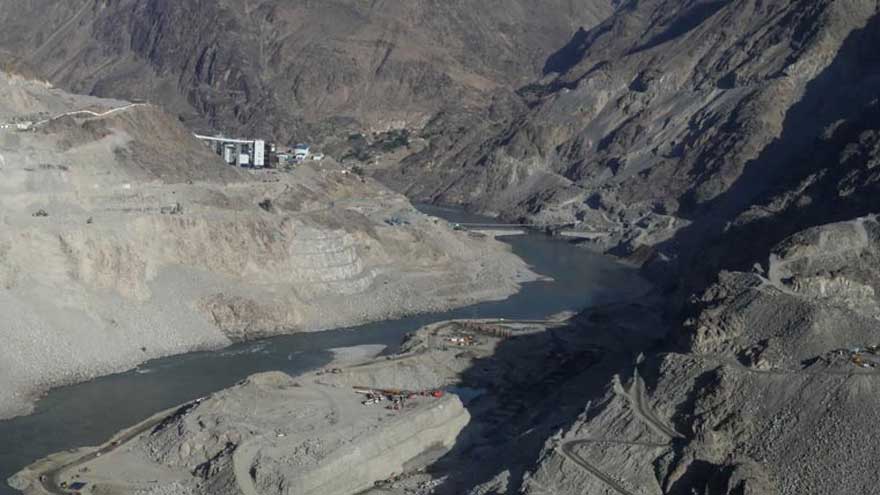
Summary The three eastern rivers — the Ravi, Beas and Sutlej — was allocated to India, while Pakistan was granted primary rights over the three western rivers — the Indus, Jhelum and Chenab
(Web Desk) – The Indus Waters Treaty is a landmark water-sharing agreement between Pakistan and India that was signed on September 19, 1960, under the mediation of the World Bank. The treaty was signed by Pakistan's President Field Marshal Ayub Khan and India's Prime Minister Jawaharlal Nehru.
Under the agreement, control of the three eastern rivers — the Ravi, Beas and Sutlej — was allocated to India, while Pakistan was granted primary rights over the three western rivers — the Indus, Jhelum and Chenab. However, India was permitted limited use of the western rivers for run-of-the-river hydropower projects, domestic consumption and restricted irrigation, provided such use does not materially affect the flow of water allocated to Pakistan.
To oversee the implementation of the treaty, the two countries established the Permanent Indus Commission, comprising one commissioner from each side. The commission meets regularly to exchange technical information, monitor the implementation of the agreement and resolve disputes through dialogue.
The treaty also provides a structured mechanism for dispute resolution. Technical disagreements may be referred to a Neutral Expert, while legal disputes can be taken to a Court of Arbitration if they cannot be resolved through the Permanent Indus Commission.
The Indus Waters Treaty is widely regarded as one of the world's most successful international water-sharing agreements. Despite multiple wars and decades of strained relations between Pakistan and India, the treaty has remained in force and has continued to serve as the principal legal framework governing the sharing of the Indus River system.
The agreement is of critical importance to Pakistan, where nearly 80 percent of the country's cultivated land depends on the Indus basin irrigation system. Agriculture, food security, irrigation and hydropower generation all rely heavily on the uninterrupted flow of water from the western rivers.
In recent years, disputes have resurfaced over India's construction of hydropower projects on the western rivers, while New Delhi has also called for a review of the treaty. Pakistan maintains that the agreement is legally binding under international law and cannot be suspended or terminated unilaterally.
Here's a polished English translation in a professional news style:
In April 2025, following an attack in Kashmir, India announced that it was suspending its participation in the Indus Waters Treaty. Pakistan rejected the move, arguing that the treaty cannot be suspended or terminated unilaterally under international law. The issue has since remained a source of diplomatic friction between the two countries.
Two Indian cabinet ministers have also publicly stated that "not a single drop" of water would be allowed to flow to Pakistan, adding that work has already begun on measures to implement the policy.
Pakistan has raised India's unilateral suspension of the treaty at various international forums, where Islamabad says its legal position has received support. However, Pakistan maintains that India continues to refuse to comply with the treaty, not only by fully utilizing the waters of the eastern rivers allocated to it but also by attempting to restrict the flow of the western rivers, which are allocated to Pakistan under the agreement.
Pakistan has twice taken India to international arbitration over alleged violations of the Indus Waters Treaty. Islamabad says international arbitration bodies have clarified key provisions of the treaty, but India has refused to accept those rulings.
Pakistan has also warned that using water as a weapon would constitute an act of war, stressing that water is vital to the country's survival and that millions of people depend on the Indus river system for agriculture, drinking water and livelihoods. Islamabad argues that international law prohibits an upstream country from blocking the natural flow of transboundary rivers and recognizes the water rights of downstream states.