Summary Mian Amer said that human civilization was governed by kings, but after several centuries, people realized that monarchy was not the solution to their problems
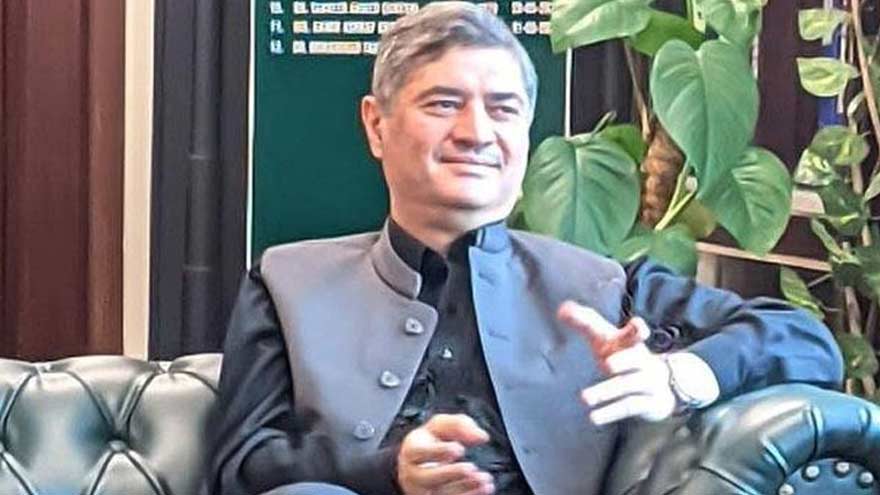
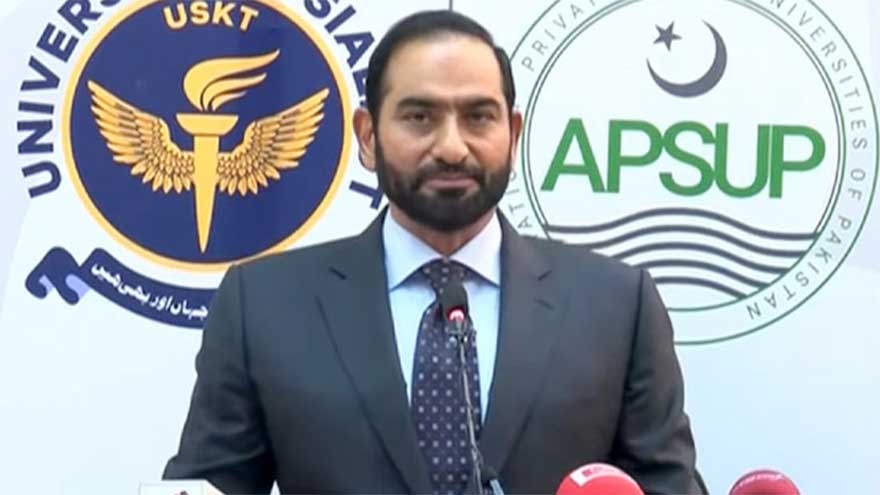
SIALKOT (Dunya News) – Dunya Media Group Chairman Mian Amer Mahmood said on Thursday that there has not been uniform development in the country and that smaller provinces are essential.
Speaking at the University of Sialkot during a special session of the Association of Private Sector Universities of Pakistan (APSUP) as part of its nationwide awareness campaign titled “Pakistan 2030: Challenges, Opportunities, and New Pathways,” Mian Amer said that human civilization was governed by kings, but after several centuries, people realized that monarchy was not the solution to their problems — they concluded that governments should be chosen through their own votes.
He said that as human civilization grew, governments and nations began to form, and new needs emerged. We delegate certain responsibilities and give people from among us the right to govern through our votes. Everyone wishes that the government and leaders work for public welfare.
PUBLIC WELFARE — A CORE DUTY OF LEADERS
Mian Amer said that it is the rulers’ responsibility to ensure public welfare, law and order, justice, economic and political welfare, and the protection of national borders. He explained that in democratic societies, three types of governments generally exist, and Pakistan is a federation made up of four provinces.
He stated that Pakistan is the only federation in the world where one federating unit makes up 52% of the total — one province is larger than the other three combined. This, he said, is a record unique to Pakistan; no other country has such a disproportionate structure.
He added that unfortunately, one province is very large in terms of population, while another is vast in area but sparsely populated. Balochistan, for instance, is large in size but has a small population, making administrative control nearly impossible. Delivering the province’s natural resources to its people is also difficult, and maintaining law and order there remains a major challenge.
The Chairman Dunya Media Group said that, unfortunately, the situation in the remaining provinces is not much better. Referring to a World Bank report on what Pakistan would look like at 100 years of independence, he noted that the report highlights several areas where the country must make significant improvements.
LOPSIDED DEVELOPMENT
Mian Amer said that in the last 79 years, five major cities have been developed. Basic facilities are not available in any city in Sindh except Karachi; everyone in Punjab is upset that the entire budget is spent in Lahore; in Khyber Pakhtunkhwa, Peshawar takes a large share of the development budget; in Balochistan, development is not seen beyond Quetta.
He said that Punjab is the most developed among the provinces. If you look at all the cities, only five capital cities were developed. Our institutions could not be strengthened.
In the past 80 years, not all the rulers were bad, some must have been good, even good people here could not perform because they did not get a level playing field for their performance, he added.
CORRUPTION DUE TO WEAK INSTITUTIONS
Chairman Dunya Media Group has said that weak institutions result in corruption. If institutions are weak, corruption increases. If there are weak institutions, the common man does not get justice. Weak institutions follow the dictates of the powerful.
Mian Amir Mahmood said that the government is formed to protect the common man from the oppression of the powerful. If institutions are weak, the common man cannot be protected from the oppression of the powerful. We have never formed a local government. When martial law is imposed, a local government is formed. When democracy comes, the first martyr is the local government.
LOCAL GOVERNMENTS SERVE MASSES
He said that there are three pillars of government – the federation, provinces and local government. The purpose of the institution of local government is to serve the people. Whenever there is chaos in the country, we abolish local government first.
He said that Pakistan is the fifth most populated country in the world; China and India are the top two in the list. China has 31 provinces. India became independent along with us. At the time of independence, India had nine provinces, today there are 39.
Indonesia is a country with a population of 270 million and it has 34 provinces.
Mian Amer said that area wise, America is the third largest country. It has 50 states and the system of local government is also strong there.
He said that the first census in Pakistan was held in 1951. At that time the population was 33 million, today the population of Pakistan is around 250 million. Punjab had a population of 20 million; today Punjab has a population of 130 million.
He said that Sindh had six million population, now it has 55 million; Khyber Pakhtunkhwa has a population of more than 40 million; Balochistan was a province of only 11 million in 1951, and now it has 15 million people. If we compare Punjab with other countries, then there are only 12 countries in the world that have more population than Punjab.
There are 172 countries that are smaller in area than Balochistan.