Summary Urges Security Council not to look away when state terrorism masquerades as counter-terrorism
NEW YORK (Dunya News) – Pakistan has warned the world about the dangers posed to the regional and international peace by collaboration between Tehrik-i-Taliban Pakistan (TTP), Baloch Liberation Army (BLA) and Majeed Brigade, which includes, among other things, sharing of terrorist training camps, that has targeted strategic infrastructure, economic projects in Pakistan, and most tragically the people.
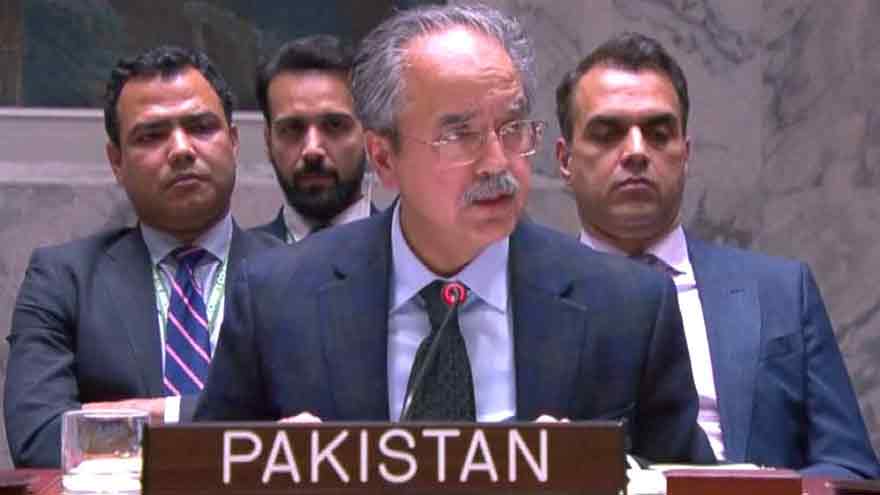
Describing the TTP as the largest UN-designated terrorist group, operating from Afghan soil, Ambassador Asim Iftikhar Ahmad, Pakistan's Permanent Representative to the UN, said that the group's presence close to our borders directly threatens the national security of Pakistan.
He made these remarks while delivering a statement at UN Security Council briefing today on "Threats to international peace & security caused by terrorist acts."
While acknowledging that the Afghan interim government has been fighting ISIL-K, he said that the threat from various other terrorist groups such as “Fitna Al Khawarij” TTP and Baloch militant groups, which have sought refuge in ungoverned spaces in Afghanistan, remains unaddressed.
He stated that the Secretary General's report highlights that Daesh remains a major global threat, with affiliates expanding in Africa—particularly West Africa and the Sahel—despite setbacks in the Middle East where nearly 3,000 fighters still operate in Iraq and Syria.
"The situation in Afghanistan remains precarious. With some 2,000 fighters, ISIL-K poses the most serious threat," he said.
"And our principal adversary in the region is active in sponsoring terrorism in Pakistan. It bankrolls and supports terrorist proxies, and carries out extra territorial assassinations that have in fact gone global," he said.
Referring to the blatant Indian aggression against Pakistan in May this year in violation of our sovereignty and international law, under the false pretext of counter-terrorism, he said that India deliberately and indiscriminately targeted civilian population and infrastructure, resulting in the martyrdom of 54 innocent Pakistani nationals, including 15 children, some of them infants, and 13 women.
He urged the Security Council not to look away when state terrorism masquerades as counter-terrorism, arguing that international peace is often the first casualty in such a situation.
The Pakistan UN Ambassador underlined the need for a holistic approach to defeat terrorism; one rooted in clarity and conviction and said that addressing the underlying drivers of terrorism is critical through a long-term vision.
He said that it is also essential to address state terrorism and oppression as part of a holistic approach. He strongly condemned collective punishment, human rights violations, demographic changes, and misuse of counter-terrorism narratives to sustain occupation in Indian Illegally Occupied Jammu & Kashmir (110JK) and Occupied Palestinian Territories. He stressed that occupation cannot be justified as counter-terrorism.
He said that there is also a need to differentiate between terrorism and legitimate struggles of people against foreign occupation.