Summary Budget focuses on exports, tax cuts, Rs70bn subsidy, IT exports to $4.5bn, agriculture reforms, salaried relief, middle-class housing and economic stability measures.
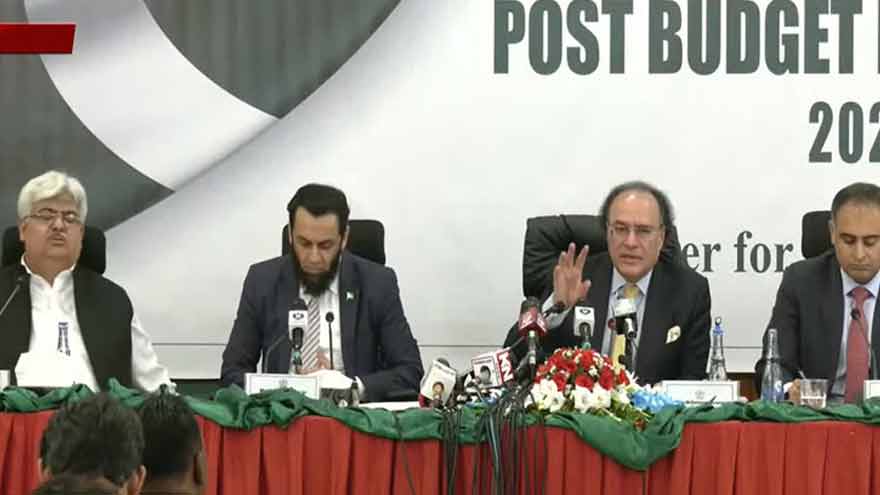
ISLAMABAD (Dunya News) – Federal Minister for Finance Muhammad Aurangzeb said the government has given special focus to exports and improvement in the tax system in the budget so that the economy can be placed on a sustainable foundation.
He stated this while addressing the post-budget press conference.
He said that repeated emphasis has been placed on export-based growth and that the government’s economic direction is aimed at long-term stability and sustainability.
Public Relief and Subsidy Allocation
The finance minister said that for public relief, additional subsidies worth 70 billion rupees have been provided in the budget. He said the government has prepared the budget with limited resources but ensured a public-friendly approach.
He added that efforts have been made to balance economic constraints while providing relief to the public through targeted measures.
IT Exports and Economic Growth Indicators
Muhammad Aurangzeb said that IT exports are expected to rise to 4.5 billion US dollars, which will be a positive development for the national economy. He said this reflects progress in the export sector and contributes to overall economic improvement.
He added that export growth remains a key pillar of the government’s economic strategy.
Super Tax and Sectoral Decisions
The finance minister said that the Prime Minister and all stakeholders agreed that the super tax should be abolished. He said decisions have been made keeping in view the requirements of exporters and industry stakeholders.
He also said that a fertility scheme has been introduced for farmers, while a Prime Minister Youth Loan scheme has been allocated for the youth.
Agriculture Sector Reforms and Facilitation
Muhammad Aurangzeb said that customs and regulatory duties on agricultural machinery and equipment have been reduced to zero. He said that facilities have been provided in the agriculture sector to reduce difficulties for farmers.
He added that agricultural credit has now exceeded 20 billion rupees, reflecting support for the farming community.
Construction Sector and Economic Development
The finance minister said that the construction sector plays an important role in economic development. He said the country has entered a journey of economic growth.
He added that despite limited resources, the government has presented a public-friendly budget. He also mentioned that during the Middle East conflict, it became clear how important it is to have a national shipping fleet.
Tax Relief for Salaried and Export Sectors
Muhammad Aurangzeb said that decisions have been taken while considering demands of the export industry. He said the 5 percent tax on salaries has been reduced to 1 percent, while the 15 percent rate has been reduced to 13 percent.
He said that positive feedback has been received on relief measures for higher salaries and surcharge-related steps.
He also said that misinformation sources should be held accountable.
Energy and Economic Pressures
The finance minister said that when the budget was presented in the cabinet, it was suggested that super tax for all exporters should be removed. He said that for the IT industry and freelancers, the fixed tax regime has been maintained.
He added that pressure on energy infrastructure will continue for some time in the next financial year as well.
Investment Confidence and Economic Stability
Muhammad Aurangzeb said that he is grateful for provincial support to the federal government and that this facility will continue for the next three financial years.
He said economic stability has no final destination and depends on remittances and policy continuity. He added that if policies remain consistent, local and foreign investors will return.
He further said that investment confidence is restored gradually and domestic investors must take the first step.
Budget for Growth and Business
The finance minister said that the budget is focused on growth and business development. He said that investment sentiment improves slowly and requires consistent effort.
He added that the first priority is to encourage domestic investors.
Statement by State Minister for Finance
State Minister for Finance Bilal Azhar Kayani said during the press conference that the finance minister presented a public budget. He said this is a budget for salaried individuals, industrialists, and exporters.
He said priority was given to providing relief to the salaried class, and the Prime Minister fulfilled his promise to this class.
He added that relief has been provided in the budget, and continuous contact was maintained with the business community.
He said consultations were held with chambers of commerce across the country and export industry needs were taken into account.
He said the 5 percent tax has been reduced to 1 percent and 15 percent reduced to 13 percent, while positive feedback has been received on higher salary and surcharge measures.
He added that groups that did not receive relief last year have now been included, including weaker segments and women.
He said an “Apna Ghar” scheme has been introduced for the middle class, as middle-income people often cannot afford construction despite purchasing plots.
He said that individuals earning up to 600,000 rupees annually will pay no tax, while those earning 600,000 to 1.2 million rupees will pay 1 percent tax.
He further said that the Benazir Income Support Programme has been increased by 17 percent.
Statement by Information Minister Attaullah Tarar
Federal Information Minister Attaullah Tarar said the budget provides relief to the public and the Prime Minister had promised that relief would be given when fiscal space becomes available.
He said the culture of the Federal Board of Revenue has changed and leakage reduction has started from the sugar industry.
He said the Prime Minister continues efforts to provide relief and resources have been created step by step for public welfare.
He said the budget is for workers, salaried individuals, industrialists, and all segments of society.
He added that at one time there were predictions of Pakistan’s default, but the government and people faced difficulties with patience and stability, resulting in macroeconomic stability.
He said FBR reforms were presented to the World Bank and digital wallets were provided under the Ramadan package.
He said FBR digitization was carried out under the Prime Minister’s supervision and the culture of recommendation has been eliminated.
He said the Prime Minister’s economic team has turned the impossible into reality.
Exports and Poverty Reduction
Chairman Federal Board of Revenue (FBR) Rashid Langrial said that poverty will end when goods produced in factories are sold in foreign markets. He said this while addressing a press conference, stressing that export-led growth is essential for economic development.
He stated that Pakistan is a small market for selling goods, and real economic progress will only be achieved when products are exported abroad. He added that this is an export-led growth budget.
Institutional Strengthening of PRAL and FBR
Rashid Langrial said that the Prime Minister has directed that PRAL should be developed into a better organization. He said that PRAL is already among better boards, and efforts are being made to bring the best professionals into PRAL and the FBR.
He added that PRAL has been given an open budget, which reflects efforts to strengthen institutional performance and efficiency.
Market Expansion and Economic Direction
He said that new players are entering the market, and Pakistan is a relatively small place for selling goods. He emphasized that industrial production must be linked with exports to ensure economic stability and poverty reduction.
He reiterated that export-led growth is the main direction of the current budget.
Digitalisation and Young Workforce
The FBR chairman said that although older officials may not be fully familiar with modern technology, the current system includes young officers who are actively working on digital planning.
He added that several digital initiatives are being developed to modernize the tax system and improve administrative performance.