Summary Experts say Xi likely aimed to restore his country’s exclusive influence on North Korea, whose foreign policy priority has shifted to Russia in recent years.
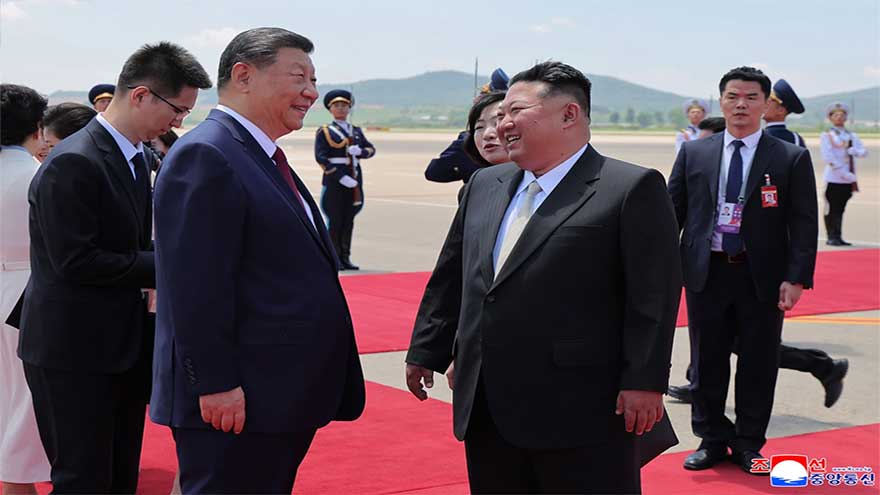
SEOUL, South Korea (AP) — Chinese President Xi Jinping returned home on Tuesday following a rare trip to North Korea that included a bilateral meeting and public appearances with leader Kim Jong Un underscoring a joint push to reestablish the alliance between their countries.
Xi flew to the capital Pyongyang on Monday in his first visit there in seven years. During their summit later in the day, Xi expressed China’s willingness to expand cooperation in a wide range of areas including trade, agriculture, construction and technology, while Kim said the two countries will maintain their friendship as “the most important top-priority strategic work,” according to Chinese and North Korean state media reports.
Xi and Kim on Tuesday visited a North Korea-China friendship tower honoring Chinese soldiers who fought alongside North Korea during the 1950-53 Korean War. They stressed the importance of carrying forward the countries’ traditional friendship and spirit of resistance against the United States, Chinese state media reported.
The leaders, who last met in Beijing in September, also toured a ruling Workers’ Party training school and planted a fir tree symbolizing bilateral ties. Xi later attended a luncheon and farewell ceremony before returning to Beijing, Chinese state media said.
Experts say Xi likely aimed to restore his country’s exclusive influence on North Korea, whose foreign policy priority has shifted to Russia in recent years. They assess Kim needs some economic and political benefits in return.
Reports from the two countries’ state media outlets on Monday’s summit touted Xi and Kim’s commitment to expand cooperation and carried Kim’s renewed support of China’s “one-China” policy over the Taiwan issue.
But the reports didn’t say whether the leaders discussed North Korea’s nuclear program, a sensitive security issue in the region. During his 2019 trip to Pyongyang, Xi said Beijing was willing play a constructive role in the denuclearization of the Korean Peninsula.
This could be seen as a diplomatic win for Kim, who is eager to win an international recognition as a nuclear weapons state, a status that experts say he would use to call for international economic sanctions to be lifted.
By not mentioning the denuclearization issue, China leaves a room for the interpretation that it appears to accept North Korea’s possible status as a nuclear state, moving beyond just overlooking it, according to a report by Ban Kil Joo, assistant professor at the Korea National Diplomatic Academy in Seoul.
In a strategic give-and-take, North Korea reaffirmed its support of China over the Taiwan issue, Ban said.
Kim Gyubeom, an analyst at the Institute for National Security Strategy in Seoul, said China appears to be pursuing a “managerial approach” that neither fully supports nor strongly pressures Pyongyang, while maintaining strategic communication with North Korea and prioritizing regional stability.
Restoring an exclusive influence over North Korea would give Xi leverage in dealings with U.S. President Donald Trump, who has repeatedly expressed his desire to restart diplomacy with Kim.
There have been questions about China’s influence over North Korea in recent years, with the North focusing on its support of Russia’s war efforts by sending troops and weapons in exchange of economic and other assistance.