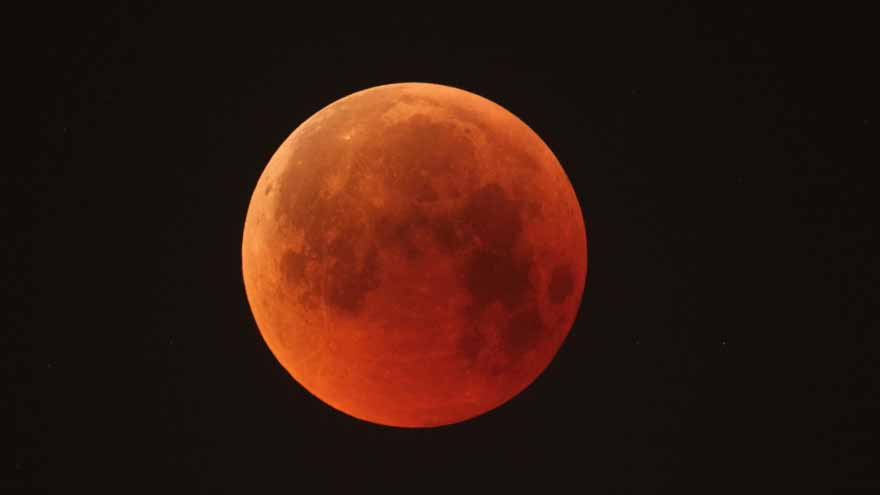
Summary The totality phase of this eclipse will last for 58 minutes and 18 seconds, with the moon about 15% inside Earth’s dark umbral shadow.
(Web Desk) - A total lunar eclipse, called as “blood moon”, will occur on Tuesday, Mar. 3, 2026, with western North America perfectly positioned to see it in its entirety.
Visible before dawn across the U.S., this relatively shallow eclipse will turn the moon a reddish color for 58 minutes as it passes into Earth’s central shadow. It’s the only total lunar eclipse of the year — and the last one anywhere on Earth until Dec. 31, 2028.
What is A Total Lunar Eclipse?
A total lunar eclipse occurs when the Earth moves directly between the sun and the moon, causing Earth’s central umbral shadow to engulf the moon. The result is a gradual dimming of the moon followed by a brief but dramatic red glow at totality as thousands of sunsets are projected onto the lunar surface. All lunar eclipses are completely safe to view with the naked eye at all times.
Why Is This Total Lunar Eclipse Special?
The totality phase of this eclipse will last for 58 minutes and 18 seconds, with the moon about 15% inside Earth’s dark umbral shadow. It won’t be as deep as some past eclipses, but it will still be a striking sight, especially from western regions of North America, where the best views will be had.
A total of 2.5 billion people — about 31% of the global population — will have a chance to see the red moon during totality, with the best viewing conditions likely in the southwestern U.S., northwest Mexico and inland Australia, where skies are typically clearest in March.
This eclipse marks the final total lunar eclipse until New Year’s Eve 2028-2029, when one will be visible across parts of Europe, Africa and the Americas. After this March event, Earth’s shadow will only skim the moon, creating less impactful partial and penumbral eclipses in late 2026, 2027 and 2028.
Exact Times For The ‘Blood Moon’ In North America
On Mar. 3, the eclipse begins at 08:44 UTC (3:44 a.m. EST), with the most dramatic part — totality — occurring between 11:04 and 12:02 UTC. Here are the local times for totality across U.S. time zones (though try to be outside an hour before to watch Earth’s shadow move across the moon):
Eastern: 6:04-7:02 a.m. EST (moon sets during totality)
Central: 5:04-6:02 a.m. CST
Mountain: 4:04-5:02 a.m. MST
Pacific: 3:04-4:02 a.m. PST
Alaska: 2:04-3:02 a.m. AKST
Hawaii: 1:04-2:02 a.m. HST
Those in the western U.S. and Canada will see the moon high in the sky during totality, while those in eastern states will need an unobstructed western horizon as the moon sets.