Summary Communities torn as Ukraine turns its back on Moscow-linked church
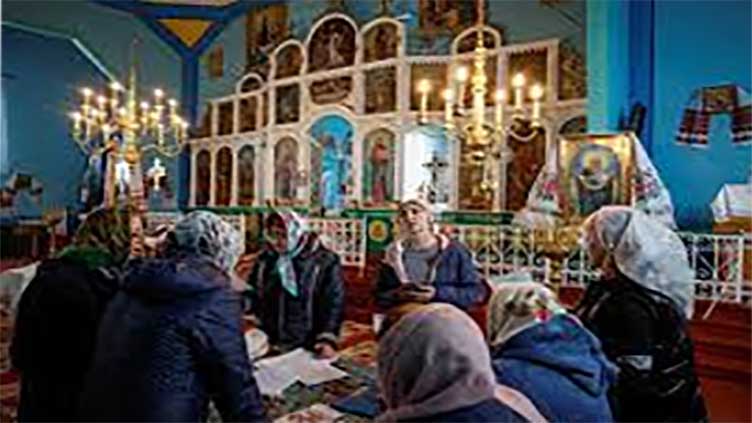
KARYSHKIV, Ukraine, May 12 (Reuters) - As a crowd gathered outside the white-brick Orthodox church in the village of Karyshkiv in western Ukraine, raised voices quickly turned to shouting. Soon old women were crying.
The villagers were quarrelling over the affiliation of their parish church, which belonged to the Ukrainian Orthodox Church (UOC) that the government in Kyiv accuses of being under the influence of Moscow.
Most of the 30 or so villagers standing by the roadside wanted to switch their parish to the Orthodox Church of Ukraine (OCU), formed in 2019 and backed by the government, as hundreds of communities have voted to do since Russia's invasion last year.
Some of the villagers angrily accused Russia of seeking to destroy their nation and said its invading troops were guilty of atrocities. Others said they wanted to worship in their own language, not Church Slavonic used by the UOC - an archaic religious language with similarities to Russian.
But a handful of the villagers strongly disagreed.
"Some kind of devil has possessed these people," said Maria, a 73-year-old who wanted the parish to switch, angry at her neighbours. "Do they not understand at all?"
Such tensions have surfaced in villages across Ukraine as authorities have cracked down on the UOC following Russia's invasion. More than 60 criminal cases have been opened against its clergy, many of them suspected of collaboration and spreading pro-Russian propaganda.
Seven have been convicted by the courts, according to Ukraine's SBU security agency.
And a legal battle is raging to evict the church from its historic monastery headquarters in Kyiv, one of the holiest sites in the Orthodox Church.
The UOC denies being allied to Moscow and says it has seen no evidence of wrongdoing by its clergy. It argues that many of its believers are patriots fighting against Russian forces. Despite that, polls show Ukrainians turning their back on the church in droves.
The Kremlin has accused Ukraine of "illegally attacking" the UOC and has used it as one justification for what it calls its "special military operation" in Ukraine: defending Russian-speakers and Russian culture from persecution.
Kyiv and its Western allies dismiss this as a baseless pretext for a war of aggression.
Reuters visited two villages in late April in the western region of Vinnytsia, which has one of the highest numbers of UOC parishes in Ukraine. Dozens of residents said the issue had caused a deep rift in their rural communities, even if most want to shun the Moscow-linked church.
A brief show of hands among the crowd in Karyshiv showed a large majority were in favour of leaving the UOC. A few said now was not the time to be arguing amongst themselves, as battles raged in the east.
Serhiy, who like many of the villagers declined to give his full name, said his son was serving near the eastern city of Bakhmut where thousands of soldiers have been killed in some of the fiercest fighting of the war.
"I don't know what he'd say if he came back to this," he said.
LOYALTY
At the heart of the dispute are not doctrinal differences but national loyalty.
The OCU was founded with significant support from former President Petro Poroshenko to create a church fully independent of Moscow, in the wake of the annexation of Crimea by Russia. It received recognition from Orthodoxy's Ecumenical Patriarch in Istanbul.
By contrast, the UOC was established in the dying days of the Soviet Union as a branch of the Russian Orthodox Church. It remained under the direct authority of Patriarch of Moscow until May 2022, three months into the invasion, when it said it was cutting ties with Russia.
The head of the Russian Orthodox Church, Patriarch Kirill, has staunchly backed the invasion and supports the Kremlin, deeply angering many Ukrainians.
Polling by the Kyiv International Institute of Sociology show the UOC's flock in Ukraine shrank dramatically from around 18% of the population before the invasion to only 4% in July 2022.
The same survey showed that followers of the OCU grew from 42% of the population in June 2021 to 54% in July 2022.
As part of its crackdown, the SBU security agency regularly posts images of documents, books and Russian passports which it says it found during searches of UOC churches – many of which glorify Russia or advocate for Russian control of Ukrainian territories. Reuters was unable to review the original documents.
Secretary of the National Security and Defence Council Oleksiy Danilov said in February that Russia had swapped captured Ukrainian soldiers for some of the detained UOC clergy, including one unidentified priest who was exchanged for 28 troops. Danilov told Reuters the priest had been working for Russia.
UOC spokesman Metropolitan Klyment said he was unaware of the identity of the priest but he must have been a Russian citizen because it was forbidden to extradite Ukrainians. He said no charges have been brought against any clergy in relation to the pro-Russian literature the SBU said it had found.
"We perceive such statements as an information campaign against the UOC," he said.
Ilze Brands Kehris, the UN Assistant Secretary-General for Human Rights, called in January for both sides in the conflict to respect freedom of religion in Ukraine. Pope Francis has called for the respect for religious sites.
Geraldine Fagan, editor of East-West Church Report, a publication that looks at Christian life in eastern Europe and the former Soviet Union, said that - while KGB archives had shown intelligence services infiltrated the Russian Orthodox church during Soviet times - any sympathies toward Russia among the UOC clergy appeared to be at an individual level, not institutional.
"The vast majority of UOC believers are firm patriots. Among the church hierarchy, even at a senior level, the church has been quite squarely behind Ukraine since the Russian invasion," she said.
A spokesperson for the Ukrainian government did not immediately respond to a request for comment.