Summary Clashes between protesters and police left 27 dead in Kiev as EU envoys were holding crisis.
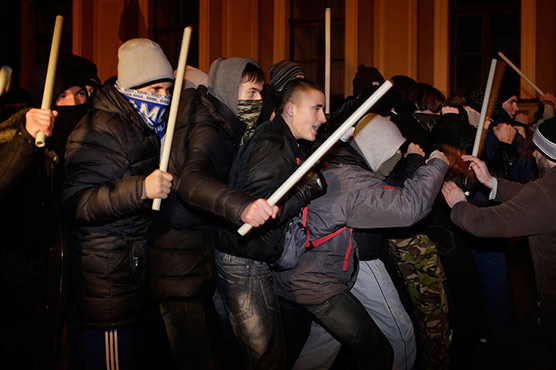
KIEV (AFP) - Ukraine s brittle truce shattered on Thursday in fierce clashes between baton-wielding protesters and riot police that claimed at least 27 lives just as EU envoys were holding crisis talks with the embattled president.
Bodies of anti-government demonstrators lay amid smouldering debris after masked protesters hurling Molotov cocktails and stones forced gun-toting police from Kiev s iconic Independence Square -- the epicentre of the ex-Soviet country s three-month-old crisis.
The retreating police unleashed a hail of rubber bullets on protesters as plumes of acrid smoke billowed into the air amid the explosions of stun grenades.
The lobby of the Ukraina hotel overlooking the square was turned into an impromptu morgue. Bodies of seven dead protesters lay side by side under white sheets on the marble floor in front of the reception desk.
An AFP photographer saw spent live cartridge shells littering the ground on the square. It was unclear who had used the ammunition.
The main government building nearby was evacuated while lawmakers ended a session of parliament early after the violence.
Ukraine s three main opposition leaders called the unrest a "planned provocation" by the pro-Russian government while Moscow blamed it on "extremists and hardliners" who were bent on sparking a civil war.
The clashes left in tatters a truce that Ukrainian President Viktor Yanukovych had called late Wednesday in response to a spurt of violence that killed more than two dozen people in less than two days.
Yanukovych was holding crisis talks with the foreign ministers of EU powers France and Germany along with Poland ahead of an emergency meeting in Brussels where the European Union was expected to impose sanctions against Ukrainian government officials for the unrest.
The US State Department has already announced travel bans on about 20 senior government figures over fighting that killed at least 28 people on Tuesday.
Yanukovych has appeared to struggle to formulate a clear policy in the face of Ukraine s deadliest violence since independence and an escalating Cold War-like war of words between the West and former master Moscow over the future of the country sandwiched between Russia and the European Union.
- Death toll climbs -
AFP reporters said they saw the bodies of at least 25 protesters with apparent gunshot wounds around two popular Independence Square hotels and lying outside the central Kiev post office on Thursday.
Ukraine s interior ministry said two policeman died from gunshot wounds sustained in the clashes and advised Kiev residents to stay indoors "because the streets of Kiev are occupied by armed and aggressive people".
Ukraine s crisis was initially ignited by Yanukovych s shock decision in November to ditch an historic EU trade and political association agreement in favour of closer ties with Kiev s historic masters in the Kremlin.
But it has since evolved into a much broader anti-government movement that has swept through both the pro-Western west of the country as well as parts of its more Russified east and exposed the deep historical fault lines between the two.
Yanukovych had appeared determined Wednesday to end the crisis by force after the country s security services announced plans to launch a sweeping "anti-terror" operation.
He also sacked the army s top general -- a powerful figure lauded by the opposition for refusing to back the use of force against those who had come out on the street.
But he then received three top protest leaders and told them he would take no immediate action against those who have taken to the streets against his rule.
The president was dealt a further embarrassing blow when Kiev mayor Volodymyr Makeyenko resigned Thursday from the ruling Regions Party in protest at the "tragedy" of the unrest.
- US and EU sanctions -
The crackdown by the authorities has triggered a storm of condemnation from the West and a new war of words with Moscow that carried the diplomatic echoes of the Cold War.
The US State Department announced it was imposing visa bans on about 20 senior Ukrainian officials "complicit in or responsible for ordering or otherwise directing human rights abuses".
Western pressure was set to mount still further on Thursday when the European Union considers its own measures during a meeting in Brussels.
France said ahead of the meeting that sanctions would be prepared specifically against those responsible for the violence.
Moscow meanwhile has issued a string of outraged comments condemning both the protesters and the West.
Prime Minister Dmitry Medvedev told Russia s cabinet that Moscow intended to follow through on its commitment to issue the next tranche of a $15 billion bailout that Putin and Yanukovych agreed shortly after Kiev rejected the EU pact.
But Medvedev said Moscow needs "partners who are in good shape and for the authorities that work in Ukraine to be legitimate and effective."
Politics even cast a shadowed over the Winter Olympic Games in Sochi when a Ukrainian alpine skier and her coach pulled out of competition in protest at the authorities use of force.