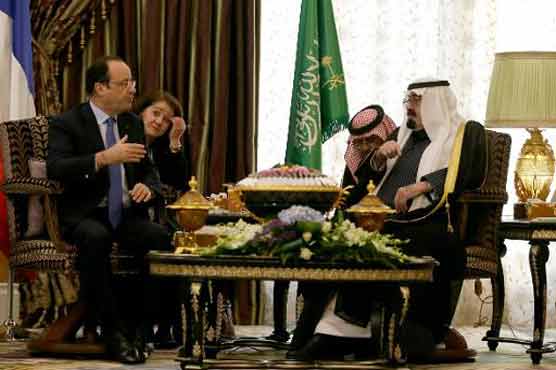
Summary The two leaders discussed mutual cooperation and "regional and international developments."
RIYADH (AFP) - French President Francois Hollande met Saudi King Abdullah on Sunday on a visit aimed at boosting commercial ties and addressing escalating tensions in the Middle East.
The monarch highlighted a "convergence" of positions between the two countries on several issues, a member of Hollande's entourage said.
Saudi state news agency SPA said the two leaders discussed mutual cooperation and "regional and international developments."
The French president is also due to meet Lebanon's former premier Saad Hariri and Syrian opposition leader Ahmed Jarba in the kingdom, an entourage member said.
Hollande was met on arrival in Riyadh by Crown Prince Salman bin Abdulaziz, before taking a helicopter to the king's Rawdat Khurayim farm, 60 kilometres (37 miles) northeast of the capital.
Four ministers and 30 top French business figures are also on the visit.
Paris and Riyadh share a "will to work for peace, security and stability in the Middle East", Hollande said in an interview published in Sunday's Saudi-owned daily Al-Hayat.
His meeting with Hariri, a staunch critic of the Syrian regime, comes after the killing in Lebanon of his close aide, ex-minister Mohammad Chatah, in a Beirut car bombing on Friday.
Hariri, the son of former premier Rafiq who was also assassinated in a massive car bomb in February 2005, lives outside Lebanon because of security concerns.
The Sunni Muslim leader is also a strong critic of Lebanon's Iran-backed Shiite Hezbollah movement, which is fighting alongside President Bashar al-Assad's forces in Syria's civil war.
Speaking to reporters in Riyadh, Hollande pledged to "meet" any requests by the Lebanese government to arm the army.
His comments came as Lebanon's President Michel Sleiman announced from Beirut that Saudi Arabia had pledged $3 billion for the Lebanese army to buy French equipment.
In his Al-Hayat interview, Hollande urged respect for "constitutional deadlines" in Lebanon, starting with "holding presidential elections in May 2014".
French Foreign Minister Laurent Fabius said Hollande would deliver a "special message" to Hariri reiterating Paris's friendship and "calls for the integrity and independence" of Lebanon.
France "rejects the contagion that some want to impose between the conflict in Syria and Lebanon," he said on board the presidential plane.
On Syria, Fabius said Hollande would tell Jarba that the opposition taking part in the proposed peace conference in Switzerland on January 22 was "desirable".
The US-Russian backed talks dubbed Geneva 2 are aimed at reaching an agreement on a transition to end the war which has claimed an estimated 126,000 lives since March 2011 and displaced millions of people.
Syria's increasingly fractured opposition has said Assad must step down as part of any deal, which Damascus rejects.
France intends to support the "moderate opposition and in no way the terrorist movements that paradoxically serve the interests" of Assad, Fabius said.
Hollande reiterated to Al-Hayat that there cannot be a "political solution with Bashar al-Assad staying" in power.
He accused Assad of using the threat of fundamentalist fighters "to put pressure on the moderate opposition".
Assad said this week that Syria was being confronted by a major offensive by Islamist extremists.
Radical Islamist groups have taken on an increasingly prominent role in the Syrian conflict.
Hollande also noted in the interview that Saudi Arabia has become France's "top client in the Middle East" with trade exceeding eight billion euros ($11 billion) in 2013, including French exports worth three billion euros.
The balance of trade remains in Riyadh's favour on the back of its oil exports to France.
Hollande also highlighted contracts won by French companies in the oil-rich kingdom, including Alstom's Riyadh metro deal.