Summary Army chief Wednesday called on countrymen to hold demonstrations in support for the army.
CAIRO (AP) - Egypt s military chief on Wednesday called on his countrymen to hold mass demonstrations to voice their support for the army and police to deal with potential "violence and terrorism," a move that signals a stepped up campaign against supporters of the ousted Islamist president.
Gen. Abdel-Fattah el-Sissi, addressing a graduation ceremony for a class of military cadets, urged Egyptians to take to the streets Friday, saying a massive turnout would give him a "mandate" and an "order" to do what is "necessary" to stop bloodshed.
A Muslim Brotherhood-led alliance of factions opposed to the military s July 3 coup that toppled Mohammed Morsi said el-Sissi s call was an "open invitation" to civil war. It called on Egyptians to boycott the pro-military rally.
The alliance is planning marches of its own on Friday, raising the specter of violence.
El-Sissi s address in the Mediterranean coastal city of Alexandria was a strong sign that the top general is the source of real power in Egypt, despite his assertions that authority has been handed completely to the civilian government set up after Morsi s fall.
On Wednesday, Washington announced it is delaying delivery of four F-16 fighter jets to Egypt as it reviews whether the military s ousting of Morsi constitutes a coup in U.S. eyes.
It was the first direct U.S. action over the military s move
though officials cautioned they had not yet decided whether to suspend military aid more broadly. Under U.S law, military aid to a country that undergoes a coup must be suspended.
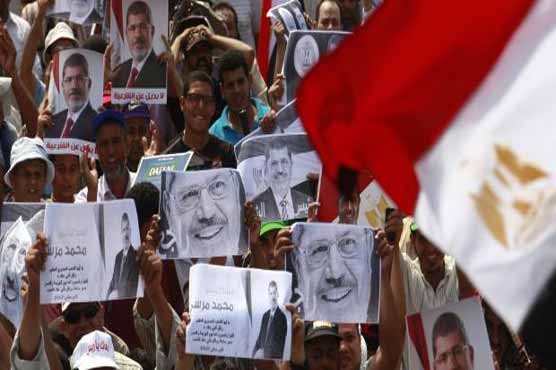
The military removal of Morsi followed four days of massive protests by millions of Egyptians calling for his removal. Since then, Morsi s Islamist supporters have taken to the streets vowing to continue protests until he is restored.
Clashes have erupted multiple times between the Islamists and Morsi opponents or security forces.
Each side accuses the other of starting the violence. Dozens have been killed, mostly from the pro-Morsi side, including more than 50 who were killed by troops during clashes at their Cairo sit-in.
Throughout, the military and its allied media have depicted the protesters as a dangerous armed movement. The Muslim Brotherhood and its allies say their protests are peaceful.
The group accuses troops or thugs hired by the Interior Ministry, which is in charge of the police, of attacking pro-Morsi rallies.
At the same time, Islamic militants have stepped up attacks on security forces in Sinai Peninsula since Morsi s fall, killing nearly 20 soldiers and policemen and raising fears of a wave of militant violence.
On Wednesday, suspected militants killed two soldiers and wounded three others in four separate attacks in Sinai. In a separate incident, three suspected militants were killed when their explosives-laden car blew up apparently prematurely just outside el-Arish, a coastal city in northern Sinai that is a stronghold of radical Islamists, security officials said, speaking on condition of anonymity because they were not authorized to talk to the press.
In the early hours Wednesday, a bomb went off outside the main police headquarters in the Nile Delta city of Mansoura, wounding 19 people. Presidential spokesman Ahmed el-Muslemani called the attack an act of terrorism.
The Mansoura bombing is a possible sign that a militant campaign could be spreading to Egypt s heartland, where so far the violence has been restricted to street clashes between the two sides.
A political adviser to interim President Adly Mansour said the state already has a mandate to keep security, but that the army chief was seeking additional assurance that the state and citizens were on the same side.
"We are talking about a people who are subjected to aggression on the streets," Mustafa Hegazi said, alluding to allegations of violence by Morsi supporters against opponents.
The youth movement Tamarod, or "Rebel," which spearheaded the campaign to topple Morsi, said it will participate in the demonstrations called by el-Sissi to denounce what it called terrorism and bring Morsi to account for "the crimes he committed against the people."