Summary With the military deadline ticking down, protesters prepare for another massive show of power.
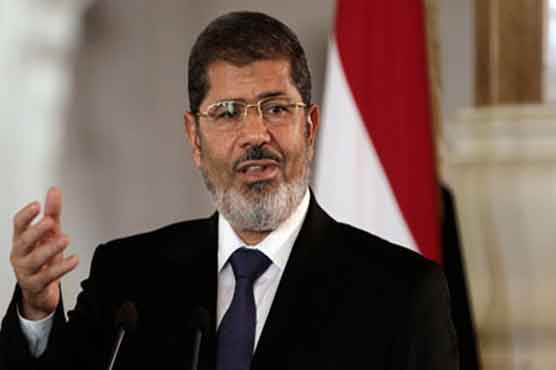
CAIRO (Reuters) -President Mohamed Mursi clung to office on Tuesday after rebuffing an army ultimatum to force a resolution to Egypt s political crisis, and the ruling Muslim Brotherhood sought to mass its supporters to defend him.
But the Islamist leader looked increasingly isolated, with ministers resigning, the liberal opposition refusing to talk to him and the armed forces, backed by millions of protesters in the street, giving him until Wednesday to agree to share power.
In a defiant statement, Mursi s office said the president had not been consulted before the armed forces chief-of-staff set a 48-hour deadline for a power-sharing deal and would pursue his own plan for national reconciliation.
Newspapers across the political spectrum saw the military ultimatum as a turning point. "Last 48 hours of Muslim Brotherhood rule," the opposition daily El Watan declared.
"Egypt awaits the army," said the state-owned El Akhbar.
Egyptian President Mohamed Morsi met the head of the armed forces on Tuesday for the second day, along with the prime minister, the president s office said in a statement.
It gave no details of the talks. They came a day after the military chief, General Abdel Fattah al-Sisi, gave Mursi and his opponents until Wednesday to resolve a political deadlock or face a solution imposed by the armed forces.
Prime Minister Hisham Kandil was also present at the meetings with Mursi and Sisi on Monday and Tuesday.
With a military deadline for intervention ticking down, protesters seeking the ouster of Egypt s Islamist president sought Tuesday to push the embattled leader further toward the edge with another massive display of people power.
Meanwhile, Mohammed Morsi faced fissures from within after a stunning surge of street rage reminiscent of Egypt s Arab Spring revolution in 2011 that cleared the way for Morsi s long-suppressed Muslim Brotherhood to win the first open elections in decades.
Three government spokesmen were the latest to quit as part of high-level defections that underscored his increasing isolation and fallout from the ultimatum from Egypt s powerful armed forces to either find a political solution by Wednesday or the generals would seek their own way to end the political chaos.
The Cabinet, led by the Morsi-backed Prime Minister Hesham Qandil, was scheduled to meet later Tuesday. But the defense and interior ministers were expected to boycott in a sign of support for the military s warnings.
The police, which are under control of the Interior Ministry, have stood on the sidelines of the protests, refusing even to protect the offices of the Muslim Brotherhood that have been attacked and ransacked.
Before the Cabinet session, Morsi met with Defense Minister Abdel-Fattah el-Sissi and Qandil in the second such meeting in as many days. No details were given about the meeting, reported by an official at the president s office, Ayman Ali.
At least 16 have been killed in clashes since Sunday between Morsi s opponents and his many backers, who have equated the demonstrations and military arm-twisting to a coup against a democratically elected president.
The Tamarod, or Rebel, movement which organized the protests has given the president until 5 p.m. Tuesday (1500 GMT) to step down or face even larger demonstrations and possible "complete civil disobedience."
In a highly symbolic move, the crowds have camped out at Cairo s Tahrir quare, the birthplace of the 2011 uprising that toppled Hosni Mubarak.
They also have massed outside the president s Ittahdiya palace in the leafy suburb of Heliopolis.
Across town, however, Morsi s backers have hunkered down at their own rally site, vowing to resist any attempts to nullifying his election last year and the rise of Islamist voices in Egypt s political affairs after bring muzzled under Mubarak.
On Monday, a line of around 1,500 men with shields, helmets and sticks assigned with protecting the rally stamped their feet in military-like lines, singing, "Stomp our feet, raise a fire. Islam s march is coming."
The volatile atmosphere has been made even more unsettled by the prospect the military could soon step in.
The military s declaration, read Monday on state TV, put enormous pressure on Morsi to step down and sent giant crowds opposing the president in Cairo and other cities into delirious celebrations of singing, dancing and fireworks.
But it also raised worries on both sides that the army could take over outright as it did after the 2011 ouster of Mubarak and raised the risk of a backlash from Morsi s Islamist backers, some of whom once belonged to armed militant groups.