Updated on
Summary
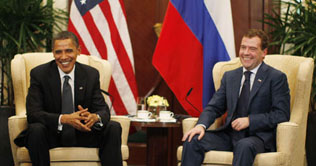
US President Barack Obama said on Sunday the world is running out of time for a diplomatic solution to the crisis over Iran's nuclear programme. Speaking immediately after talks in Singapore with Russia's President Dmitry Medvedev, on the sidelines of an Asia-Pacific meeting, Obama said Iran still faced two alternatives. It was my strong belief that if countries like the United States and Russia were able to present two paths to the Islamic Republic of Iran - one that led to further integration, the ability to obtain peaceful nuclear energy by an insistence on Iran's foresaking nuclear weapons, that would be the most positive outcome. The alternative would be an approach that would involve increasing pressure on Iran to meet its international obligations, he said.Obama said he and Medvedev would continue to urge Iran to meet its international obligations, but warned that time was running out.We are now running out of time with respect to that approach. And so I discussed with President Medvedev the fact that we have to continue to maintain urgency and that our previous discussions confirming the need for a dual-track approach are still the right approach to take. We believe that the United States and Russia will continue to urge Iran to take the path that leads them to meeting its international obligations. We can't count on that and we will begin to discuss and prepare for these other pathways, Obama said.Medvedev said other means could be used if discussions did not yield results. On the other hand, the leaders of Japan and Russia met in Singapore on Sunday after the conclusion of the Asia-Pacific Economic Cooperation summit. Japanese Prime Minister Yukio Hatoyama and Russian President Dmitry Medvedev held a bilateral meeting where they both expressed a desire to forge stronger ties between their countries. Medvedev said he hoped to tackle economic and humanitarian issues.Iran says it is enriching uranium only for power plant fuel, not for nuclear warheads. But its history of nuclear secrecy and continued restrictions on U.N. inspections have raised Western suspicions Iran is latently pursuing nuclear weapons capability.In talks with six powers in Geneva on Oct. 1, Iran had agreed in principle to send the bulk of its low-enriched uranium to Russia and France for further processing and conversion into fuel plates for the Tehran reactor, Western officials said. The plan for Iran to part with stocks of potential nuclear explosive material in exchange for fuel to keep a nuclear medicine facility running has subsequently stumbled on Iranian calls for amendments and more talks, which Washington has rejected. Iran's pledges in Geneva won itself a reprieve from sanctions targeting its oil sector but Western powers stressed they would not wait indefinitely for Tehran to follow through.