Summary Once sufficient in fuel and food, Syria is now an impoverished country unable to feed its people.
DAMASCUS: Driving around Damascus, you see the vestiges of times past. Dip Dip Cafe, Mocha and More, luxury clothing shops which change their gleaming window displays with every new season of fashion.
If you can afford it, you can still sit in wrought-iron chairs and order steaming cappuccino with sprinkles of chocolate in a stylish Italian cup, or still sit in elegant parks where young couples flirt and savour the sweet smell of jasmine.
This is graceful Damascus, Damascus of Old. This is the Syria that two years ago prided itself on being an Arab state sufficient in food and fuel, a middle-income country with soaring highways and decent health care.
"I d never thought I d see this," lamented a Syrian woman working with an international agency. "I never thought I d see the day when we d be discussing the distribution of high-energy biscuits."
Those are the biscuits flown to impoverished countries facing famine, nations wracked by war unable to feed their people.
That is not Syria, not yet, but cracks are emerging.
A punishing war that has left vast swathes of this country in ruin is now steadily encroaching on the capital.
There is still what is called the Damascus bubble - a place where civil servants dutifully go to work on public transport, and children sit their exams. But that bubble is slowly, steadily, being squeezed.
This rock-solid sense of solidarity is showing strain as the war drags on, and savings run out”
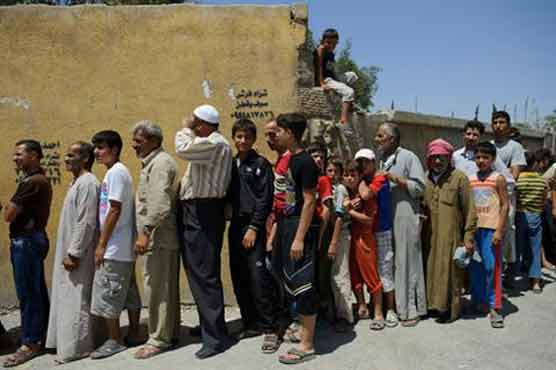
On this trip to Syria, we saw queues for petrol that snake around the block. And Damascenes wait for hours just to buy their daily bread - standing outside government bakeries in the cold, then hurrying away with towering piles of flatbread. Some people even fill up the boot of their cars.
At government bakeries, bread is still cheap - 10 cents for 10 pieces. Buy it from a private bakery - it is a lot more.
No-one is starving, one Western aid official told me. But they have already started monitoring for malnutrition.
But who will come to Syria s help? This is a country isolated by the West, under a growing list of sanctions, but also deeply suspicious of foreign aid.
The biggest relief effort by far is traditional Syrian solidarity. Extended families are now living together, sometimes 30, 50 people to a house.
Syria used to say it was self-sufficient in food and fuel.
Neighbours are opening their homes and hearts to each other, and sometimes to strangers fleeing homes in the suburbs or other cities flattened by ferocious government assault, overtaken by rebel forces.
But even this rock-solid sense of solidarity is showing strain as the war drags on, and savings run out.
And in a deeply divided land, even sympathy is suspect. Families who offer a room to homeless people can get a knock on the door from intelligence agencies.
"We can t even rent our rooms," moaned one woman who needs the extra income. "How can we face desperate people who come to us in need? What can we say?"
Even a proud, defiant government is starting to admit to the scale of this crisis.
For months, it rejected recognised terms like displaced people, using euphemisms like "mutanaqaleen", which just means "people who are moving". And they are, in every direction, as soon as they can.
For Syrian civilians, trapped in a vicious spiral of a war of global consequence, it s shocking they aren t getting enough help. But for them, it s equally shocking and shameful that they have to seek aid at all”
It is now feared the refugee exodus into neighbouring countries will soon reach 1m. More than 2m are displaced inside Syria, taking shelter in abandoned buildings, half-finished ones, wherever they can find space.