Updated on
Summary Anti-Japan protests again erupted in China over disputed islands in the East China Sea.
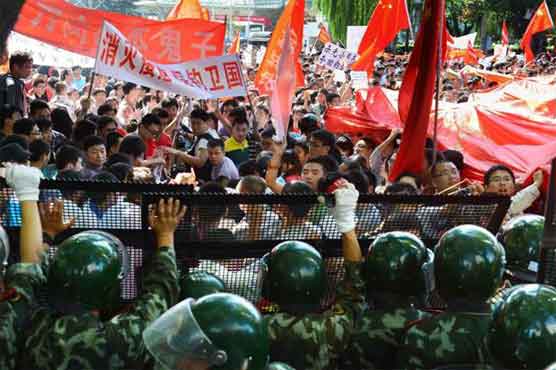
Thousands of anti-Japanese demonstrators mounted protests in cities across China on Sunday over disputed islands in the East China Sea, a day after an attempt to storm Tokyos embassy in the capital.Beijing was infuriated last week when Japan said it had bought the rocky outcrops and while the authorities often suppress demonstrations, many of Sundays events took place with police escorting marchers, while state-run media called the protests reasonable.Still, there were reports of violence. Demonstrators in the southern city of Shenzhen -- some holding a banner calling for a bloodbath in Tokyo -- clashed with riot police, who fired tear gas to disperse the crowd, Hong Kong broadcaster Cable TV showed.It also showed footage of more than 1,000 protesters burning Japanese flags in nearby Guangzhou and storming a hotel next to the Japanese consulate. Chinese state media reported a turnout of more than 10,000 in the city.Japans Prime Minister Yoshihiko Noda called on China to ensure the safety of Japanese citizens and businesses after widespread protests on Saturday saw attacks on individuals, establishments and Japanese-built cars.This situation is a great disappointment and so we are protesting to China, he told Fuji Television.Japanese media said that Panasonic, whose production line in Qingdao was damaged by protesters Saturday, had decided to suspend operations at the factory until at least Tuesday.About 10 employees had shouted anti-Japan slogans, the Kyodo News agency said.The relationship between China and Japan, the worlds second and third largest economies, is often strained by their historical rivalry even though they have significant business links.The row over the islands, which Tokyo administers and calls Senkaku while Beijing claims them and knows them as Diaoyu, has heightened in recent weeks.Six Chinese ships sailed into waters around the disputed archipelago Friday, with Beijing saying they were there for law enforcement, prompting Tokyo to summon the Chinese ambassador to protest what it called a territorial incursion.Pictures posted on Sina Weibo, Chinas version of Twitter, showed marches in half a dozen cities around the country on Sunday, while the state-run Xinhua news agency reported protests in five others.In Beijing, thousands of protesters gathered outside the Japanese embassy, carrying posters of Mao Zedong and Japanese flags scrawled with obscenities, throwing beer bottles and singing the national anthem.But large numbers of police escorted the protesters as they marched past the building, while volunteers wearing red armbands gave food and water to demonstrators and a medical team stood by.In Shanghai, where there were major protests on Saturday, more than 1,000 demonstrators gathered outside the Japanese consulate, one group chanting Down with little Japan.Police blocked off roads using shipping containers and plastic barriers, but guided marchers through police lines to protest in front of the building.One Weibo user in the southeastern city of Quanzhou contacted by AFP said: Theres no violence, just peaceful marches under police guidance.Hundreds of protestors also marched to the Japanese consulate in the former British colony of Hong Kong.Microbloggers questioned whether Sundays demonstrations were spontaneous.Such large-scale uniform banners and dresses cannot be made in one day. Do you really believe its people-initiated? wrote a Weibo user named Linglingqi.Another named Afraxafra said: I feel such a massive demonstration definitely cannot be organised by a small number of average people.Xinhua said that companies and social groups organised some protests, while others were publicised through online forums and messaging services.A commentary from the agency called the weekend protests a reasonable move and natural reaction to Japanese provocation and urged Tokyo to take notice, even as it warned protesters against damaging property.China National Radio said 1,000 Chinese fishing boats were preparing to head to the disputed waters after the fishing season in the area resumed.Another flashpoint could be Tuesdays anniversary of the 1931 Mukden incident that led to Japans invasion of Manchuria, which is commemorated every year in China.Willy Lam, a China expert at the Chinese University of Hong Kong, said: In the beginning the leadership wants to use the so-called public opinion card to put pressure on Japan.