Updated on
Summary UN military observers departed Damascus on Monday after a four-month mission.
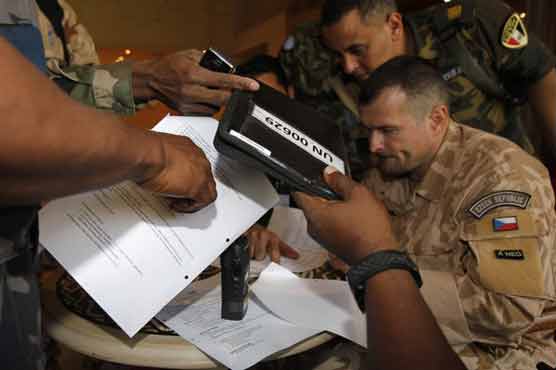
They became helpless spectators of Syrias conflict, and activists said government forces launched air strikes near the capital that killed two dozen people.Helicopter gunships attacked Mouadamiya and Daraya, suburbs south of Damascus, activists and residents said, giving casualty tolls that could not be independently verified.It seems they suspected that there were rebels in the area, said an activist in Daraya, speaking on condition of anonymity. Gunships also appeared to hit targets in the western Damascus district of Kfar Souseh, a housewife said by phone.Video footage posted on YouTube showed no movement in the streets of Mouadamiya, with the silence broken by the sound of shelling. Control of the area has changed hands several times, as have many other places in a war with no clear front lines.Our mission failed because the two sides did not abide by their commitments, said one uniformed observer, who declined to be named, before seven United Nations cars left a Damascus hotel carrying some of the last members of a mission once 300 strong.The unarmed monitors suspended operations in June after coming under fire and most have already departed, leaving a small liaison office in the Syrian capital in case a chance for a political settlement to the bloodshed ever emerges.Battling a 17-month-old uprising against his familys 42-year rule, President Bashar al-Assad has used fighter jets and helicopter gunships to pound rebel strongholds. Insurgents have stepped up their own attacks, hitting tanks, military convoys and security buildings.The mandate of the monitoring mission, known as UNSMIS, expired on Sunday. The last monitors are due to leave by Friday.After a brief lull, violence intensified during the monitors presence in Syria and at least 9,000 people have been killed since they arrived to oversee a ceasefire declared on April 12 by outgoing U.N.-Arab League mediator Kofi Annan.The truce never took hold. At least 18,000 people have now been killed in Syria since the anti-Assad revolt began. At least 170,000 have fled the country, according to the United Nations, and 2.5 million need aid inside Syria.Rebel fighters have complained that foreign powers have supplied neither the quantity or quality of weaponry they need to defeat Assad, such as anti-aircraft missiles.France, which like the United States and Britain, says it is supplying only non-lethal assistance to the Syrian opposition, ruled out providing arms in case they fell into the wrong hands.Qatar and Saudi Arabia are among countries arming the rebels, French Foreign minister Laurent Fabius said, whereas European countries had imposed an arms embargo on Syria.As for heavy weapons, especially to destroy planes, there is a huge problem. We cannot deliver weapons in conditions where the people we deliver to later use them against us, said Fabius, who will host a foreign ministers meeting on Syria at the United Nations on Aug. 30.His remarks, on Europe 1 radio, appeared to contradict a Russian assertion that the West was arming the Syrian rebels.Russian Deputy Foreign Minister Gennady Gatilov, whose country is an ally of Syria, said evidence had grown that Syrian rebels were massively supplied with Western-made weapons.While outgunned by Assads forces, rebels still managed to seize control of districts in Damascus and Aleppo last month, as well as several border crossings and parts of the north, before the army counter-attacked in Syrias two main cities.Making his first public appearance since a July 18 bombing killed four of his top security officials, Assad prayed at a Damascus mosque at the start of a Muslim holiday on Sunday.Fighting raged on around Syria, killing some 120 people on Monday, the Syrian Observatory for Human Rights reported.With diplomatic efforts to end the war stymied by divisions between world powers and regional rivalries, Syria faces the prospect of a prolonged conflict that increasingly sets a mainly Sunni Muslim opposition against Assads Alawite minority.The United Nations may need to create a safe zone within Syria to cope with a swelling exodus of refugees, Turkish Foreign Minister Ahmet Davutoglu, whose country already hosts nearly 70,000 Syrians, told the Hurriyet newspaper.