Updated on
Summary Hundreds of people fleeing Damascus fearing violent clashes.
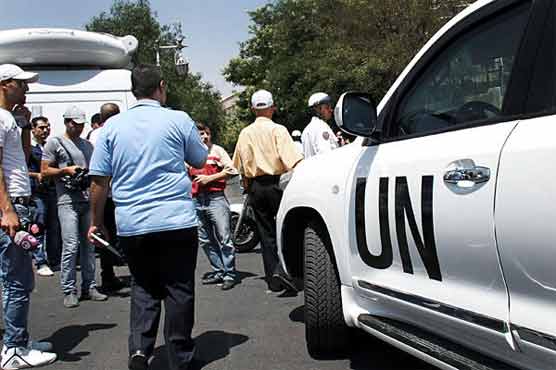
One day after Bashar al-Assad’s two top security chiefs—one of which was his brother-in-law—were killed in a suicide bombing, the Syrian president has yet to make a statement or even a public appearance.Opposition sources say they believe the embattled dictator to be “at his palace in Latakia and that he may have been there for days.”Meanwhile, rebels, armed with small guns and rocket-launched grenades, are moving en masse on Damascus.Residents say fighting is the heaviest it’s been since the revolt against Assad began 16 months ago.Meanwhile, Pentagon officials are in talks with Israel’s government to strategize for what appears to be the Assad regime’s eminent collapse.Hundreds of people were fleeing Damascus flashpoints on Thursday after the army warned of a violent clashes with rebels following a bomb blast that killed three security chiefs, witnesses said.Major General Robert Mood, head of the UN monitoring mission, meanwhile warned that Syria was not on track for peace and that the violence was spiralling, as President Bashar al-Assad appeared to have gone to ground.The military gave residents 48 hours to leave areas where clashes are taking place between security forces and rebels pushing their Damascus Volcano offensive.These extremely violent clashes should continue in the next 48 hours to cleanse Damascus of terrorists by the time Ramadan begins on Friday, a security source told AFP, referring to the Muslim holy fasting month.The Britain-based Syrian Observatory for Human Rights watchdog said that in the western district of Mazzeh alone, hundreds of people were on the move, fearing a large-scale operation by regime troops.Residents also fled the southern district of Tadamon and the Palestinian refugee camp Yarmuk, it said.The developments come a day after a bombing in the city killed three top security officials, including the defence minister and Assads brother-in-law, in a severe blow to the regime.There is an escalation by the Syrian regime to avenge the operation that targeted the (security chiefs), said Rami Abdel Rahman, head of the Britain-based Observatory.The rebels have also escalated (the violence) to reap the fruits of the attack, and to try to finish off the battle for Damascus, he added. Clashes and shelling have engulfed Syria, and they are taking place day and night.The whereabouts of Assad are still not known and he has not commented on the bombing or appeared in public since the attack.However, he was cited by state media as appointing Fahd al-Freij defence minister to replace Daoud Rajha, who was among those killed when the National Security headquarters was targeted.State media have yet to distribute images of the aftermath, unlike on previous occasions when there have been attacks in the capital.The deaths on Wednesday of Rajha, Assads brother-in-law Assef Shawkat and General Hassan Turkmani, head of the regimes crisis cell, marked the first time in the 16-month revolt that Assads inner circle has been targeted.The army has so far exercised restraint in its operations, but after the attack, it has decided to use all the weapons in its possession to finish the terrorists off, the security source said.The army has told residents to stay away from combat zones, as the terrorists are trying to use residents as human shields.The Damascus blast came on one of the deadliest days in the conflict.At least 214 people -- 124 civilians, 62 soldiers and 28 rebels died on Wednesday, the Britain-based Observatory said, revising an earlier toll. That figure did not include the three regime members.It pains me to say, but we are not on the track for peace in Syria, and the escalations we have witnessed in Damascus over the past few days is a testimony to that, General Mood, head of the UN Supervision Mission in Syria, said in a statement to reporters.The deteriorating situation in the capital comes as the West and Russia and China prepare for a showdown later Thursday over a draft UN resolution calling for sanctions against Syria.UN chief Ban Ki-moon and international envoy Kofi Annan called on the Security Council to take strong action, but Russia and China are expected to veto the resolution.Ban said there was an extreme urgency for action to halt the violence which activists say has killed more than 17,000 people.