Updated on
Summary With martial law effectively in force, the generals issued an interim constitution.
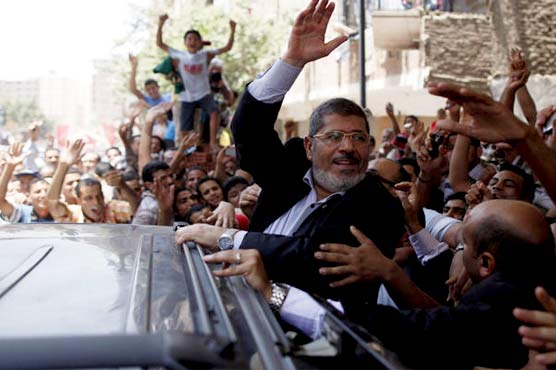
The Muslim Brotherhood declared early Monday that its candidate, Mohammed Morsi, won Egypts presidential election, which would be the first victory of an Islamist as head of state in the stunning wave of protests demanding democracy that swept the Middle East the past year. But the military handed itself the lions share power over the new president, sharpening the possibility of confrontation.With parliament dissolved and martial law effectively in force, the generals issued an interim constitution granting themselves sweeping authorities that ensure their hold on the state and subordinate the president. They will be Egypts lawmakers, they will control the budget and they will determine who writes the permanent constitution that will define the countrys future.But as they claimed a narrow victory over Hosni Mubaraks last prime minister Ahmed Shafiq in a deeply polarizing election, the Brotherhood challenged the militarys power grab. The group said Sunday it did not recognize the dissolution of parliament, where it was the largest party. It also rejected the militarys right to issue an interim constitution and oversee the drafting of a new one.That pointed to a potential struggle over spheres of authority between Egypts two strongest forces. The Brotherhood has campaigned on a platform of bringing Egypt closer to a form of Islamic rule, but the militarys grip puts it in a position to block that. Instead any conflict would likely center on more basic questions of control if the Brotherhood pushes a fight. It has reached accommodations with the military in the past.Official final results are not due until Thursday, and Shafiqs campaign challenged the Brotherhood claim, which was based on the groups compilation of election officials returns from nearly all polling centers nationwide.But at their campaign headquarters, the Brotherhood officials and supporters were ebullient over the turn of fate. The fundamentalist group that was banned for most of its 80-year history and repeatedly subjected to crackdowns under Mubaraks rule now held the chair from which their nemesis was ousted by last years 18 days of mass protests. The uprising was launched by secular, leftist young activists, joined only later by the Brotherhoods leadership as millions took to the street, seeking an end to an authoritarian regime considered hopelessly corrupt.In a victory speech at the headquarters, Morsi clearly sought to assuage the fears of a large sector of Egyptians that the Brotherhood will try to impose stricter provisions of Islamic law. He said he seeks stability, love and brotherhood for theEgyptian civil, national, democratic, constitutional and modern state and made no mention of Islamic law.Thank God, who successfully led us to this blessed revolution. Thank God, who guided the people of Egypt to this correct path, the road of freedom, democracy, the bearded, 60-year-old U.S.-educated engineer declared.He vowed to all Egyptians, men, women, mothers, sisters ... all political factions, the Muslims, the Christians to be a servant for all of them.We are not about taking revenge or settling scores. We are all brothers of this nation, we own it together, and we are equal in rights and duties.Morsi, who just before the two days of voting declared he loves the military, did not make show of defiance against the generals. Still, the speaker of the parliament, Brotherhood member Saad el-Katatni, stood next to him in a sign of the groups insistence the legislature remains in place.Some in Brotherhood were ready for a challenge. Down with military rule, the supporters chanted at the headquarters. The secular revolutionary group April 6, which helped launch the anti-Mubarak uprising, congratulated the Brotherhood on its win.The next phase is more difficult. We must all unite against the oppressive rule of the military council, its founder Ahmed Maher said.By the groups count, Morsi took 13.2 million votes, or 51.8 percent, to Shafiqs 48.1 percent out of 25.5 million votes with more than 99 percent of the more than 13,000 poll centers counted.The count was based on results announced by election officials at individual counting centers, where each campaign has representatives who compile the numbers and make them public before the formal announcement. TheBrotherhoods early, partial counts proved generally accurate in last months first round vote.The Shafiq campaign accused the Brotherhood of deceiving the people by declaring victory. A campaign spokesman on the independent ONTV channel said counting was still going on with Shafiq slightly ahead so far.The Arab Spring uprisings have brought greater power to Islamists in the countries where longtime authoritarian leaders were toppled but Morsi would be the first Islamist president. The Islamist Ennahda party won elections in Tunisia for a national assembly and it leads a coalition government, but the president is a leftist. Libyas leadership remains in confusion and there is no president, though Islamists play a strong role, and an Islamist party is part of the coalition government in Yemen under a president who was once ousted leader Ali Abdullah Salehs deputy.The question now will be how a Brotherhood president will get along with the military generals who have ruled since Mubarak fell on Feb. 11, 2011 and who will still hold powers that can potentially paralyze Morsi. Critics often accuse theBrotherhood of acceding to those in power in return for a taste of authority, citing its understandings with the generals over the past 16 months and deals struck with Mubaraks regime itself.The Supreme Council of the Armed Forces, the body of top generals headed by Field Marshall Hussein Tantawi, Mubaraks defense minister for 20 years, has built a formidable lock on ultimate control in Egypt.Just before the election, the military council, which has ruled since Mubaraks fall, slapped de facto martial law on the country, giving military police and intelligence the right to arrest civilians for a host of suspected crimes, some as secondary as obstructing traffic. Then came Thursdays ruling by the Supreme Constitutional Court dissolving parliament.The issuing of the interim constitution was declared just after polls closed Sunday.According to a copy of the document obtained by The Associated Press, the generals would be the nations legislators and control the budget. The president will be able to appoint a Cabinet and approve or reject laws. Notably, the declaration prevents him from changing the make-up of the military council and gives Tantawi the commander-in-chief powers that previously went to the president.The generals will also name the 100-member panel tasked with drafting a new constitution, thus ensuring the new charter would guarantee them a say in key policies like defense and national security as well as shield their vast economic empire from civilian scrutiny. Parliament had been tasked with putting together the panel.Under the document, new parliament elections will not be held until a new constitution is approved, likely meaning an election in December at the earliest. In the constitution-writing process, the military can object over any articles and the Supreme Constitutional Court which is made up of Mubarak-era appointees will have final say over any disputes.In freezing the SCAFs current membership in place and giving it such sweeping powers, the provisions really do constitutionalize a military coup, Nathan Brown, a professor of political science and international affairs at George Washington University, said in an e-mail.Earlier Sunday, the Brotherhoods el-Katatni met with the deputy head of the military council, Chief of Staff Gen. Sami Anan and told him the group does not recognize the dissolution of parliament, according to a Brotherhood statement.El-Katatni insisted the military could not issue an interim constitution. He also said that a constitution-writing panel that the parliament formed just before the court ruling would meet in the coming hours to go ahead with its work.Still, the Brotherhood has no power to force recognition of the parliament-created constituent assembly, which already seems discounted after parliaments dissolution and is likely to be formally disbanded by a pending court ruling.Lawmakers are literally locked out of parliament, which is ringed by troops.The generals, mostly in their 60s and 70s, owe their ranks to the patronage of Mubarak. All along, activists from the pro-democracy youth groups that engineered the anti-Mubarak uprising questioned the generals will to hand over power, arguing that after 60 years of direct or behind-the-scenes domination, the military was unlikely to voluntarily relinquish its perks.The presidential race was a bitter one.Shafiq, a former air force commander and an admirer and longtime friend of Mubarak, was seen by opponents as an extension of the old regime that millions sought to uproot when they staged a stunning uprising that toppled the man who ruled Egypt for three decades.Morsis opponents, in turn, feared that if he wins, the Brotherhood will take over the nation and turn it into an Islamic state, curbing freedoms and consigning minority Christians and women to second-class citizens.Trying to rally the public in the last hours of voting, the Brotherhood presented a Morsi presidency as the last hope to prevent total control by the military council of Mubarak-era generals.We got rid of one devil and got 19, said Mohammed Kanouna, referring to Mubarak and the members of the military council as he voted for Morsi after night fell in Cairos Dar el-Salam slum. We have to let them know there is a will of the people above their will.But the prospect that the generals will still hold most power even after their nominal handover of authority to civilians by July 1 deepened the gloom, leaving some feeling the vote was essentially meaningless.It is as if the revolution never happened, Ayat Maher, a 28-year-old mother of three who voted for Morsi in Cairos central Abdeen district. The same people are running the country. The same oppression and the same sense of enslavement. They still hold the keys to everything.