Updated on
Summary Russia's upper house finally adopted a controversial bill.
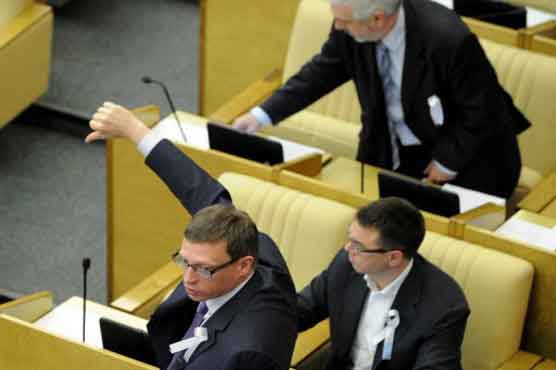
Russias upper house on Wednesday adopted a controversial bill that would greatly increase fines for opposition protesters, hours after the lower house approved the measure in a stormy midnight vote.The Federation Council passed the bill with 132 in favour, one vote against and one abstention, days ahead of a planned new anti-Kremlin protest on June 12. It now just needs to be signed by President Vladimir Putin to become law.The rubber-stamp vote in the upper house was in stark contrast to the marathon debate on the bill in the lower house, the State Duma, the previous day which ended in the measure only being passed around midnight.In a highly unusual move, an opposition party in the State Duma had deliberately stalled the passing of the bill by calling for votes on hundreds of amendments. It was finally passed at the third reading by 241-147.The bill, backed by ruling party United Russia, will hike the maximum penalty for organisers of illegal protests to one million rubles ($32,100), while participants could be fined up to 300,000 rubles ($9,000).Amid huge controversy over what activists condemned as a draconian restriction of civil liberties, the head of the presidential council on human rights, Mikhail Fedotov, said that he would ask Putin to veto the bill.This is some kind of arbitrary rule and I am sure that society will reject this, the last Soviet leader Mikhail Gorbachev told the Interfax news agency. However state media has argued that the punishments are in line with those in other countries.Putin will look at pleas from rights activists before signing the bill, his press secretary said, but added he would only oppose the bill if it contradicted European norms.If there is an appeal, it goes without saying it will be examined, Dmitry Peskov told RIA Novosti.But he told journalists later that Putin would object only in one case if this law contradicts practices that are universally accepted and used in other countries.Putin could sign the law into force before the next big opposition rally, called the March of Millions, planned for June 12, a public holiday. Opposition leaders including Alexei Navalny have called on people to turn out.The bill was submitted last month and has been hastily pushed through the legislative hoops apparently in time to slap heavy fines on protesters.The maximum penalty is about 3.5 times the average annual salary reported by the Rosstat statistics agency at the end of last year. Previously, the maximum fine for individual protesters was 5,000 rubles.The most costly sanctions would come in play if protesters caused damage to property or hurt someone in a way that was not serious enough to be a criminal offence.The measures also allow the authorities to punish organisers of walking protests -- mass strolls through city centres that the opposition has used recently -- calling these being simultaneously en masse.It also bans protesters from disguising their faces with masks or other coverings.This is a police law, intended to increase police measures against the protest movement of citizens, political analyst Alexander Morozov, editor of Russky Zhurnal website, told AFP.Putins September announcement to run for a third Kremlin term coupled with fraud-tainted parliamentary elections in December triggered unprecedented protests in Moscow this past winter.After the Russian strongmans crushing victory in March election, opposition activists have tried out tactics like staging Occupy-style sit-ins and walks as they seek to breathe new life into the protest movement.