Updated on
Summary The passage of a special law has made things worse for the embattled premier.
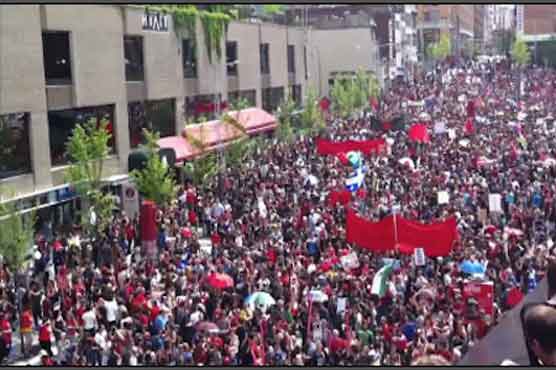
The decision of Quebec Premier Jean Charest to get tough with student protesters and introduce a draconian new law has backfired and only served to build support for their movement, experts say.Student protests have raged here since mid-February over a plan by the Charest and his Liberal Party to raise tuition fees at Quebec universities by 82 percent, or $1,700, over five years, to rein in a budget deficit.The conflict escalated on Sunday with more than 300 overnight arrests after the passage of a special law putting restrictions on demonstrations and suspending classes at strike-bound universities until mid-August.Bill 78 prohibits freedom of assembly anywhere in the francophone province without prior police approval and requires protesters to give the authorities eight hours notice before an event and follow a planned route.Rather than quelling the unrest, it appears to have made things worse for the embattled premier. Tens of thousands of demonstrators ignored their official itinerary on Tuesday as they took to the streets of Montreal to mark the 100th day of the movement.People are backing the students because Charest went too far, said Jacques Hamel, a sociology professor at the University of Montreal. Its a threat to fundamental rights, freedom of expression, freedom of association.After nine years in power, Charest hoped an originally popular hike in tuition fees might boost his dismal poll numbers, but months of building protests coupled with disapproval for this controversial new law appear to have had the opposite effect.A poll released on Tuesday by the Journal de Montreal found an 18 percent shift in favor of the students, compared to a poll taken 10 days previously.The QMI/Leger Marketing survey still showed the students adrift from the government by eight points on the central question of who the respondents supported, but the momentum has clearly turned.Some 53 percent of respondents agreed that Bill 78 went too far, while 32 percent judged it to be fair and eight percent believed it didnt go far enough.The government shot itself in the foot, said Marcos Ancelovici, assistant professor of sociology at McGill University.Today, even those who were for an increase in tuition fees see that the special law is counterproductive, he told AFP, adding that it had mobilized people who were not engaged before.Bill 78 was passed last Friday after students rejected a deal with the provincial government that would have gradually raised tuition fees over a seven-year period, instead of the original five.Ancelovici saw pride and ego in the center-right governments stubborn stay-the-course approach to the conflict, adding that it had banked on the student movement dying out, which is not at all the case after nearly four months of often violent demonstrations.As a result, Charest, who has been in power since 2003 and is the first Quebec premier to win three consecutive elections in over 50 years, finds himself in an unusually precarious position.The crisis has already felled one cabinet member, education minister Line Beauchamp, who said she was quitting politics altogether because she had lost confidence in the goodwill of student leaders.The administration also faces claims of corruption and illegal political financing, while environmentalists are up in arms about oil exploration and the regions growing production on shale gas.With elections looming before December 2013, Charest is running out of time to turn things around.But La Presse columnist Mario Roy argued that the challenges are in fact only coming from a decentralized left that is in fact a small minority but also ardently loud, militant and backed by the populist elite.Ancelovici and Hamel said negotiations were the only path forward.Talks between the students and the government broke down earlier this month but Beauchamps successor, Michelle Courchesne, stressed Wednesday that the government was still open to communication.Student leaders say they also want talks but are insisting on a tuition fee freeze, which the government rejects out of hand.