Updated on
Summary G-8 nations agreed that Europe's crisis must be addressed with growth and austerity measures.
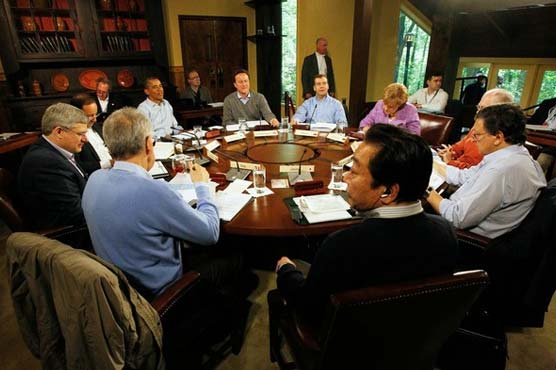
The United States and other members of the Group of Eight industrial nations agree that Europes financial crisis must be addressed with a mix of growth and austerity measures, President Barack Obama said Saturday as leaders gathered for a discussion that also will cover world concerns about ups and downs in oil prices.Leaders of the United States, Germany, France, Canada, Italy, Britain, Russia, and Japan are trying to figure out how to tame Europes debt crisis while also increasing the demand for goods and spurring job growth.They expressed hope that faltering Greece would remain in the eurozone, saying all of the nations have an interest in the success of efforts to strengthen the eurozone and help Europes economy grow.The economic powers said in a statement released Saturday at their summit at the wooded presidential retreat in Maryland that the global economic recovery is showing signs of progress, but significant headwinds persist.Earlier, Obama said the group was committed to making sure that growth and stability and fiscal consolidation are part of an overall package to help struggling European countries.Obama was referring to the debt crises in Greece and Spain, primarily, although he was not specific in brief remarks to reporters.Obamas argument for additional stimulus measures alongside belt-tightening is primarily aimed at Germany, the strongest member of the union of European countries that uses the common Euro currency, although Obama did not say so. German Chancellor Angela Merkel was seated a few places away from Obama at a small round table.Leaders of the worlds economic powers say Germany should balance its push for European fiscal austerity with doses of stimulus spending to avoid a financial calamity with global repercussions.In talks Saturday, the leaders were looking to build consensus even though a decisive plan of action seemed out of reach for now.Well also be talking about uncertainty in the energy markets and how to resolve some of those issues, Obama said at the start of discussions on the global economy.Obama chose the secluded Camp David setting in part to give leaders a chance for a freewheeling discussion out of sight of most media and far from the raucous protests that have accompanied previous meetings of the G-8.The G-8 session sets the stage for a far more consequential European summit in Brussels next week where the countries that share the euro as their currency hope to come together on specific steps to fight rising debt while spurring a recovery.The Camp David gathering opened with a Friday evening discussion focused on global trouble spots Iran and Syria. Obama said the session also touched on North Koreas aggression and hopeful signs of democratic change in Myanmar.We are unified on our approach to Iran, and hopeful of progress ahead of a diplomatic meeting with Iran next week, Obama said Saturday.Iran may have a peaceful nuclear energy program but misuse of that program for a nuclear weapon is unacceptable, Obama said. Ever-tighter economic sanctions cannot be loosened while the world encourages Iran to rein in its program, Obama said.All of us are firmly committed to continuing with the approach of sanctions and pressure in combination with diplomatic discussions, Obama said.And our hope is that we can resolve this issue in a peaceful fashion that respects Irans sovereignty and its rights in the international community, but also recognizes its responsibilities.On Syria, Obama said the group supports a United Nations cease-fire plan that has yet to be honored in full. He said a statement to be issued at the close of the G-8 summit will reflect that support for the plan brokered by envoy Kofi Annan, but also say that the plan has not taken hold fast enough.Most of the leaders are part of overlapping international coalitions formed to address the Iranian nuclear problem and the newer crisis in Syria, where an estimated 9,000 people have died in more than a year of violence that arose from the pro-democracy Arab uprisings.Faced with implacable Russian opposition to significant new United Nations punishments on the Syrian regime, U.S. officials are trying to get consensus among other allies about ways to promote the ouster of Syrian President Bashar Assad.