Updated on
Summary The new model is designed to blast through ice more than 4 meters thick.
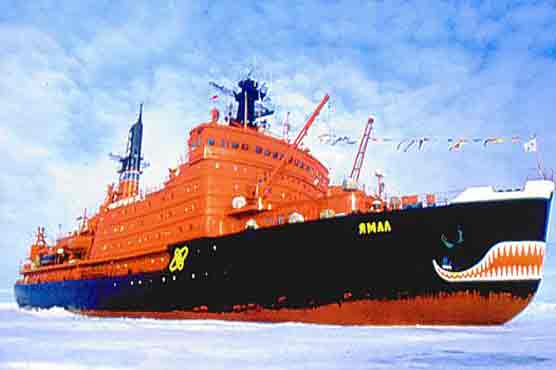
Russia’s rapidly expanding nuclear industry has set sights on the freezing waters of Arctic basin with an ambitious goal to build the world s largest universal nuclear icebreaker.Russia s dream to dominate the Arctic will soon get a boost with a nuclear-powered icebreaker designed to navigate both shallow rivers and the freezing depths of the Northern Sea. Last month Rosatomflot, Russia s atomic fleet, inked a deal to begin construction of a massive new vessel 170 meters long and 34 meters wide. That is 14 meters longer and four meters wider than any of Russia s other nuclear vessels.Powered by two RITM-200 compact pressurized water reactors generating 60MWe, the new model is designed to blast through ice more than 4 meters thick and tow tankers of up to 70,000 tons displacement through Arctic ice fields. Rosatomflot says the vessel would have liquid ballasts allowing it to alter its draught (the depth of the loaded vessel in the water) between 8.5 to 10.8 meters, allowing it to access both Siberian rivers that reach deep into Russia as well as the Northern Sea.Why the effort and cost? Climate change is a pivotal factor in accelerating Russia s interest in icebreakers, says Charles Ebinger, a Brookings Institute energy expert who has advised over 50 governments on restructuring their state-owned energy sectors. With climate change we are seeing a major change in the Northern Sea Route, which is a transport route along Russia s northern coast from Europe to Asia. Just in the last few years, with less and less permanent sea ice, maritime traffic across the Russian Arctic has risen exponentially. The expectation is that the melt will continue, but there are still sections of route that would require icebreakers to keep it open year round. The icebreakers are also crucial for collecting data on Russia s continental shelf borders, needed to stake a claim to exclusive economic rights along vast tracts of the Arctic and fend off other claimants like the US, Canada, Norway, and Denmark and Iceland.Russia argues that an undersea formation called the Lomonsov Ridge is an extension of Siberia s shelf, and therefore belongs to Russia exclusively. A few years ago Russia upped the ante by sending submersibles to the seabed floor, planting a specially designed rust-proof titanium Russian flag at a 13,980 foot depth; a Russian think tank has offered an even more straightforward solution to the Arctic dispute, suggesting re-naming the Arctic Ocean the Russian Ocean. Russia is the only country in the world currently building nuclear icebreakers, and has a fleet of about half a dozen in operation, along with a larger fleet of less powerful, diesel-powered icebreakers. While Russia s new-generation nuclear icebreaker is budgeted at 1.1 billion dollars, the US this year has been relying on a Russian diesel icebreaker to deliver supplies to its main base in Antarctica due to our own shrinking fleet of the cold-water, diesel-fueled vessels, reports Stars and Stripes.