Updated on
Summary After spending a year at a giant asteroid NASAs Dawn spacecraft started journey to its next target.
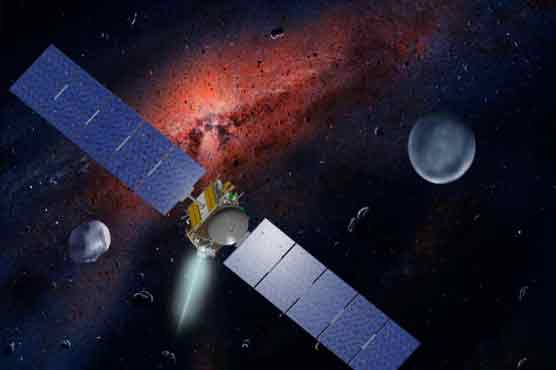
After spending a year gazing at a giant asteroid, NASAs Dawn spacecraft on Wednesday began the cruise toward an even bigger target a voyage that will take nearly three years.Ground controllers received a signal from Dawn that it successfully spiraled away from the asteroid Vesta and was headed toward the dwarf planet Ceres, where it will arrive in early 2015.Launched in 2007, Dawn is on track to become the first spacecraft to rendezvous with two celestial bodies in a bid to learn about the solar systems evolution.Firing its ion propulsion thrusters, Dawn gently freed itself from Vestas gravitational hold Tuesday night. Since its antenna was pointed away from Earth during the maneuver, NASA did not get confirmation until the next day.It was smooth and elegant and graceful, said chief engineer Marc Rayman of the NASA Jet Propulsion Laboratory, which manages the $466 million mission.Vesta and Ceres are the largest bodies in the asteroid belt between Mars and Jupiter thats littered with space rocks that never quite bloomed into full-fledged planets. As cosmic time capsules, theyre ideal for scientists trying to piece together how Earth and the other planets formed and evolved.Dawn slipped into orbit last year around Vesta and beamed back stunning close-ups of the lumpy surface. It used its cameras, infrared spectrometer and gamma ray and neutron detector to explore the asteroid from varying altitudes.Dawn uncovered a few surprises. Scientists have long known that Vesta sports an impressive scar at its south pole, likely carved by an impact with a smaller asteroid. A closer inspection revealed that Vesta hid a second scar in the same region evidence that it had been hit twice within the last 2 billion years.The collisions spewed chunks of debris into space. Some fell to Earth as meteorites.With its rugged exterior complete with grooves, troughs and pristine minerals and iron core, Vesta acts more like an almost planet than the usual lightweight asteroids.Vesta was on its way to planethood if it continued to grow, said chief scientist Christopher Russell of the University of California, Los Angeles.Scientists expect a different world at Ceres, which has a dusty surface with an icy interior. Some think it may even have frost-covered poles.Almost everything we see at Ceres will be a surprise and totally different from Vesta, Russell said.Asteroids have received renewed attention of late. President Barack Obama canceled a return to the moon in favor of landing astronauts on a yet-to-be-selected asteroid as a stepping stone to Mars.