Summary Morocco was under French protectorate from 1912 to 1956. The two countries have remained closely connected through education, business and migration
BOSTON (Reuters) – France and Morocco meet in a World Cup quarter-final on Thursday with their post-colonial ties coursing through the fixture, from Morocco players born and developed in France to the close friendship between Kylian Mbappe and Achraf Hakimi, forged during their time together at Paris St Germain.
With the build-up, match and aftermath subject to a heavy security presence in France, the Boston setting may lend the occasion a more familial feel: a meeting between countries whose histories are inseparable, but whose footballers and supporters are often connected by migration, language, family and friendship.
Morocco was under French protectorate from 1912 to 1956. The two countries have remained closely connected through education, business and migration, while football has become one of the clearest expressions of those ties.
Six members of Morocco’s squad were born in France, while several others have played in Ligue 1 or passed through France’s youth system before choosing to represent Morocco.
Their paths reflect the dense sporting links between the countries, and Morocco’s ability to turn its diaspora into a competitive strength.
Teenager Ayyoub Bouaddi is one of the clearest examples of those overlapping ties: born in France, developed at Lille and capped by France at youth level before choosing Morocco, he embodies the kind of dual footballing identity that gives this fixture particular resonance.
France, world champions in 2018, are one of the game’s established powers, with the tournament experience and attacking talent expected of a team chasing another World Cup. Morocco arrive with the confidence of a side who have made a habit of shifting expectations, four years after becoming the first African country to reach a World Cup semi-final.
Their meeting in Qatar in 2022, won 2-0 by France, was charged with emotion but also marked by a striking sense of mutual recognition. Morocco’s run captivated supporters far beyond its borders while France’s squad again illustrated the multicultural currents that have long shaped its football.
INTRIGUING SETTING
Boston provides an intriguing setting for the rematch.
The Moroccan community is smaller and less visible than in French cities, but it is established in the wider metropolitan area, where Morocco-born residents have helped build a network of families, students, professionals and businesses.
For those supporters, the quarter-final will not necessarily divide a room cleanly in two.
"Some live in the same building and French and Moroccans will watch the game together and shake hands at the end," said Mohammed Saadi, a 57-year-old taxi driver.
"There is no tension here. Soccer is a family thing and France v Morocco will be no different. Quite the opposite, even."
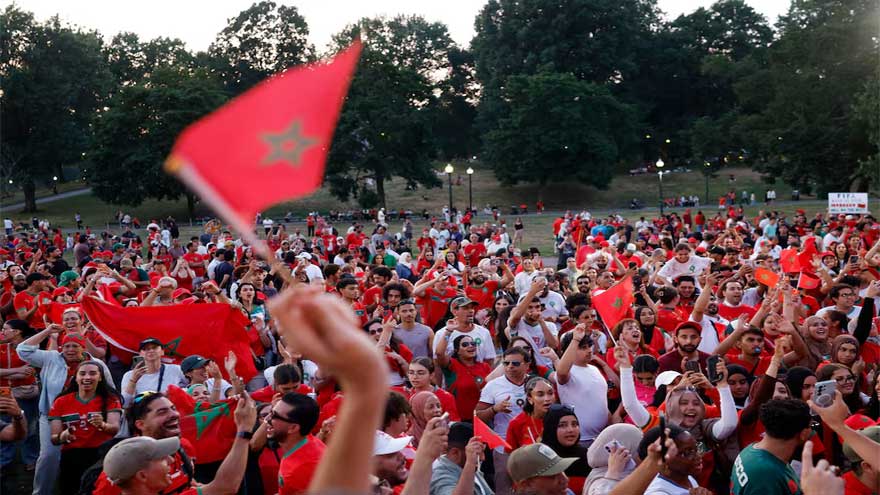
In Boston Common, over 1,000 fans gathered singing Dima l-Maghrib (Always Morocco) and waving flags in a peaceful gathering ahead of Thursday's game.
"I've come all the way from Finland," said Youssef Bennani, a 36-year-old software engineer.
"I’ve been to all of Morocco's games and here it's the best place. I met a lot of Moroccans, also some French and it's going to be a big party tomorrow."
Morocco’s progress has changed the texture of the fixture.
They are no longer simply the compelling underdogs of 2022 but a side with the organisation, player development and belief to challenge the sport’s traditional powers.
Their squad has benefited from a federation strategy that has connected domestic development with talent raised in Europe.
France, who beat Paraguay to reach the last eight, have their own reasons to be wary. Their attack has been among the most potent at the tournament, but Morocco’s 3-0 win over Canada underlined the pace, discipline and ambition that have carried them back to the quarter-finals.