Summary Pitch-perfect 87 from veteran rescues team from turmoil at 11 for 4, to square series
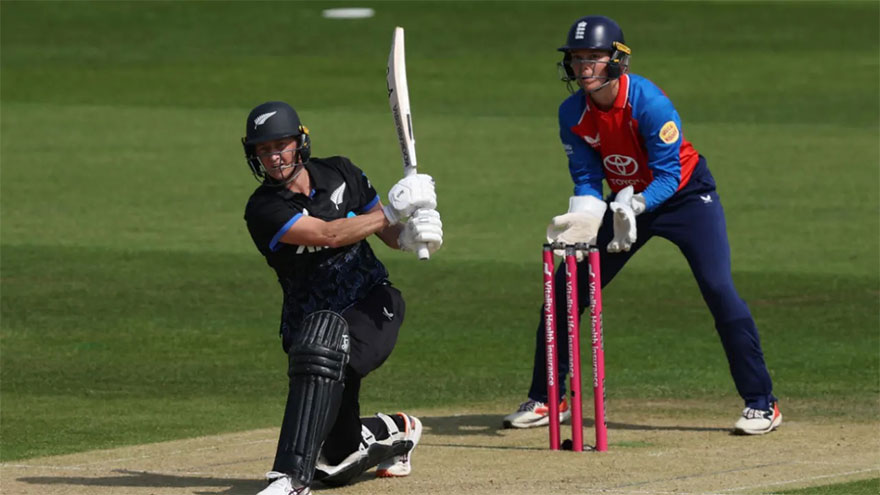
CANTERBURY (Web Desk) - A firefighting 87 from Sophie Devine propelled New Zealand from a perilous 11 for 4 to a series-squaring 14-run win over England in the second women's T20I at Canterbury.
Already 1-0 down, the tourists were floored when reduced to 5 for 3 after just nine balls - New Zealand women's joint-lowest total at the fall of the third wicket in T20Is. They were soon four-down in the fourth over, with Linsey Smith (3 for 25) the main destructor, her wily brand of slow left-arm swing flummoxing the top-order.
But Devine and Maddy Green, who finished with an unbeaten 56, rebuilt and then thrived with a stand of 159 that ended with Devine's run-out off the final ball of the innings. Regular boundaries between the pair - including eight sixes, six belonging to Devine - ensured the White Ferns did not miss out on the pristine batting conditions that convinced Melie Kerr to bat first upon winning the toss.
Yet again, Lauren Bell struck early, dismissing Izzy Gaze at the end of her first over having dismissed Georgia Plimmer with the first delivery of the opening T20I at Derby. Plimmer had the ignominy of a second successive golden duck when she got herself in a tangle to gift Smith a return catch at the start of the second over.
But Devine and Green ensured there would be no repeat of Wednesday's defeat. England's target would have been more manageable than 171 had Smith effected a run-out at the non-striker's end midway through her third over. It would have removed Devine for 48 in the 14th over. She struck 39 off her remaining 20 deliveries, and faced 57 in all before finally being run out off the final ball of the innings.
In their reply, England were above the rate at the three-over mark, before Sophia Dunkley was dismissed for a sprightly 26, caught off Nensi Patel, the offspinner having come into the side for Suzie Bates. And New Zealand assumed the ascendancy out when set batters Heather Knight (25) and Maia Bouchier (38) were dismissed in successive balls. It was particularly poor from Bouchier, finding the fielder at long-on off Patel, moments after Knight had been run out after aborting a second run following a late call.
The silver lining for England was that it brought hard-hitting allrounders Freya Kemp and Dani Gibson to the middle at the death. But with too much to do, Gibson was bowled by Bree Illing hacking across the line, and Kemp became the returning Leah Tahuhu's 99th T20I wicket when caught on the fence with 23 required from the final four balls.
Issy Wong, replacing Sophie Ecclestone who sat out with a tight hamstring, lofted the final ball over the boundary, reducing the margin of defeat. It also highlighted a key difference between the two teams. It was only England's second six, a third as many as Devine had managed on her own.
GREEN SHOOTS, DEVINE SAVES
It has been an excellent first half of the year for Sophie Devine. Saturday's half-century was her third so far, giving her an average of 48 and strike rate of 160. While admittedly from a sample size of seven innings, it speaks to a player focussed on going out on a high. This, by the way, is now her second highest score in the format, slotting beneath her sole century that came against South Africa in February 2020.
"I'm enjoying my cricket and enjoying what I got left on the international scene," Devine said during her play of the match interview. Retiring at the end of the upcoming T20 World Cup, the 36-year old is gunning for the sweetest swansong.
England were warned. On, Wednesday in a similar situation, Devine counterpunched with 45 off 22 from less shakier ground - 13 for 2 in the fourth over - but was eventually trimmed off by Gibson. The difference this time was not just carrying on (especially after the life on 48) but support from Green.
Overall, Green was only striking at 116.66, but she was able to keep pace for the majority of what became a maiden T20I fifty. A brace of fours off Gibson took Green to 40 from 33, with Devine watching on appreciatively, 49 off 38 to her name.
That passage of five overs after the midway point saw Green momentarily assume senior status, facing 20 balls and allowing Devine to rest up for the final push. The 56 from the final four overs - 36 from Devine - put New Zealand out of reach.
"It shows the growth of the group, to be able to rebound and put on a score of 170," said Devine. "For a player like me, I don't really like sitting back. It's a real battle of the mind regarding what you want to do.
"We absorbed pressure really well and then to be able to throw it back at them at the backend. It's a fantastic confidence builder for us."
SWINGING SMITH
"They keep playing her like a left-arm spinner - they need to play her like a left-arm swing bowler," said Nasser Hussain on Sky. In between celebrating Linsey Smith's brilliance, the former England men's captain could not help but lament New Zealand's approach to the left-arm orthodox bowler.
At the toss, Melie Kerr revealed the team had discussed how best to combat Smith, who had flummoxed them in the first T20I. Stifling the White Ferns scoring with 15 dot balls among her 1 for 10 from her four overs, Kerr called for a more pro-active batting effort. Unfortunately, she could not lead as an example, out LBW sweeping her first ball, gifting Smith her second dismissal halfway through her first over.
Blindly swinging across the line was surely not a tactic formulated in that brainstorming session. Georgia Plimmer attacking immediately - a return catch giving her a second successive golden duck - was a little too cavalier. Left-hander Brooke Halliday's initiative to advance down the crease felt the most appropriate, even if that resulted in a straight-forward catch to Bouchier at long off.
Smith has added a fascinating dimension to the XI, as a slower bowler thriving in the Powerplay. And it will be interesting to see how opposition batters deal with her at the World Cup given what she's shown weeks out from the competition.
As Hussain states, it may be wiser to approach Smith like a seamer, focussing on the movement through the air rather than what revolutions there may be on the ball. It was instructive that Smith, speaking ahead of the match, revealed she had got into trouble for forgetting to shine the ball, a regular habit for quick bowlers but something this spinner needs to remember to do given how much of her success is coming from swing rather than spin.
Most of New Zealand's right-handers have had little joy trying to heave her to leg. Might more joy be found making room and accessing the off side, particularly during the first six overs? We may be about to find out.
BETTER USE OF DEATH BATTING RESOURCES
That England happened to get their strongest hitters Kemp and Gibson out there in the final five overs was entirely by accident. Even if they had managed the 52 required from the remaining 26 deliveries, the main takeaway should be that they were introduced too late.
Angling for what would have been the side's third-highest successful chase, perhaps Kemp, off the back of a handy 31 not out to finish the first T20I, should have come out when Capsey fell at the end of the 10th over. At that point, the required rate was on the verge of reaching double figures. By the time Knight and Bouchier were done, both allrounders would have had to strike at 200 to get England home.
Head coach Charlotte Edwards has focussed on adding more heft to the lower order, and there is no doubt Kemp and Gibson give opponents something to fear. Gibson's consecutive fours off Devine sparked momentary jeopardy before her dismissal. A little more time and maybe her and/or Kemp could have made a decisive impact. No doubt an error to learn from ahead of the main event next month.