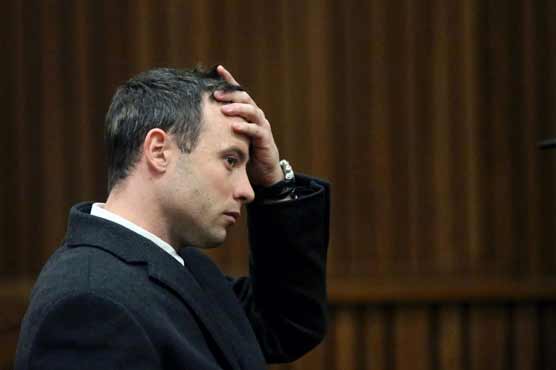
Summary Oscar Pistorius is accused of killing his girlfriend Reeva Steenkamp on Valentine's Day of 2013.
PRETORIA, Sept 09, 2014 (AFP) - South African amputee sprinting star Oscar Pistorius faces a judge s verdict Thursday on charges he deliberately shot dead model girlfriend Reeva Steenkamp in 2013.
Here is a snapshot of the events that began on a fateful Valentine s Day:
--2013-
February 14: South African police arrest Pistorius, a Paralympic and Olympic sprinter nicknamed the "Blade Runner", for the murder of Steenkamp, shot four times with one of his guns at his house near Pretoria.
February 15: Pistorius breaks into tears as he is charged, denying the murder "in the strongest terms".
February 19: Pistorius claims in an affidavit that he mistook Steenkamp for an intruder and was "filled with horrible fear" that someone had sneaked into his home through an open window.
He insists he did not intend to kill Steenkamp, but is accused of firing through a locked bathroom door in what prosecutors term a "premeditated" murder.
February 20: Witnesses testify they heard arguing, a woman screaming and gunfire at Pistorius s house the night of the slaying, police tell the court.
The French cosmetics firm Clarins drops an advertising campaign featuring Pistorius.
February 21: US sportswear giant Nike suspends its contract with Pistorius.
South African police name a top detective to the case after it emerges that the officer initially assigned to it faces attempted murder charges.
February 22: Pistorius is granted bail by a magistrate. It is set at one million rand ($100,000, 75,000 euros) after the sprinter spent more than a week in custody and sat through a tense four-day bail hearing.
March 28: A court clears Pistorius for international travel, easing his strict bail terms.
April 14: Pistorius is seen partying at a trendy Johannesburg hangout, media report.
May 20: Pistorius will not race this season, his agent says.
June 28: Pistorius is to resume limited training for his mental wellbeing, but does not plan a return to competition, his family announces.
August 13: A magistrate orders Pistorius to stand trial in March.
--2014--
January 23: Pistorius lawyers and Steenkamp s family are discussing an out-of-court financial settlement, a lawyer says.
February 25: A judge rules that most of Pistorius s trial can be broadcast live, but not his own testimony.
March 3: The trial opens in Pretoria, before an army of journalists from around the world, with the testimony of a neighbour who told the court she heard "terrible screams" from a woman and shots.
March 13: Pistorius vomits when a picture of the dead model s body was accidentally flashed on the court s television screens.
April 7-15: Pistorius takes the witness stand and begins with a tearful apology to the family of the woman he shot dead.
This is followed by five days of hell for the accused, including intense cross-examination, marked by several bouts of tears and breaks in the session.
But while he admits to having fired the shots, he refuses to admit any intention to kill his girlfriend.
June 30: After a six-week interruption, a panel of three psychiatrists and a psychologist conclude that Pistorius was not suffering from mental illness.
He faces up to 25 years in prison if convicted.
July 12: Pistorius, who is on bail, is expelled from a nightclub after a scuffle with another patron.
August 7: State prosecutor Gerrie Nel, in his final argument before the court, accuses Pistorius of concocting an alibi that led to a "snowball effect" of lies.
August 8: The trial concludes with closing arguments from the defence. A verdict is scheduled for September 11.
Accused of killing his girlfriend Reeva Steenkamp on Valentine s Day of 2013, the double-amputee sprinter is also facing charges of gun and ammunition possession.
Here are the key questions that might determine his fate:
Who decides Pistorius s innocence or guilt?
South Africa does not have jury trials, so the verdict will largely come down to Judge Thokozile Masipa.
However in this case the judge has been given two "assessors", Themba Mazibuko and Janet Henzen-du Toit, as aides. If the pair both disagree with Masipa s decision they could choose to overrule her on matters of fact.
Did the trial produce any smoking gun ?
Not really. Both defence and prosecution were arguably more effective when dismantling their opponent s case than building their own.
But while in the dock, Pistorius appeared to change his defence, from saying he shot at Steenkamp through a locked door in self-defence thinking she was an intruder, to saying he fired "accidently".
Masipa and her colleagues will have to assess reams of evidence from dozens of witnesses, but ultimately it may all come down to just one person s testimony.
"It would largely come down to what she thinks of Oscar s testimony, and how good he was as a witness," said lawyer David Dadic, adding that the change of defence "would hurt him".
Evidence related to previous gun charges against Pistorius could also prove important. "His character was brought down because of those lesser charges," said Dadic.
Can Pistorius avoid conviction?
Pistorius has admitted he killed Reeva Steenkamp, but the judge s understanding of his motive and mind-set will decide if that is viewed as a criminal act.
To find him guilty of murder, the state must have proved there was a direct intention to kill.
"He could also be found guilty of culpable homicide, if the court finds that there was an indirect intent to kill," said Dadic. "The judge would find it hard not to find him guilty of anything."
Pistorius s lawyers tried to argue that his disability bred a sense of insecurity that made him shoot wildly at a perceived intruder.
But Dadic said "to acquit him based on his disability would set a bad precedent."
Will he go to jail?
If found guilty the judge will prescribe a suitable sentence based on the evidence and mitigating factors put forward by the defence.
"There is no prescribed sentence, unless he is found guilty of premeditated murder which carries a 25 year term," said Dadic. "For culpable homicide he might get anything from a suspended sentence to a jail term."
Will he appeal if found guilty?
Almost certainly, yes, according to sources familiar with the case.
"The trial is the first leg of a multi-legged legal process. It s just the beginning," said Dadic.
"If he gets a jail term on any of the charges he can appeal. The appeal process can take years."
"I don t believe Oscar will go to jail until he has exhausted all the legal avenues available to him, including the possibility of going to the constitutional court."