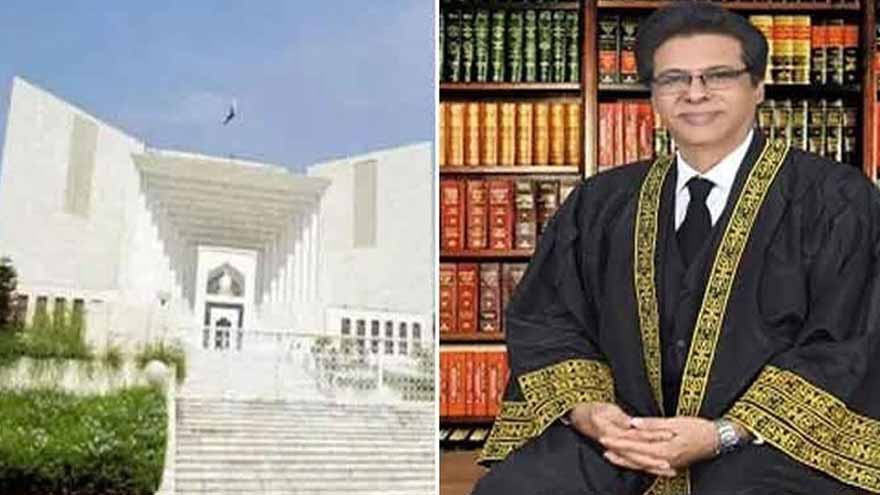
Summary Justice Mazhar wrote that if a judge becomes angry with a party or counsel or loses patience, it becomes impossible to dispense justice in accordance with law
ISLAMABAD (Dunya News): Supreme Court senior judge Justice Muhammad Ali Mazhar has declared that the execution of former Prime Minister Zulfikar Ali Bhutto, based solely on the statement of an approver, was contrary to law and the fundamental principles of justice.
In a detailed 24-page note issued on the presidential reference concerning Bhutto’s execution, Justice Mazhar stated that decisions made in haste, anger, or prejudice violate not only Pakistan’s legal framework but also Islamic principles of justice.
Referring to past interviews of former Chief Justice Naseem Hasan Shah, Justice Mazhar noted that Shah had himself admitted that the verdict in the Bhutto case was delivered under pressure. He observed that such an admission leaves no room for doubt that the execution amounted to a “judicial killing” and constituted a clear violation of a judge’s oath.
Justice Mazhar wrote that if a judge becomes angry with a party or counsel or loses patience, it becomes impossible to dispense justice in accordance with law. He pointed out that judges hearing Bhutto’s appeal were allegedly in an angry state of mind, eliminating the possibility of an impartial and independent decision.
According to the note, Zulfikar Ali Bhutto’s trial failed to meet the standards of a fair trial guaranteed under Articles 4 and 9 of the Constitution. The proceedings lacked transparency and did not fulfill the legal requirements of due process. Awarding the death penalty solely on the testimony of an approver was described as a violation of fundamental legal and moral principles.
Justice Mazhar further observed that the record demonstrated personal bias and preconceived notions on the part of the judges, which undermined the foundation of a fair judgment. He also noted that a case previously closed by the police was reopened during the martial law period without any lawful justification.
The note stated that the transfer of the case from the Sessions Court to the High Court was carried out in a cursory manner without notifying the accused or fulfilling mandatory legal requirements. Justice Mazhar emphasized that Bhutto’s expression of no confidence in the head of the bench during the trial was not accepted, which was against the principles of justice.
Justice Mazhar highlighted that the Supreme Court’s advisory jurisdiction carries significant legal weight for all state institutions. He remarked that the use of harsh language and sarcastic remarks during the trial compromised judicial dignity and impartiality.
Raising critical questions, Justice Mazhar asked why the court framed the question of “repentance” in a case involving an unfair and biased trial, and who exactly was expected to repent—the deceased judges who heard the case in the High Court, or those who heard the appeal and review petitions.
He concluded that although later opinions did not explicitly express remorse, they did reflect a degree of regret over the failure to ensure a fair trial and due process. Justice Mazhar noted that no final decision has yet been reached on Question No. 4 of the presidential reference.