Summary New tariff for commercial consumers to take effect from Aug 1, for domestic consumer from Oct 1.
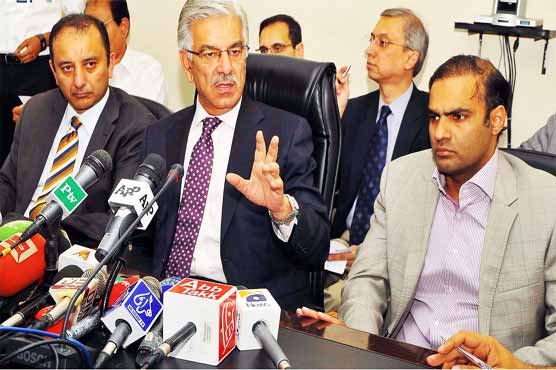
ISLAMABAD (Dunya News) - Addressing a news conference after approval of the national energy policy by the Council of Common Interests‚ Minister for Water and Power Khawaja Muhammad Asif said the new policy envisages measures to end load-shedding‚ bring down generation cost and make necessary investment in the infrastructure to attract investment in the energy sector.
He said the subsidy being paid on electricity would be reduced by next year through tariff rationalization.
Khawaja Asif said new rates would be announced in a few days while new tariff for commercial and industrial consumers would be applicable from first of August and change in tariff for domestic consumer would take effect from first of October this year.
He‚ however‚ made it clear that new rates would not be applicable to those consuming upto two hundred units a month.
The minister said through tariff rationalization‚ efforts have been made to put burden on those who have the capacity to pay. He said the country will have to confront again circular debt worth 600 to 700 billion rupees next year if no tariff rationalization is done.
Asif said due to payment of circular debt worth 480 billion rupees‚ peak generation of hydel power and other measures introduced by the government‚ the system produced 16170 MW of electricity last evening which was highest in the history of the country.
He said it would be effort of the government to maintain electricity generation at 15000 MW so as to bring down the duration of load-shedding.
He said the government on the whole succeeded in eliminating load-shedding during Sehr‚ Iftar and Taraveeh during Ramazan and areas where problem were encountered were due to technical reasons.
The minister said as of today 5900 MW of electricity is being generated through hydel sources and 7900 MW by IPPs. He said average generation is 15300 MW as against demand of about 18000 MW.
He said on the average daily load shedding of eight to nine hours is taking place but its duration varies from six to seven hours to twelve to thirteen hours in different areas for different reasons.
Referring to rioting in Bannu‚ the Minister for Water and Power said two local feeders have been shut down as PESCO is receiving just seven and eight percent dues from areas being fed by these feeders.
The federal government has asked the Provincial Government to sort out the matter through jirga seeking assurances from consumers to pay their arrears and end illegal connections so that electricity is restored, he added. He said free of cost electricity cannot be provided at the cost of consumers who pay their bills regularly and honestly.
Khawaja Asif said Pakistan is producing costly electricity through furnace oil and to bring the prices down such plants would gradually be converted into coal.
He said it would be effort of the government to change the ratio of energy mix in a manner so as to maintain electricity prices at affordable level.
The minister said new laws would be enacted to provide for stricter punishment for electricity theft and it would be a non-bail able offence. He said at the moment electricity worth 120 to 200 billion rupees is either stolen or is lost due to technical reasons.
About Nandipur power project‚ he said its cost has gone up due to interest and fluctuation in exchange rate. He‚ however‚ pointed out that revised estimates of the projects were prepared by the previous Government in January this year and approved by the ECC recently.
Earlier, a meeting of Council of Common Interests chaired by Prime Minister Nawaz Sharif here on Wednesday approved the new National Energy Policy.
Addressing the meeting Prime Minister Nawaz Sharif said responsibility rests with the provinces to ensure implementation of the energy policy.
He said Sindh is the hub of energy and its sources including wind and coal will be exploited to meet the energy requirements. The prime minister congratulated the members of the council for unanimous approval of the energy policy.
Chief Minister Punjab Shahbaz Sharif‚ Chief Minister Khyber-Pakhtunkhawa Pervez Khattak‚ Sindh Chief Minister Qaim Ali Shah and Balochistan Chief Minister Dr Abdul Malik and other members of the council attended the meeting.