Updated on
Summary United States decided Friday to designate the Pakistan-linked Haqqani network as a terrorist group.
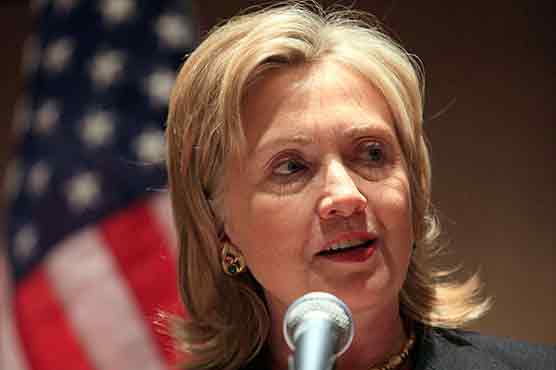
After intense pressure from US lawmakers, Secretary of State Hillary Clinton filed a report required by Congress to say that the Haqqani network -- known for bloody attacks in Afghanistan -- was a terrorist group, an official said.Clinton signed a report to Congress this morning stating that the Haqqani Network meets the statutory criteria for designation as a Foreign Terrorist Organization, the official told reporters travelling with her, on a tour that saw her leave Brunei on Friday to her next stop in Vladivostok, Russia.Congress had given Clinton a deadline of Sunday to determine if the group met the characteristics to fall into the category, which would make it a crime in the United States to provide the Haqqanis with any material support.While technically Congress did not force Clinton to make an actual decision on designation, the official said that she would soon formally list the Haqqani network as a terrorist group.President Barack Obamas administration, while pressuring the Haqqani network, had previously stopped short of declaring it to be a terrorist group due to worries over relations with Pakistan.Admiral Mike Mullen, the former head of the US military, said before stepping down last year that the Haqqani network had become a veritable arm of Pakistans Inter-Services Intelligence, leading to suggestions that a designation would indirectly be branding Pakistan a terrorist state.The Haqqani network has triggered growing outrage in Washington through a series of attacks in Afghanistan, including a June assault on a hotel near Kabul that killed 18 people and a siege last year of the US embassy.Clinton, asked last week in the Cook Islands about her decision-making on the Haqqani network, said that the United States was putting steady pressure on the group.We are drying up their resources, we are targeting their military and intelligence personnel, we are pressing the Pakistanis to step up their own efforts, she said.As part of the US efforts to increase pressure on the group Luke Bronin, a deputy assistant US Treasury secretary, held talks in Pakistan on disrupting sources of terrorist financing to terrorist organisations, according to the US embassy in Islamabad.The United States has recently started to resume cooperation with Pakistan after relations nosedived over incidents including the secret raid that killed Osama bin Laden and an air raid that accidentally killed 24 Pakistani troops.Officials on Clintons plane declined to comment further, but the Obama administration is likely to seek to reassure Pakistans government on overall relations after the designation.It is unclear whether the designation would lead to many prosecutions in the United States as the Haqqani network receives support largely through unofficial channels.But advocates of the blacklisting believe that the move can be used as pressure to persuade funders of the group in Pakistan and Arab Gulf states to sever ties.The United States has already blacklisted individual leaders of the group including Jalaluddin Haqqani, a guerrilla formerly supported by the United States as part of the Islamic-infused fight against Soviet troops in Afghanistan in the 1980s.The US Senate and House of Representatives have both been virtually unanimous in urging the administration to go a step further and target the overall network, saying that it unmistakably carried the traits of a terrorist group.While the Haqqani network has no sympathy in Washington, some US officials believed that the links between Pakistan and the Haqqanis were more complicated than it appeared.According to such voices, Pakistani intelligence works with the Haqqanis not to wreak havoc but to keep the group on its side amid the turbulence in both Afghanistan -- where US forces plan to pull out by the end of 2014 -- and at home.Pakistani officials have in the past admitted to having contact with the Haqqanis as a hedge for influence when US troops leave Afghanistan, but deny supporting their operations and downplay the groups importance.