Updated on
Summary There is no water for us, no food for our animals and no milk for our children
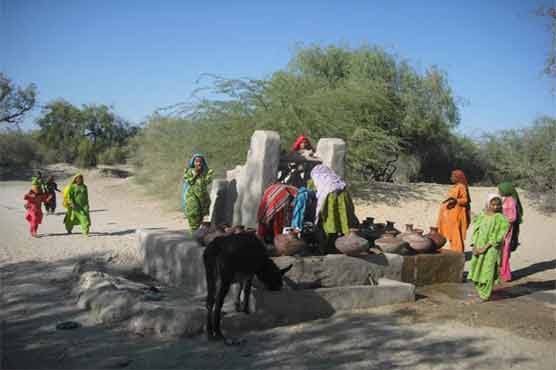
Its a vast, hot, dry, dusty, shady desert area stretching from the corner of Interior Sindh of Pakistan up till Rajasthan and Gujarat over the other side there in India.Water is a main problem here, food is insufficient, and education is luxury. Thar or Tharparkar desert is where about one and half million tribal people, living in more than 800 widespread villages, survives their life, with their cattle, despite all of the hardship.Umerkot is the center of administration of Tharparkar, well connected to other cities in Sindh province and have quite good infrastructure to support live in this sizeable town. Umerkot, is like a Little India.In spite it is part of the Islamic Republic of Pakistan, most of the population (some says more than 70%) are Hindus.Many parts of the desert are now reachable by public transport. The government has built quite good road infrastructure to connect some big villages in the deep desert to outside world. Even the remote Naga Pakar and Indian border of Kokhrophar are now accessible by public bus.The buses are mostly very old, but it provides cheap transport for the villagers. There are several buses serving many different routes, waiting for passengers in the bus terminal of Umerkot everyday. The schedule of departure and arrival is very limited, and suited to the villagers needs.The bus usually departs early morning from the deep desert bringing all of the villagers who are going to town to shop or to trade, wait until the afternoon in the town, and go back with almost the same passengers, happy to go home, back to the deep desert.Life here is so difficult, said Jamal, a Muslim Sindh living in deep Thar desert in Ramser village, there is no water for us, no food for our animals, no milk for our children because the cows are so weak, and there was no rain for years.Drought had come to this desert since four years ago, said Jamal. The rainy season is supposed to be in June until August, where there should be around three or four times of rain. Jamal said that no rain came at all in last four years. Other villagers told me that rain came every year but the quantity of water was too low.But you should see when rain comes here this dry desert would turn into green plain and our Thar becomes like Kashmir, said Jamal. He has never been to Kashmir, but I believe his description that desert can be zipped into a jungle just in overnight after a rain.Old woman in the neighborhood feeds the cattle with wheat extract (bought from Umerkot) which was mixed and pressed with water. The donkeys and camels like it very much. They are extremely skinny. Then it is turn for the boys and girls to bring the goats and cows to the grassland.The cowboy sits on his donkey, navigating his cattle. The donkey and camel also serve as water collector. The people put rubber skin water gallon on the animals, and then walked for a kilometer where the family water storage is located, put some kilograms of water for the day use, and go home.Some NGOs and government institutions has built water storage near the community, so the villagers dont need to walk far to collect water everyday.Before they had to go far away to the well, dig the water, and walk back the distance of some kilometres, everyday. Now life is little bit easier. The cows are there to provide milk. But they are too skinny that now the village children have no milk to drink. So are the goats. The Muslims also eat the beef, as their cows hardly sell in the town.Water collecting is a big business here. Near this Hindu village, a water pump was built by a foreign organization. Everyday, started at 11 when the day also starts to be hot, people collect water. As water is scarce, there is numbering order of who should collect water at what time.Women start walk from their village with the water pots on their head. Some old ladies even didnt wear shoes to walk on the burning sand. The water pump is a kilometer away.The water is very deep in the well. There were four donkeys, connected to a bucket which could carry 25 kg of water, to pull out the water from the well. The donkeys were navigated by a boy, who pushed them to walk around 100 meters to pull the bucket out.Then it turns for the people waiting around the well to distribute the water. The women put the water to the pots and carry them on their heads. Some other men put directly to his water storage nearby for his further use, and the others load it onto their donkey. Water is priceless here.The water storage buried inside the sand has even padlock to prevent people of stealing water. Has the water here even dried? The well might have few water after a session of pumping, but an hour or two later water will come again so that the next shift of people will be assured to get water. But in this hot summer the need of water is enormous, that the well never completely fulfils the needs of the villagers.Waiting for hopes, waiting for someone who will come to change their future is the only thing children here spend their days for. Under the hot sun they play the traditional Sindhi game or wrestling, or otherwise force the animals to do the wrestling. Insects and goats are favorite fighting animals.Children also came around the sunflower seed weighing area, and pick some seeds on the ground, and eat it (supposed to be food of their animals). Waiting for hope is best described when a vehicle coming to their village, all children will run happily to see which outsiders are coming today to change their life. They always welcome guests. And I experienced this many times during my participation in the field works of the NGO.At the afternoon, the children of the Muslim village ran cheerfully towards a truck coming. This truck is a special vehicle made for desert transport. It is called as kekra, now no longer produced. The kekras are the king of desert, replacing the camels which are frustratingly too skinny now after the long drought. The kekras brought water and workers to this village.The government decided to build a school nearby, and the materials are coming today. The workers are staying in the same otagh as I do, but they prefer to sleep on the floor or outside. The building of the school is supposed to finish in three months, but as commonly in Pakistan, whether it is going to finish or not is another question. Not to mention in deep desert like this, in the biggest city of Karachi there are many unfinished buildings due to mismanagement.The government of Pakistan works hard to build infrastructure in villages in deep desert like this. This is something that should be praised. But infrastructure is not enough.Many schools they built become merely buildings with desks and chairs, but no teachers and students. What is the meaning of school without teachers and students? The school buildings turn to be meeting point or community hall for the villager men, to pass their boring day by chatting around. Teachers usually come from the localities. Their education is also not high.And students? Even education is free, the parents dont want to send their children to school. In one interview with a parent who doesnt want to send his children to the school, he said in energetic motion, We are illiterate, why should our children be educated? They have to be like us. They have to be like our ancestors In my humble opinion the government should teach the parents first. But who will teach the government, argued someone.