
Oil nears $100 as fresh Middle East strikes raise supply risks
Oil prices rose for the fourth straight session, gaining more than $1 in early trade on Wednesday after renewed attacks across the Middle East heightened worries about supply disruptions.
Brent crude futures rose 1.4%, to $99.33 a barrel by 0212 GMT, while U.S. West Texas Intermediate crude was at $94.34 a barrel, up 1.4%.
Iran FM strongly criticizes new US sanctions
Iranian Foreign Minister Abbas Araqchi has strongly criticized the new sanctions imposed by the United States on Iran.
In a statement on social media, Araqchi said that after 47 years of sanctions, the US had waged war against Iran on behalf of Israel, with devastating consequences for Washington, particularly in terms of its reputation on the global stage.
According to Araqchi, Washington’s new solution after failing to achieve its goals through sanctions and war is to impose more sanctions.
He criticized the US policy, saying that the latest sanctions demonstrated Washington’s continued reliance on the same approach despite its failure to achieve its objectives.
US Treasury ratchets up pressure on Iran with sweeping new aviation sanctions
The United States on Tuesday issued 36 Iran-related sanctions targeting the country's aviation sector and other companies as part of a broad ?push to escalate economic pressure on Tehran as the war in the Middle East has moved into a seventh month.
The U.S. Treasury Department said the action was aimed at grounding Iran's Mahan Air, which was already sanctioned by the U.S. and the European Union, and expanding sanctions to all other Iranian airlines.
The sanctions also took aim at covert front companies, cargo handlers, foreign intermediaries and deceptive trans-shipment routes that Washington says Iran relies on to obtain U.S.-origin aircraft and sensitive technology.
US military underwater drone malfunctioned in Middle East, says official
A US military drone malfunctioned in the Middle East while it was surveying regional waters in support of the Iran war, a US official told Reuters on Tuesday.
The official, speaking on the condition of anonymity, said the defective drone was an older model and was not carrying any classified sonar or radar equipment.
It malfunctioned more than a day ago, the official added.
Iran says shot down US MQ1 drone
Iran's IRGC said that in another statement carried by state TV that they thwarted a drone attack on Tuesday.
"An advanced MQ1 drone was intercepted and destroyed by the IRGC's new advanced defence system, under the control of the country's integrated air defence network, over the Strait of Hormuz," it said, without saying who was behind the attack.
The model is used by only a few countries, including the United States.
Iran says captured unmanned US submersible at Hormuz entrance
Iran's Revolutionary Guards on Tuesday said they seized an American submarine drone in the strategic Strait of Hormuz, which Tehran has blockaded in the months-long Middle East war.
"The IRGC naval forces captured one of the most modern, unmanned, and smart submarines of the US terrorist army at the entrance to the Strait of Hormuz in a complex intelligence and operational action at dawn today," the Guards said in a statement carried by state TV.
"This smart submarine is equipped with the latest technology in the subsurface field in the world, which was delivered to the US terrorist army fleet in 2025," the statement added.
"This submarine has now been captured and images of it will be released in the coming hours."
Qatar condemns Houthi attacks on Saudi civilian, economic sites
Qatar has strongly condemned Houthi attacks targeting civilian and economic sites in several Saudi Arabian cities, including Abha, Khamis Mushait, Jazan and Najran.
According to Al Jazeera, Qatar’s Foreign Ministry also denounced the continued targeting of commercial vessels in the Red Sea, warning that such attacks threaten the safety and freedom of maritime navigation.
In a statement, the ministry described the attacks as a “reprehensible act of aggression” and an unacceptable disregard for civilian lives and the security of countries across the region.
Qatar said the attacks constituted a blatant violation of Saudi Arabia’s sovereignty and a clear breach of international law. It warned that the continued escalation posed a serious threat to regional security and stability.
The Qatari Foreign Ministry reaffirmed its opposition to attacks against civilian and economic infrastructure and stressed the need to protect maritime navigation and regional security.
Trump says Iran has been 'punished greatly' by US
US President Donald Trump has said Iran has been “punished greatly” by the United States, reiterating that Tehran will not be allowed to acquire a nuclear weapon.
Speaking at an event in Washington, DC, Trump said the US was engaged in the conflict because Iran had been seeking a nuclear weapon and was close to achieving that goal.
“We’re right now fighting because we have a certain nation that wanted a nuclear weapon; they were very close to getting it, and now they have no chance at getting it,” Trump said.
He insisted that Iran would never possess a nuclear weapon, claiming that the country had suffered severe consequences as a result of US military action.
Trump also praised the US military for its role in the conflict and described the US naval blockade of Iran as “so powerful and so effective.”
The US president reiterated that Washington would continue to prevent Iran from developing or acquiring a nuclear weapon.
Nigeria's Dangote refinery expects fuel shortages beyond Iran war as it spurs expansion
Fuel shortages are expected to persist long after the US war with Iran due to the damage inflicted on refineries and the need to replenish stocks, the chief executive officer of Nigeria’s Dangote oil refinery tells Reuters.
Dangote is set to double its capacity to equal the world’s largest, the Jamnagar Refinery in India, and plans a second refinery in Kenya.
“We went in [to the Iran war] at high refinery utilisation (rates), and there’s been deferred maintenance and damages to Middle East refineries — that’s just to meet current demand,” CEO David Bird tells Reuters.
“Plus inventories have to be rebuilt, plus a lot of countries are talking about supply security and increasing stocks.”
Hormuz disruptions hitting small businesses hardest, UN trade agency warns
Disruptions in the Strait of Hormuz could push small and medium-sized businesses out of global supply chains, increasing economic concentration and weakening the resilience of international trade, Reuters reports citing a report by the United Nations Conference on Trade and Development.
Rising energy bills, freight rates, insurance premiums and financing constraints sparked by the US-Iran war place heavier burdens on small and medium-sized enterprises (SMEs) than on large firms, leaving them more vulnerable than large corporations that can diversify suppliers, markets and funding sources.
Saudi FM says 'road to diplomacy' with Houthis remains open
Saudi Arabia’s Foreign Minister Prince Faisal bin Farhan Al Saud has said the door to diplomacy with the Houthis remains open despite recent heavy attacks on the kingdom.
Speaking to Al Jazeera, Prince Faisal said diplomatic efforts could still play a role in ending the conflict, while accusing the Houthis of attempting to shift their internal problems onto Saudi Arabia and Yemen’s internationally recognised government.
“The Houthis have their own problems and they want to export these problems to the Kingdom of Saudi Arabia and to the legitimate government in Yemen,” he said.
The Saudi foreign minister warned that the Houthis’ continued provocations would ultimately fail, saying their actions and what he described as their “selfishness” could lead to consequences that would become difficult to bear.
His remarks came after a series of heavy strikes on Saudi Arabia, amid heightened regional tensions and ongoing efforts to prevent the conflict from escalating further.
Iran says 'significant progress' in talks with Oman over Hormuz
Iran’s Foreign Minister Abbas Araghchi says “significant progress” has been made in talks with Oman over the administration of the strategic Strait of Hormuz, AFP reports.
According to an Iranian foreign ministry statement, Araghchi “explained the latest status of Iran-Oman talks on the Strait of Hormuz, reporting significant progress” during a call with his Japanese counterpart.
Kuwait condemns Houthi attacks on Saudi Arabia, warns of regional security threat
Kuwait has strongly condemned the attacks carried out by Houthi rebels against Saudi Arabia, describing them as a “flagrant violation” of the kingdom’s sovereignty.
In a statement, Kuwait’s Foreign Ministry said the attacks posed a direct threat to the safety and security of Saudi citizens and residents. It also described the attacks as a violation of international law and international humanitarian law, warning that they represented a dangerous and unjustified escalation that could undermine regional security and stability.
The ministry reaffirmed Kuwait’s support for all measures taken by Saudi Arabia to safeguard its sovereignty, security and stability, protect its national interests, and ensure the safety of its citizens and residents.
???? ???? ?? ????? ????????
— ????? ???????? (@MOFAKuwait) September 8, 2026
???????? 8 ?????? 2026
????? ????? ???????? ?? ????? ???? ?????? ?????????? ???????? ????????? ??????? ?????? ???? ??????? ??????? ?????? ?????????? ?? ??? ?? ??? ??????? ??????? ???????? ???????? ?????? ?? ????? ????? ????????? ????? ???? ??????? ??… pic.twitter.com/ItemaZwpxC
Saudi Arabia condemns Houthi attacks on civilian areas
Saudi Arabia “strongly condemns” the targeting of civilian sites in Abha, Khamis Mushait, Jazan and Najran by Yemen’s Houthi militia, Al Jazeera reports citing the kingdom’s foreign minister.
Riyadh’s top diplomat, Prince Faisal bin Farhan Al Saud, has made the comments in a joint press conference with his Russian counterpart, Sergey Lavrov, in Moscow.
PM Shehbaz condemns Houthi attack on Saudi civilian, energy facilities
Prime Minister Shehbaz Sharif on Tuesday strongly condemned the attack by Houthis targeting civilian and energy facilities in the Kingdom of Saudi Arabia, leaving many people injured.
“I condemn in the strongest terms the cowardly attack by Houthis targeting civilian and energy facilities in the Kingdom of Saudi Arabia, which have left many people injured,” the prime minister wrote on his X timeline.
He reiterated that Pakistan stood in unwavering solidarity with the Custodian of the Two Holy Mosques King Salman bin Abdulaziz Al Saud, Crown Prince Mohammed bin Salman, and the brotherly people of Saudi Arabia.
“Such dastardly attacks threaten innocent lives as well as regional peace and security,” Prime Minister Shehbaz said and reaffirmed Pakistan’s steadfast support for the Kingdom’s sovereignty, security and territorial integrity, and prayed for the swift recovery of all those injured.
Iran will continue resistance with full strength until aggressors are brought to complete regret: Pezeshkian
Iran’s President Masoud Pezeshkian said the Islamic Republic of Iran has always opposed war and has considered the preservation of the people's interests and regional security to lie in refraining from igniting conflict.
“However, just as it has boldly risen to defend against aggression up to this day, it will continue this resistance with full strength until the aggressors are brought to complete regret and will remain the guardian of the rights of the great Iranian nation,” he wrote on X.
?????? ?????? ????? ?????? ?? ??? ????? ???? ? ??? ????? ???? ? ????? ????? ?? ?? ????? ?? ??? ?????? ?????? ???. ??? ?????? ?? ????? ?? ????? ?????? ??????? ?? ???? ??????? ??? ??? ?????? ?? ?? ??????? ???? ???????? ?? ??? ????? ????? ??? ? ?????? ???? ??? ???? ????? ????? ???.
— Masoud Pezeshkian (@drpezeshkian) September 8, 2026
Oil hits multi-week highs after Houthi attacks on Saudi energy facilities
Oil prices hit multi-week highs on Tuesday after Iran-backed Houthis attacked Saudi energy facilities and Tehran threatened the United States with "economic warfare".
Brent crude futures were up $2.00, or 2.06%, at $99.00 a barrel by 0800 GMT. U.S. West Texas Intermediate crude was at $94.41 a barrel, up $2.93, or 3.2%.
Brent earlier rose to as much as $99.22 a barrel, its highest since July 24, while WTI reached $94.60 a barrel, its highest since June 8.
Egypt strongly condemns missile and drone attacks targeting Saudi cities
Egypt has strongly condemned the “missile and drone attacks targeting the cities of Abha, Khamis Mushait, Jazan, and Najran” in Saudi Arabia.
Egypt’s foreign ministry termed the act a “dangerous escalation, a violation of the kingdom’s sovereignty, and a threat to the security and safety of its people”.
Cairo reaffirmed its support for Riyadh in “confronting any threats to its security, sovereignty and territorial integrity”.
“Egypt categorically rejects the targeting of civilians and civilian infrastructure, and emphasises that the security of the Kingdom is an integral part of Egyptian and Arab national security,” it stressed.
Houthi attacks disrupt Saudi energy facilities, wound 73, authorities say
Operations at some energy facilities in Saudi Arabia, the world's top oil exporter, were halted on Tuesday following attacks by Yemen's Houthis that wounded 73 people, in what Saudi authorities described as a dangerous escalation.
Fires erupted at the sites and several people were injured as firefighting and other emergency teams rushed to contain the blazes and assess the damage, the Saudi energy ministry said.
The Houthis attacked the southern cities of Abha, Khamis Mushait, Jazan ?and Najran, the Saudi-led coalition in Yemen said in an earlier statement, adding that the ?injured included women and children.
The flare-up in violence between Saudi Arabia and the Houthis came as tensions mounted between the United States and Iran as the wider Middle East ?conflict sent oil prices soaring with diplomatic negotiations stalling.
73 people injured in Houthi strikes on Saudi Arabia
Strikes on Saudi Arabia by Yemen’s Houthi rebels wounded 73 people, a Riyadh-led coalition said, vowing to respond to the attacks, AFP reported.
The “senseless attacks” by Houthis, the latest of which “targeted civilian and economic sites” resulted in “injuries to (73) civilians,” the Joint Forces Command of the Coalition said in a statement.
“The command will also take all necessary measures and actions to respond to the sources of the threat and neutralise its danger,” it said.
— ??????? ?????? ???? ???? ??????? (@CJFCSpox) September 8, 2026
Hormuz traffic slows after Iran threatens retaliation for US attacks
Shipping traffic through the Strait of Hormuz slowed at the start of this week, after Iran threatened on Monday to retaliate for any new U.S. attacks.
The number of commodity vessels sailing through the Strait of Hormuz totalled seven on Monday, compared with eight on the previous day, Kpler data showed on Tuesday.
Iran had warned that energy infrastructure across the Gulf, including U.S. oil and gas interests, was vulnerable.
Iran hits out at Canada over 'strategic confusion' and submission to US intimidation over Strait of Hormuz
On the very day the U.S. president, in blatant contempt for Canada’s sovereignty and independence, portrayed the entire country as part of the United States, Canada’s foreign and finance ministers chose to further appease their bullying neighbor—this time by targeting Iran with a…
— Esmaeil Baqaei (@IRIMFA_SPOX) September 7, 2026
Oil rises as risks of prolonged Mideast conflict heighten supply worries
Oil prices extended gains on Tuesday as risks of a prolonged conflict in the Middle East grew after Iran threatened to retaliate against any new U.S. attacks on its assets, heightening worries over supply disruption.
Brent crude futures climbed 34 cents, or 0.35%, to $97.34 a barrel by 0000 GMT. U.S. West Texas Intermediate crude was at $92.63 a barrel, up $1.15, or 1.26%.
Iran war costing Americans $1million every two minutes, Warner says
Democratic Senator Mark Warner said Monday that the war with Iran had cost Americans $100 billion and was adding another $1 million every two minutes.
“It has now been documented that the Iran war of choice that Donald Trump started has cost Americans a hundred billion dollars,” Warner said in a video posted on X.
He said the United States was “nowhere” in terms of achieving the goals Trump had laid out for the war and pointed to $4 gasoline and record-high diesel costs.
“This is what happens when you start a war of choice with no plan, no strategy, no allies, and no way to get out,” Warner said.
Araghchi calls for Islamic nations' unity after US-Israeli attacks
Iran’s foreign minister called Monday for “a responsible response from Islamic nations” to US and Israeli attacks on Iran in a phone call with Ismail Ould Cheikh Ahmed, the new secretary-general of the Organization of Islamic Cooperation.
Abbas Araghchi also called for a united response from Islamic countries to Israeli actions in the Palestinian territories and Lebanon, according to a post on his Telegram channel.
Iran says it plans new Gulf 'exclusion zone'
Iran threatened the United States with "economic warfare" on Tuesday and said it had fired an advanced missile at U.S. warships, underscoring the risks of further escalation in ?the war only days after both sides traded blows again.
The six-month-old war, opens new tab has been marked by a cycle of pauses followed by periodic flare-ups, with the U.S. last reporting attacks on Iranian targets on Saturday, when U.S. forces struck three Iranian oil tankers. Iranian state media on Sunday reported that Iran fired the Qassem Basir missile.
Despite U.S. attempts to open up the Strait of Hormuz, Iran has continued to disrupt shipping through the critical artery for global oil and gas supplies, and there is no sign of progress towards a diplomatic breakthrough that could end the war which began with ?U.S. and Israeli strikes on Feb. 28.
The Islamic Republic has vowed to announce a new restricted zone in the Gulf in the coming days, along with maps of ?a new shipping corridor through the Strait of Hormuz, though it was unclear when details would emerge.
Trump vows oil prices will plunge after Iran war, gas could fall below $2
President Donald Trump predicted Monday that oil and gasoline prices will plunge once the war with Iran ends, claiming gas could eventually fall below $2 per gallon.
“Oil prices will drop precipitously, like everything else is dropping (but more!), when we WIN the war with Iran,” Trump said in a post on Truth Social.
“Three Dollars a gallon, but ultimately, below Two Dollars a gallon,” he added, saying it would “happen quickly” and that “Iran will never have a Nuclear Weapon.”
.jpg)
Russia calls for Iran to be included in a Gulf security system
Russian Foreign Minister Sergey Lavrov on Monday called for Iran to be included in a regional security system in the Gulf.
Speaking at a meeting with students and faculty at the Moscow State Institute of International Relations (MGIMO), Lavrov said Iran’s participation in a Gulf security system would be an important practical step toward ensuring regional stability.
Lavrov also referred to the Makkah Defence Agreement presented by Saudi Arabia, Pakistan, and Türkiye as a framework “for collective security and a defensive alliance”.
He highlighted that the agreement’s proponents have emphasised its doors remain open to other countries, including those outside the Gulf region.
“Egypt is often mentioned. I am sure that if Algeria shows interest, that too would have a positive effect at some stage,” Lavrov said.
The operational posture toward US warships, bases has been recalibrated: Iran
Iran’s Supreme National Security Council chief, Mohsen Rezaei, warned Monday that Tehran’s new maritime exclusion zone across the Persian Gulf will alter how its forces position themselves and prepare to respond to U.S. warships and bases.
“In recent days, Washington has received a clear warning from Iran’s new missiles,” Rezaei said in a post shared on X.
“Economic warfare will be met by a maritime exclusion zone across the Persian Gulf to the blockade perimeter,” he said of the new zone.
“The operational posture toward U.S. warships and bases has been fundamentally recalibrated.”
In recent days,Washington has received a clear warning from Iran’s new missiles. Economic warfare will be met by a maritime exclusion zone across the Persian Gulf to the blockade perimeter.The operational posture toward U.S. warships and bases has been fundamentally recalibrated.
— ???? ????? (@ir_rezaee) September 7, 2026
Yemen says decision made to retake Sanaa from Houthis
Yemen’s assistant defense minister said Monday that a decision had been made to retake Sanaa from the Houthis, Al Jazeera reported.
“The decision has been made to liberate Sanaa,” the official said, adding that this would “settle the matter.” No further details were provided.
The Houthis have controlled Sanaa since 2015. Fighting between the group and Yemeni government forces has intensified sharply this summer
Trump's blockade pushes Iran toward military escalation: report
As Washington abandons talks with Iran for an aggressive economic pressure campaign, a cornered Tehran is now threatening military escalation and a wider war to force negotiators back to the table.
US President Donald Trump has dismissed diplomacy with the Islamic Republic, calling a June ceasefire agreement one that “isn’t worth the paper it’s written on.” His administration has instead piled pressure on Iran through a global sanctions campaign, military strikes and a maritime blockade that stops goods from leaving or entering the country.
The multifront campaign has put Iran under unprecedented pressure, forcing its fatigued population to endure still more strain. Iranian Supreme Leader Mojtaba Khamenei, meanwhile, remains conspicuously absent. Tuesday will mark his sixth month in hiding in an attempt to avoid the fate of his father and predecessor, Ayatollah Ali Khamenei, who was killed in an airstrike at the start of the US-Israeli war against Iran in late February.
Iran’s military officials are increasingly touting new tactics in response to the pressure, threatening to target nations taking part in the blockade and warning that they could broaden the conflict.
US official says Strait of Hormuz fully open, under US Navy control
The Strait of Hormuz is fully open and under US Navy control despite Iranian threats to establish a restricted zone in the waterway, a senior US official told Al Jazeera.
The official said the assessment followed a covert US Navy mine-clearing operation in the strait since April, previously reported by the Financial Times, in which US special operations forces removed an estimated 80 naval mines.
Shipping traffic is expected to increase as a result, the official told Al Jazeera, adding that Washington remains satisfied with current oil and gas flows through the strait.
The official also said the US economic pressure campaign had “completely” damaged Iran’s economy through sanctions and a tightened naval blockade, which the official described as “the most successful in history.”
About 20 vessels remain involved in the blockade and are escorting commercial ships through the strait, according to the report.
Tehran can strike US warships enforcing blockade: minister
Iran’s acting Defense Minister Majid Ebn al-Reza said Monday that Tehran has the capability and technology to target US warships taking part in an economic blockade against Iran.
“The Americans believe that we do not have the capability and technology to target the ships participating in the economic blockade against our people,” Ebn al-Reza said in an interview with state television. “God willing, you will see the results.”
Syria says Arab states should not be drawn into Iran war
Syria rejects the use of Arab territory to settle other countries’ disputes and opposes the use of its own territory as a platform for attacks, Foreign Minister Asaad Hassan al-Shaibani said Monday, according to state news agency SANA.
Addressing Arab foreign ministers at the Arab League meeting in Cairo, al-Shaibani said Syria refused to be drawn into a conflict that would divert its efforts from rebuilding the country.
Burnham, Trump discuss Hormuz reopening, Iran nuclear programme
UK Prime Minister Andy Burnham and US President Donal ?Trump discussed the Middle ?East in a phone all on Monday, with Burnham stressing the importance of “the reopening of the Strait of Hormuz, and ensuring that Iran never acquires ?a nuclear ?weapon", ?a spokesperson for his office said.
.jpg)
Iran says to announce new restricted zone in the Gulf in the coming days
Iran said it will announce a new restricted zone in the Gulf in the coming days, along with maps of a new shipping corridor through the Strait of Hormuz, as a weekend exchange of strikes on shipping sent oil prices higher on Monday.
The new restricted zone will begin from where the US blockade of Iran begins and extend into areas of the Gulf, Mohsen Rezaei, the secretary of Iran's Supreme National Security Council, said on Sunday in an interview with state TV.
In addition, maps detailing passage routes for the Strait of Hormuz, a vital energy conduit largely closed to tanker traffic, would also be approved soon, Rezaei said.
"The maps of a new international corridor which lies in Iranian and Omani waters and in which Iran will have management have been agreed and should be signed in the coming days," he said.
"We will only commit to the Strait of Hormuz being open when they (the Americans) stop the sabotage, threats and attacks on Iran," Rezaei added.
UAE says its energy exports will not be 'held hostage' by Iran war
The United Arab Emirates is building alternative routes for its energy exports and trade to ensure they are not "held hostage" by the ongoing war between the US and Iran, UAE presidential adviser Anwar Gargash said on Monday.
The conflict has had a significant impact on Gulf Arab states, including the UAE, after Tehran fired missiles at the country and attacked its oil tankers in the Strait of Hormuz.
"Our energy exports will not be held hostage, nor will our trade and economic activity," Gargash told the Hili Forum in Abu Dhabi.
While acknowledging that relations with Iran could eventually recover, Gargash warned that rebuilding trust after the attacks could take decades.
He also criticised Gulf Arab states for failing to mount a coordinated response to Iran, saying they had been unable to translate shared concerns into a unified strategy.
IAEA head urges Iran to reengage as western powers seek UN referral
IAEA head Rafael Grossi on Monday said giving the UN nuclear agency access to key nuclear facilities in Iran would have "positive repercussions" for the Islamic republic as a draft resolution seen by AFP proposes referring Tehran to the UN Security Council.
"The best, shortest way for a positive outcome is for Iran to engage with us," Grossi told a press conference after opening the quarterly meeting of the IAEA board of governors.
"If Iran engages with us in a serious dialogue, if we can start getting access... I can guarantee to you that this will have very, very positive repercussions," he said.
In a statement ahead of the meeting on Monday, Grossi called the lack of contact with Iran "regrettable".
"These issues are not going to disappear until we address them, until we have the necessary access, until we can return," he said.
Iran's mission to the UN on X called the draft resolution a "new desperate action" that would bring "no benefit".
LNG traffic in Strait of Hormuz falls sharply
LNG traffic through the Strait of Hormuz falls more sharply than oil amid heightened security risks
— Anadolu English (@anadoluagency) September 7, 2026
? Daily oil flows drop from 21.6M to 4.9M barrels between Q4 2025 and Q2 2026
Crude tanker transits fall from 66 to 4, while LNG carrier transits drop from 16 to zero
Oil… pic.twitter.com/bugJhtdD1a
Oil prices creep towards $100 a barrel
Oil prices remain near six-week highs, creeping closer to $100 a barrel, as tit-for-tat strikes between the US and Iran on vessels sailing in the Strait of Hormuz and other areas keep crude oil flows in the Middle East low, Reuters reports.
Brent crude futures were up 89 cents, or 0.92 per cent, at $97.17 a barrel by 1333 GMT (6:33pm PKT), having earlier hit their highest point since July 24 at $97.93.
US West Texas Intermediate crude also hovered near a recent six-week high at $92.27 a barrel, up 79 cents.
Iran can 'ground' US forces anywhere, Iranian naval commander warns
Iranian Navy Commander Rear Admiral Shahram Irani has warned that Tehran has the military capability to “ground” US forces wherever necessary, as tensions between the two countries remain high.
According to Iran’s state news agency IRNA, Irani said the United States was “deeply concerned” about Iran’s military operations and strategic initiatives.
He stressed the need for Iran’s armed forces to remain fully prepared for what he described as the “Khorramshahrs ahead”, referring to the defence of the city of Khorramshahr during the Iran-Iraq War and possible future battles.
“Our main mission is to prevent the enemy from achieving its goals and objectives, and with God’s help, we will succeed in this path, because the enemy’s movements are monitored moment by moment,” Irani said.
The naval commander’s remarks come amid heightened regional tensions and growing concerns over a possible escalation involving Iran and the United States.
Navy commander warns enemies over Iran’s military capabilitieshttps://t.co/nrE1kbubDl pic.twitter.com/VVsicyrsIx
— IRNA News Agency (@IrnaEnglish) September 7, 2026
Iran's enemies did not expect it to expand war to regional level: Deputy army chief
Deputy Chief of Staff of Iran’s Armed Forces Brigadier General Kioumars Heydari has said Iran’s adversaries did not anticipate that Tehran would alter the “equations of war” and expand the battlefield to the regional level.
According to Press TV, Heydari said Iran’s strategic capabilities had enabled it to influence both regional and global developments.
“The Strait of Hormuz, one of the region’s key strategic points, has the capacity to significantly influence regional and global equations,” he said.
Heydari added that Iran had used its strategic capabilities to exert a significant impact on global economic equations.
Oman says it evacuated 16 crew members of Saudi Sidr vessel attacked by Iran
Oman says it has evacuated 16 crew members from the Saudi-owned tanker Sidr after it was attacked by Iran, according to a statement posted on X by its Maritime Security Centre, Reuters reports.
The Sidr was one of two supertankers carrying Saudi oil that were reported hit while transiting the Strait of Hormuz last week.
?????? ???? ????? ????? ????? (SIDR). pic.twitter.com/nMkHVerQfA
— ???? ????? ??????| MARITIME SECURITY CENTRE (@OMAN_MSC) September 7, 2026
Ghalibaf warns US energy assets will face retaliation if Iran is attacked
It’s simple: the oil and gas production chain here is sprawling, accessible, and exposed. American oil and gas companies across these waters and facilities share that exposure. Strike our assets and you get struck. We’ve already proven it. Ask the bases that are no longer viable. https://t.co/XiHAf6KzqV pic.twitter.com/0wBf40K4D3
— ???????? ??????? | MB Ghalibaf (@mb_ghalibaf) September 7, 2026
Iran will reciprocate if UN nuclear watchdog adopts resolution against it, official says
Iran will reciprocate if the UN nuclear watchdog adopts a resolution against it, Tehran's Foreign Ministry spokesperson Esmail Baghaei said in a press briefing on Monday.
He added that European states seeking a UN resolution against Iran were "irrational" as the war with the United States has made nuclear facilities inaccessible.
Iran warns South Korea against joining Gulf operations
Iran's ?Foreign ?Ministry spokesperson said in a ?post on ?X that ?South Korea's military participation or ?presence in operations in the Gulf ?and Strait of Hormuz would be ?regarded as ?support ?for US "aggression" ?and would have serious consequences.
??? ????? ??? 64?? ?? ??? ??? ???, ?? ??? ?? ?? ??? ???? ??? ????. ??? ?????? ?? ??? ?? ???? ??? ????.
— Esmaeil Baqaei (@IRIMFA_SPOX) September 7, 2026
??? ?? ?? ??? ??? ??? ??? ?? ???? ???, ??? ???? ??? ? ???… pic.twitter.com/ThlIXzIyIN
Iran war shows strategic alliance with the US is not enough, Qatari official says
The Iran war showed that Gulf Arab countries should not only depend on their strategic partnership with the United States for their security, Qatar's foreign ministry spokesperson Majed al-Ansari told a panel on Monday at the Hili forum in Abu Dhabi, Reuters reported.
"We need to realise in the Gulf that having international forces in the region, having a strategic alliance with the U.S. is very important but is not enough. Self-sufficiency when it comes to security is the only way forward," Ansari said.
Nine killed in overnight Israeli strike on southern Lebanese village, Lebanon state media reports
Lebanon state media says overnight Israeli strike on southern village killed nine.
'America started the war but expects the whole world to pay the bill,' says Iranian Foreign Ministry spox
The Strait of #Hormuz was wide open until 28 February, when the #USrael attacked Iran. Washington unleashed an unlawful and savage war on the region and disrupted the normal flow of commercial shipping; tankers are halted, trade is disrupted, and energy prices are rising.
— Esmaeil Baqaei (@IRIMFA_SPOX) September 6, 2026
The US… pic.twitter.com/ll5oHCQoEv
Oil extends gains after US and Iran strike ships
Oil prices extended gains on Monday as tit-for-tat strikes between the U.S. and Iran on vessels sailing in the Strait of Hormuz and other areas heightened concerns of a prolonged supply disruption from the Middle East.
Brent crude futures climbed 52 cents, or 0.54%, to $96.80 a barrel by 2354 GMT while U.S. West Texas Intermediate crude was at $92.14 a barrel, up 66 cents, or 0.72%.
Ship fuel shortage looms as refiners strained by war favour other products
A shortage of fuel oil used in ships ?and power plants looms in the third quarter as refiners increasingly squeezed by wars that have disrupted both crude processing and tanker traffic prioritise output of diesel and other products at its expense.
While crude oil has avoided major price spikes in recent months, refined product prices have soared as strikes damage refineries in Russia and the Middle East and curbs on ship traffic choke flows. China has also cut refining capacity and exports to avoid burning stocks.
Tightening supply threatens to further raise costs for shipowners and power generators already ?dealing with war-related disruptions. Higher bunker fuel costs could also in turn feed into shipping rates.
Asia will be hardest-hit as it is most reliant on ?Gulf flows disrupted by the Iran war, with Singapore, the world's largest bunker hub, importing more than half its nearly 1 million ?barrels a day of demand, according to import data from Kpler. Consultancy Rystad has a similar outlook.
The deficit is expected to hit 218,000 barrels per day in ?the third quarter, consultancy Energy Aspects has forecast, the first shortfall it has estimated since the third quarter of 2025, when it was a marginal 6,000 bpd.
Saudi, UK foreign ministers call for de-escalation, safe waterways
Saudi Foreign Minister Prince Faisal bin Farhan and his British counterpart Ed Miliband discussed rising Middle East tensions and called for intensified diplomatic efforts to de-escalate the situation, according to the Saudi foreign ministry.
The two discussed regional developments and their impact on security and stability, stressing the importance of protecting international waterways and ensuring freedom of navigation, the ministry said.
Senior Qatari delegation visits Tehran to ease tensions: Iranian media
A senior Qatari diplomatic delegation traveled to Tehran on Sunday as part of regional efforts to reduce tensions, moderate Iranian outlet Fararu reported, citing an informed source.
The delegation was headed by a senior adviser to Qatar’s prime minister and foreign minister, according to the report.
The Qatari official met Iranian Foreign Minister Abbas Araghchi for talks during the visit, Fararu said.
Iran security chief says new restricted zone to be announced in Persian Gulf
A restricted zone will be announced outside the Strait of Hormuz in the coming days, Iran’s Supreme National Security Council secretary said on Sunday.
Mohsen Rezaei said the zone would begin at the US Navy’s blockade line and extend into parts of the Persian Gulf, adding that any vessel entering it would be placed on the Islamic Republic’s sanctions list.
In an interview with state broadcaster IRIB, Rezaei called the Strait of Hormuz “completely closed” and described US President Donald Trump’s claim that the waterway was open as “a big lie.”
He said no more than seven to eight ships were currently passing through the Strait, five to six of them carrying essential goods for Iran.
Rezaei added that the United States sometimes allows five to six vessels to pass along a route near Oman and that those vessels are “usually targeted.”
Hormuz shipping falls to lowest level since May after tanker strikes
Shipping through the Strait of Hormuz has fallen to its lowest level since May following US and Iranian strikes on tankers, according to shipping data.
An average of 10 commodity vessels a day crossed the waterway over the past 10 days, Kpler data showed, down from more than 15 on Friday and nearly 13 on Saturday.
Only two vessels transited the strait on Saturday and six on Sunday, most using the Iranian route.
On Sunday, one very large crude carrier and three bulk carriers carrying metals, grains or oilseeds entered the strait, according to Kpler. No very large crude carrier has exited the Strait of Hormuz since Wednesday, according to Kpler.
A tanker carrying refined products loaded at a Saudi port attempted to exit but was turned back, LSEG data showed.
Iran raises third-tier gasoline price to 100,000 rials per litre
Iran’s government spokeswoman said the price of gasoline purchased with fuel-station cards would rise to 100,000 rials, or about 4.5 US cents, per liter from Tuesday, while the existing monthly quotas would remain unchanged.
Fatemeh Mohajerani said the first 60 liters would remain priced at 15,000 rials, or about 0.7 cents, per liter, while the next 50 liters would remain at 30,000 rials, or about 1.3 cents, per liter.
She said different figures had been discussed in expert meetings, but the 100,000-rial rate was set in light of a promise by President Masoud Pezeshkian, adding that revenue from the increase would be used to support people’s livelihoods.
.jpg)
Rezaei says Hormuz shipping maps agreed with Oman to be signed soon
Iran’s Supreme National Security Council secretary Mohsen Rezaei said on Sunday that maps for the passage of ships through the Strait of Hormuz, agreed with Oman, would be signed in the coming days.
Energy chief says US 'always open' to Iran deal while pushing for change
US Energy Secretary Chris Wright said Sunday that Washington remains open to diplomacy with Iran, after earlier suggesting there “may not be a nuclear agreement” with the current government.
“We are always open for a deal,” Wright told CBS’s Face the Nation, saying President Donald Trump preferred a negotiated settlement over military action unless “absolutely necessary.”
But Wright said the US military’s “biggest role” in the region was stopping Iranian oil and other energy exports.
“We are strangling their economy to try to bring either a change in policy from the existing regime or a new regime,” he said, adding that Tehran’s current strategy was “slowly failing.”
Govt forces report gains against Houthis on several fronts
Yemen’s government forces said they retook positions and repelled Houthi infiltration attempts across several fronts amid renewed fighting.
The military’s media center said troops regained positions in al-Kadha, west of Taiz, and established new positions south of Hodeidah following a Houthi attack from three directions in the al-Barh area.
Government forces also repelled an infiltration attempt on the al-Dhabab front in Taiz, with the military claiming more than 20 Houthi fighters were killed or wounded.
Iran blames US for Hormuz disruption with Simpsons 'controlled burn' meme
Iran’s Foreign Ministry spokesman Esmaeil Baghaei accused Washington of causing the disruption to shipping through the Strait of Hormuz and then attempting to blame Tehran for the consequences.
“The US is now trying to present the world with the bill for a disruption of its own making — and put Iran’s name on it,” Baghaei wrote on X on Sunday.
Baghaei accompanied the post with an image from The Simpsons showing Homer and Bart standing beside a spreading fire. Bart says, “Relax. It’s a controlled burn,” before adding: “Uh-oh.”
The Strait of #Hormuz was wide open until 28 February, when the #USrael attacked Iran. Washington unleashed an unlawful and savage war on the region and disrupted the normal flow of commercial shipping; tankers are halted, trade is disrupted, and energy prices are rising.
— Esmaeil Baqaei (@IRIMFA_SPOX) September 6, 2026
The US… pic.twitter.com/ll5oHCQoEv
“America started the war but expects the whole world to pay the bill,” he added, calling Washington’s portrayal of Iran as responsible for the disruption “utterly preposterous.”
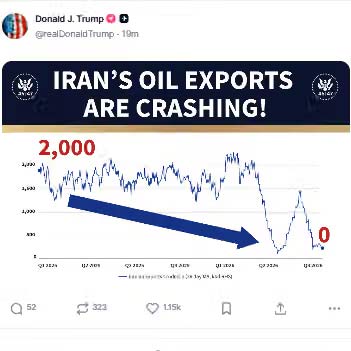
Trump highlights falling Iran oil exports, rebound in Hormuz flows
US President Donald Trump posted graphics on Truth Social on Sunday highlighting falling Iranian oil exports and recovering oil flows through the Strait of Hormuz.
One graphic declared “IRAN’S OIL EXPORTS ARE CRASHING!” and showed exports falling toward zero.
Another said “Hormuz Oil Volumes are BACK!” and contrasted pre-conflict flows of about 20 million barrels per day with current flows of about 18 million barrels per day.
Netanyahu says 'end of Iranian regime is near'
Israeli Prime Minister Benjamin Netanyahu said on Sunday that “the end of the Iranian regime is near,” adding that its fall would “change the fate of the Middle East and the Jewish people.”
“Together with the United States, we accomplished tremendous achievements in removing an existential threat from above us. We have removed atomic bombs and ballistic missiles from above us and have hit the Iranian axis with great force,” Netanyahu said.
“We are determined to defend ourselves; we are determined to strike our enemies,” he said, adding that Iran and Israel’s other adversaries could “make a mistake” and “suffer a blow they don’t even imagine.”
US rejects Iran's claim of attack on Sea Drone
The United States military has rejected Iran’s claim that its forces struck an unmanned US military vessel in the disputed Strait of Hormuz, describing the report as false.
Iranian state media had earlier reported that its forces targeted a sea drone attempting to enter what Tehran described as a “restricted” area in the strategic waterway.
US Central Command spokesperson Captain Tim Hawkins dismissed the claim, saying the report originated from Iranian state media and was “a total lie.”
The denial came after the US military said it had targeted Iranian oil tankers in response to Iran’s reported launch of ballistic missiles toward US Navy warships.
Israel cuts fuel tax as US-Iran conflict pushes up gasoline prices
Israeli Finance Minister Bezalel Smotrich has signed an order to cut the country’s fuel excise tax for the next two months, citing a spike in gasoline costs due to the US conflict with Iran, Reuters reports.
On September 1, petrol prices rose by 0.16 shekel a litre to 8.25 shekels ($2.74) a litre, matching an all-time high and raising the public’s ire. At $10.41 a gallon, gasoline in Israel is among the highest in the world.
Some 44pc of the price is Israel’s “blu” tax, or its fuel excise tax, which was 3.66 shekels a litre at the start of the month. Another 15pc of the cost is value-added tax, and 33pc is the price of oil globally.
Iran Condemns US Attack on Tanker in Gulf of Oman
Iran’s permanent mission to the Organisation of Islamic Cooperation (OIC) has condemned a US attack on an Iranian commercial oil tanker in the Gulf of Oman, according to Iranian news agency ISNA.
In a post on X responding to a statement by US Central Command (CENTCOM), the Iranian mission criticised Washington’s description of the operation as “precision and professionalism.”
“You call it precision and professionalism, while failing to realise that a cowardly attack on a commercial oil tanker is hardly something to boast about or glorify,” the mission said.
Lebanon president urges US to help stop Israeli attacks after 'dangerous escalation'
Lebanese President Joseph Aoun has urged Washington and the international community to help stop Israeli attacks after strikes killed at least four people despite a truce and an Israel-Lebanon deal, AFP reports.
The strikes, which also damaged government premises and destroyed an out-of-service hospital, were “a dangerous escalation… reaching Lebanese state institutions” and health facilities, Aoun said in a statement, calling on the US and other countries “to urgently act to stop these violations”.
Iran sets up 'economic war headquarters' amid US conflict and sanctions
Iran’s Ministry of Economy has established an “economic war headquarters” to coordinate and accelerate measures to address economic challenges arising from wartime conditions, Deputy Economy Minister Morteza Zamanian said Sunday.
Zamanian said the new body would initially focus on issues within the ministry’s authority, with the aim of swiftly resolving problems affecting businesses, trade, financing and other sectors of the economy.
The headquarters will centrally identify disruptions caused by the conflict and develop practical solutions, while coordinating with other government institutions on issues that fall beyond the ministry’s jurisdiction.
Zamanian said the mechanism was also intended to prevent economic issues requiring inter-agency cooperation from being delayed by bureaucratic procedures.
US economic pressure won't force Iran to change policies, says Finance Minister
Iranian Finance Minister Ali Madani-Zadeh has rejected the idea that US economic pressure can force Tehran to change its governance policies, calling such an approach a “mistake,” Al Jazeera reported.
Madani-Zadeh said responsibility for reforming Iran’s economy rests with the Iranian government and people, rather than the US Treasury Department.
He argued that years of Western sanctions had pushed millions of Iranian workers to develop alternative ways to sustain their livelihoods.
Despite the sanctions, imports, exports and domestic production continue, the minister said.
Iran’s economy is managed to serve the lives and welfare of its people and cannot be dictated by the United States, Madani-Zadeh was quoted as saying.
Any aggression against Iran to be met with 'faster, heavier, and more painful' response, warns Ghalibaf
Iranian parliament speaker Mohammad Bagher Ghalibaf has warned that any aggression against Iran will receive a “faster, heavier, and more painful” response, ISNA reports.
“The Americans have certainly realised that the era of ‘proportionate responses’ has come to an end,” Ghalibaf was quoted as saying by ISNA.
???????: ??????????? ????? ?????????? ?? ????? «???????? ??????» ?? ????? ????? ???? ?????? ?????? ?? ????? ? ????? ?????? ????? «???????????????? ? ?????????» ?????? ????? ???
— ???????? ????? (@isna_farsi) September 6, 2026
Four killed, 20 injured in Israeli strikes in southern Lebanon
Four people, including two women, were killed and 20 others injured in Israeli strikes in southern Lebanon on Sunday, Lebanon's Health Ministry said.
Israeli air strikes level hospital in southern Lebanon
Israeli air strikes have destroyed Ghandour Hospital in Nabatieh al-Fawqa in southern Lebanon, Al Jazeera says citing local media reports.
No staff or patients were inside the hospital when it was struck, the reports said, with images and videos shared online showing a vast amount of rubble and no structure left standing.
The strikes follow threats from the Israeli army that it would respond to an alleged drone attack by Hezbollah in southern Lebanon.
US aircraft carrier departs Thailand after port call
Thousands of US sailors aboard an aircraft carrier departed from Thailand on Sunday, AFP journalists said, concluding its first port call following reports of deteriorating living conditions on board after nine months at sea.
The 5,000-strong crew of the USS Abraham Lincoln docked just north of the resort town of Pattaya, near Bangkok, on Wednesday for five days of rest and recreation after a lengthy Middle East deployment.
The Lincoln departed from the port of Laem Chabang, a half-hour drive from Pattaya, at around 11:00 am (0400 GMT), AFP journalists saw.
Iran's Araghchi holds calls with Saudi, Turkish counterparts
Iranian Foreign Minister Abbas Araghchi held separate phone calls with his Saudi and Turkish counterparts to discuss regional developments and diplomatic efforts.
The discussions focused on the latest situation in the region and efforts to pursue diplomatic solutions to ongoing tensions.
Israel army claims striking southern Lebanon, urges evacuation
The Israeli military claims it is carrying out strikes in southern Lebanon after Hezbollah launched drones at its soldiers, and urges residents of the town of Arab Salim to evacuate, AFP reports.
“Terrorists from the Hezbollah terrorist organisation launched two drones towards IDF soldiers operating in the Security Zone in southern Lebanon… In response, the IDF is now striking in southern Lebanon,” the military claimed in a statement, adding that there were no reports of Israeli soldiers wounded.
Yemeni forces say they struck Iran-backed Houthi camp
Yemen’s government forces said they carried out retaliatory attacks on an Iran-backed Houthi camp in al-Jawf province, Al Jazeera reported, citing a military spokesman.
Col. Majeed Al-Nuzayli said the forces used “advanced capabilities recently introduced into service” in the attack on Al-Labnat camp.
“We destroyed the Houthi militia’s capabilities and elements in the Al-Labnat Camp,” Al-Nuzayli said, according to the report.
He said the operation came in response to what he described as continued “escalation and violations” by the Iran-backed Houthis.
IRGC says it fired ballistic missiles at US carrier, destroyer
Iran’s Revolutionary Guards said it fired several ballistic missiles at a US aircraft carrier and a Navy destroyer that it accused of interfering with Iranian vessels and taking part in a maritime blockade, according to a statement carried by state media on Saturday.
The IRGC said the two warships were damaged and forced to leave the area because of the risk of further strikes.
There was no immediate confirmation from the United States or regional authorities of the attacks described by the Guards.
“If the United States continues its hostile and aggressive actions, it should expect a severe response from the armed forces of the Islamic Republic of Iran,” the IRGC said.
CENTCOM releases video of Iranian tanker Kylo sinking
US Central Command released video Saturday showing the Iranian oil tanker M/T Kylo on fire, heavily listing and sinking in the Gulf of Oman after US attacks a day earlier.
“Thanks to the precision and professionalism of American service members, the M/T Kylo sank in the Gulf of Oman today and joined Iran’s navy at the bottom of the sea,” CENTCOM said in a post on X.
The Kylo was one of three Iranian oil tankers targeted by US forces after the Revolutionary Guards fired ballistic missiles toward a US aircraft carrier and guided-missile destroyer, according to CENTCOM.
Netanyahu says Israel must finish remaining 'work' on Iran
Israeli Prime Minister Benjamin Netanyahu said Israel had completed “80-90% of the work” related to the threat from Iran’s nuclear program and said the remaining work needed to be completed, according to an interview with i24NEWS.
“The existence of the state was under threat from atomic bombs from Iran,” Netanyahu said. “We have done 80-90% of the work. We need to complete what remains.”
US intelligence assesses Iran may expand attacks across region
US intelligence assesses that Iran is considering expanding its attacks in the near future, including strikes on American and Israeli targets, i24NEWS reported, citing sources familiar with the matter.
According to the report, Tehran is still weighing whether to strike Israel because Iranian decision-makers expect any Israeli response to be unrestrained.
The assessment also says Israel’s election campaign is a factor in Tehran’s calculations. Iranian decision-makers are considering whether an intense war with Israel could strengthen the right-wing bloc or, in an extreme scenario, lead to the postponement of the elections.
Sanders calls for end to Iran war as US gas prices rise
Sen Bernie Sanders called Saturday for an end to the war in Iran, arguing that the conflict was driving up gasoline prices and hurting the US economy.
In a post on X, Sanders said President Donald Trump’s “illegal and disastrous war in Iran” had resulted in “thousands of casualties” and was “wreaking havoc on the economy.”
He said the national average gasoline price had reached $4.15 a gallon over Labor Day weekend.
“We must end this war NOW,” Sanders wrote.
US gas prices hit record high for Labor Day as Iran war drives energy costs
Americans are facing record-high gasoline prices for Labor Day weekend as renewed US-Iran fighting pushes up energy costs, Reuters reported Saturday.
The national average gasoline price is expected to reach $4.03 a gallon on Labor Day, above the previous record of $3.83 set in 2012, according to GasBuddy analyst Patrick De Haan. The average stood at about $4.13 on Thursday, nearly $1 higher than a year earlier.
Crude oil climbed back above $90 a barrel this week after renewed military action between the United States and Iran revived concerns about disruptions to global oil supplies.
Analysts said concerns over energy shipments through the Strait of Hormuz have lifted crude prices and refining margins, while US refinery utilization is already at 98%, leaving limited room to boost fuel supplies.
Diesel prices also hit a record this week, while air travelers over the Labor Day holiday are expected to pay 20% more for tickets than a year earlier, Reuters reported.
Egypt, Oman call for safeguarding navigation through Strait of Hormuz
Egyptian Foreign Minister Badr Abdelatty and his Omani counterpart, Badr Albusaidi, discussed developments in the Strait of Hormuz and their impact on regional security and the global economy.
Egypt’s Foreign Ministry said Saturday the two ministers called for safeguarding maritime navigation and ensuring the continued flow of trade and energy supplies through the waterway.
Abdelatty also called for an end to the current escalation and urged the United States and Iran to return to negotiations under the Islamabad memorandum of understanding, describing diplomacy as the best path to address the causes of the crisis.
The ministers exchanged views on efforts to restore calm and stability in the region, according to the ministry.
IRGC says it targeted six vessels after US attack on Iranian tankers
Iran’s Revolutionary Guards Navy said Saturday it targeted three tankers in what it called an “unauthorized” route through the Strait of Hormuz and three US-linked vessels elsewhere in response to a US attack on three Iranian tankers.
In a statement carried by state media, the IRGC Navy said the US military attacked three Iranian tankers on Saturday morning, causing damage. It gave no details on the extent of the damage or the condition of the crews.
11 killed, 7 injured in fuel tanker blast in western Iran
At least 11 people were killed and seven others injured after a fuel tanker crashed, exploded and caught fire on the Sanandaj-Hamadan road in western Iran, the governor of Sanandaj said Saturday.
The tanker was traveling from Hamadan toward Marivan when a technical failure in its braking system caused the accident, according to the governor.
He said firefighters had brought the blaze under control, adding that the casualty figures were based on initial reports.
Iran's rial sinks to record low as dollar breaks 2.27 million
Iran’s currency fell to a new record low on Saturday, with the US dollar rising above 2.27 million rials on the open market, marking the weakest level ever recorded for the currency.
IRGC says it targeted 2 to 5 vessels a day in Strait of Hormuz
Iran’s Revolutionary Guards Navy targeted between two and five vessels a day in the Strait of Hormuz over a 10-day period, a senior IRGC Navy official said Saturday.
“In the 10 days leading up to Aug. 30, every night the IRGC Navy punished and penalized between two and five violating vessels,” Ali Mohammadi, the force’s deputy for political affairs, said, according to the IRGC-affiliated Fars news agency.
He added that after that period, the IRGC Navy had continued to take action against vessels it considered in violation whenever it chose.
Mohammadi said US attacks had not caused “the slightest disruption” to the IRGC Navy’s surveillance or its ability to impose its will over the area.
Iran's central military command warns of intensified strikes on US warships: military spox
A spokesperson for the Iranian military’s Khatam al-Anbiya Central Headquarters has warned that if the US continues its naval blockade and “harassment of Iranian ships”, then Iran will carry out more severe and potentially expanded strikes targeting American military vessels, Al Jazeera reports citing a statement.
The statement, carried by Iranian broadcaster IRIB, comes after the US claimed to have hit three Iranian oil tankers.
— ???????? ???? (@FarsNews_Agency) September 5, 2026
????? ??????? ??????????? ?? ??????: ????? ???? ?????? ????? ???
?????? ??????? ????? ???????????: ?? ???? ????? ????? ? ?????? ???? ??????? ?????? ? ?????? ??????? ?????? ?????? ????? ????? ???? ???????? ????? ?????? ?? ????? ?????? ????? ? ????? ????? ????? ???? ????.
US embassy in Bahrain urges citizens to 'exercise heightened vigilance'
A security alert issued by the US embassy in Bahrain has urged American nationals in country and throughout the region to “exercise heightened vigilance”, Al Jazeera reports.
“The US embassy reminds American citizens that Iran has previously targeted civilian infrastructure in Bahrain, including hotels in Manama,” the alert says, instructing US nationals to prepare for “potential flight cancellations, airspace closures, and travel disruptions”.
Event: Due to tensions in the Middle East, the security environment remains complex with the potential for unforeseen escalation.
— U.S. Embassy Manama (@USEmbassyManama) September 5, 2026
The U.S. Embassy reminds American citizens that Iran has previously targeted civilian infrastructure in Bahrain, including hotels in Manama.… pic.twitter.com/tyMHGSuzob
Fuel tanker explosion after traffic accident kills 10 in Western Iran
Ten people were killed when a fuel tanker exploded on a highway in western Iran as a result of a traffic accident, state media reported on Saturday.
Iran has foiled military plots, ready for economic war: vice president
Iran’s Vice President Mohammad Reza Aref says that the country has overcome challenges to its sovereignty and foiled “military, economic, social and political plots” against it, according to state broadcaster Press TV.
The VP says that Iran has “repeatedly overcome attempts by the ‘system of domination’ led by the United States to bring down the Islamic republic”, the broadcaster reports, adding that he says Tehran’s strategy in recent decades has revolved around using advanced technology “to meet the needs of the country and the peoples of the region”.
He adds that Iran is preparing for “economic war”.
VP: Iran has defeated military plots, is ready for economic warhttps://t.co/zzP4uyIPGD
— Press TV (@PressTV) September 5, 2026
US Centcom confirms strikes on three Iranian oil tankers
US Central Command (Centcom) has confirmed that it “destroyed” three Iranian oil tankers.
In a statement on X, it claims that Iran’s Islamic Revolutionary Guard Corps (IRGC) launched ballistic missiles at two American warships, prompting the attack on the three tankers.
“A US aircraft carrier and guided-missile destroyer successfully evaded multiple unprovoked Iranian attacks. No American personnel were harmed,” Centcom adds.
“Following Iran’s failed attacks, Centcom permanently disabled the IRGC crude oil carriers M/T Downy off the coast of Kharg Island and M/T Stark 1 near Jask. American forces also completely destroyed the unladen crude oil carrier M/T Kylo (also known as the ‘Noxen’) in the Gulf of Oman, striking the vessel in multiple critical locations to render it inoperable after the crew was directed to abandon ship,” the statement reads.
Centcom claims that the tankers were part of a multibillion-dollar “shadow network” funding the IRGC.
“Let the message to the IRGC be clear: If you shoot at two of our ships, we will impose an even higher economic cost — taking out three of yours,” Centcom chief Admiral Brad Cooper is quoted as saying. “We will not hesitate to defend American forces, and if necessary, destroy Iran’s limited and exposed oil fleet.”
— U.S. Central Command (@CENTCOM) September 5, 2026
Iran stands against an enemy with top military technology: senior commander
Deputy Coordinator of the Islamic Republic of Iran Army Rear Admiral Habibollah Sayyari describes modern warfare as a battle of willpower and endurance, adding that the country stands against an enemy possessing the world’s full range of equipment and technology, IRNA reports.
The state news agency adds that the Iranian army has unveiled a comprehensive recruitment, selection and employment system, developed by the Human Resources Department using AI.
According to IRNA, the system, available to all units in the army, allows personnel to identify, recruit and ultimately attract talented candidates, while also providing online testing capabilities.
Sayyari says, “The most important capital of any organisation is its human resources, because people with qualitative characteristics can contribute to the growth of organisations.”
He adds that human resources are also the most important element in strengthening the Army’s combat capabilities.
“Pure and faithful human resources can take us to our destination,” he says.
Iran stands against an enemy with top military technology: Senior commanderhttps://t.co/mFDQc9UbWT pic.twitter.com/SUphfk8r8t
— IRNA News Agency (@IrnaEnglish) September 5, 2026
IRGC denies attack on nuclear facility in Isfahan: Iranian media
The Islamic Revolutionary Guard Corps’ (IRGC) Imam Sahib al-Zaman Corps has denied any attack on nuclear centres and facilities in Iran’s Isfahan province, according to state news agency IRNA.
“Following the circulation of false reports and claims on social media and online platforms alleging that the American-Zionist enemy had attacked nuclear centres and facilities in Isfahan Province, we inform the honourable and vigilant people of the province that this report is completely false,” the Corps says in a statement.
“No attack by the Zionist regime (Israel) or the United States on Isfahan’s nuclear facilities, as claimed in the report, has taken place.”
The IRGC adds that spreading misinformation in sensitive circumstances “is an example of efforts by hostile elements to create tension, alarm public opinion, and disrupt the psychological calm of the people”.
????: ??? ?????? ?? ????? ? #???????_?????? ?????? ????? ???? ???#???? ??????????(??) ????? ?????? ?? ???????? ?????? ???? ?? ????? ? ??????? #?????? ??? ????? ?? ????? ???.https://t.co/JdOMXVQeca pic.twitter.com/VvPABcB3SU
— ???????? ?????? ?????? - ????? (@IRNA_1313) September 5, 2026
Iran needs internal reform to withstand US pressure, says Tehran mayor
Tehran Mayor Alireza Zakani said Iran’s future depends not only on resisting US pressure but also on addressing serious domestic failures, warning that the country could otherwise “erode from within,” Al Jazeera reports.
Zakani, a prominent conservative figure, said there were three competing approaches inside Iran: making concessions to reach an understanding with Washington, resisting without adequately addressing the requirements of that resistance, or combining resistance with domestic reform.
“Resistance does not mean that we should ignore internal problems,” he said, according to IRGC-affiliated Tasnim. “Alongside standing against the enemy, we must reform the country from within and move toward building strength.”
Iraqis queue for fuel as regional war disrupts imports
Drivers have formed long lines outside fuel stations in Baghdad as gasoline supplies dropped in oil-rich Iraq due to import disruptions caused by the Middle East war, AFP reports.
Despite being Opec’s second-largest oil producer, Iraq imports oil derivatives because its refineries do not produce enough gasoline to meet domestic demand.
In recent weeks, as regional hostilities drag on, long queues have been reappearing every few days, mostly outside government-run fuel stations in Baghdad and other provinces.
Baghdad resident Ibrahim Hashem waited for two hours outside a fuel station on Friday without any luck, only to return early the next day hoping to fill his car.
The oil ministry said yesterday that “regional events and the ongoing conflict are causing logistical challenges to tanker traffic, delaying their arrival at Iraqi ports”.
Iranian tanker hit by US attack near Iran's Kharg Island
An Iranian tanker was hit by US forces on Saturday near Iran's key oil export hub, Kharg Island, in the Gulf, the semi-official Iranian news agency Tasnim reported.
According to a Tasnim correspondent from Kharg, the tanker was hit by four US missiles in the area of Kharg Island's anchorage.
Tasnim quoted local sources as saying there were no casualties and the tanker's crew was being evacuated.
There was no immediate official announcement by Iranian authorities and US Central Command did not immediately respond to a request for comment.
Iran judiciary chief says Tehran will 'never surrender' to US
Iran’s judiciary chief Gholam-Hossein Mohseni-Ejei said the Islamic Republic had prevailed over its adversaries in two wars over the past 18 months and would “never surrender to America,”IRNA reports.
“Over the past year and a half, we prevailed over the enemy in both wars, and we will never surrender to America,” Ejei said during a meeting with Indian Supreme Court Chief Justice Sanjiv Khanna in New Delhi on the sidelines of the BRICS summit.
Explosions heard near Iran's Kharg Island in Gulf: Iranian media
Explosions were heard near Iran’s Kharg Island in the Gulf, a key oil terminal, but their origin was unknown, Reuters reports citing Fars news agency.
US sanctions Turkish bank, subsidiaries over Iran links
The US Treasury Department has imposed sanctions on a Turkish bank and its subsidiaries over alleged ties to Iran, as Washington seeks to economically isolate Tehran, Al Jazeera reports.
Top US military officials subjected to polygraph tests over information leaks on weapons stockpiles, CBS reports
Some of the highest-ranking officials in the US military were subjected to polygraph tests as part of a sweeping leak probe after highly sensitive classified details about the nation’s stockpiles of sophisticated weapons were reported in the media, CBS News reported, citing US military officials.
BREAKING: The Trump administration subjected military leaders to polygraphs over leaks about weapons stockpiles, sources say. https://t.co/HpjiGVEmsJ
— CBS News (@CBSNews) September 5, 2026
Trump administration drafting post-war Middle East plan, Axios reports
The Trump administration is drafting a post-war Middle East plan, Axios reports.
It said that while the plan was still in the early stages of drafting, it was intended to guide the US approach in the Middle East after the Iran war ended.
SCOOP: The Trump administration is drafting a post-war Middle East plan
— Axios (@axios) September 4, 2026
While the plan is still in the early stages of drafting, it's intended to guide the U.S. approach in the Middle East after the Iran war ends.https://t.co/8Otdg9C5Ox
Israeli strikes on Lebanon kill three: ministry
Israeli strikes in southern and eastern Lebanon kill at least three people and injured 23, AFP reports, citing the Lebanese health ministry.
The ministry says in a statement that strikes hit five locations in the southern Tyr and Nabatieh regions and the Bekaa region in the east.
It updated an earlier toll given by Lebanese official media which had reported two of the deaths in the south.
The strikes came despite a truce between Israel and Hezbollah.
Lebanon’s state-run National News Agency reports the strike hit near the strategic Ali al-Taher ridge, which the Israeli army said it had captured, though Hezbollah did not confirm losing it.
US approves $5bn sale of bombs to Saudi Arabia
The United States announces the approval of a $5 billion sale of bombs, guidance kits and other equipment to Saudi Arabia, according to AFP.
“The proposed sale will improve Saudi Arabia’s airborne defence capability to counter current and future regional threats, strengthen its homeland defense, and improve interoperability with systems operated by US forces and other Gulf region partners,” the US State Department says in a statement.
The sale will also “support the foreign policy goals and national security objectives of the United States by improving the security of a Major non-Nato Ally,” the department says.
The State Department has notified Congress of the proposed sale of the bombs to Riyadh, which still needs to be approved by US lawmakers.
Israeli strike on Lebanon kills two: state media
An Israeli strike on south Lebanon has killed two people, AFP reports citing Lebanese official media.
Lebanon’s state-run National News Agency (NNA) says the strike hit near the strategic Ali al-Taher ridge, which the Israeli army claims it had captured, though Hezbollah has not confirmed losing it.
Two young men were “targeted while riding a motorcycle” in the city of Nabatieh, NNA says, adding that rescuers transported their bodies to a local hospital.
Trump says pipelines in Middle East rendering Hormuz Strait unnecessary
US President Donald Trump says China has had minimal involvement in Iran and that the construction of pipelines is making the Strait of Hormuz “not very necessary anymore”.
“I said ‘please don’t get involved’ to President Xi … there’s very little invovlement from China,” Trump tells reporters, noting that Beijing gets most of its oil from the Strait of Hormuz, and adding that piplines are being built to transport oil through Syria rather than the waterway.
“A lot of alternatives are being made to the Hormuz Strait … [Iran is] going to end up with a Hormuz Strait that is not very necessary anymore. Pipelines are being built all over the Middle East no so they (oil tanker) don’t have to go through the Hormuz.”
UN nuclear agency members draft resolution reporting Iran to UNSC
The United States, Britain, France and Germany have drafted a resolution for possible consideration by the Board of Governors of the U.N. nuclear watchdog that seeks to refer Iran to the U.N. Security Council for failure to comply with its nuclear nonproliferation obligations, diplomats say.
Under those obligations, which are part of the Nuclear Non-Proliferation Treaty, Iran is legally bound to declare all nuclear material and activities and allow inspectors of the Vienna-based International Atomic Energy Agency to verify that none of it is being diverted from peaceful uses.
The diplomatic move has been under consideration since June 2025 when the IAEA board found Iran officially in noncompliance with its nonproliferation obligations for the first time in 20 years — one day before the U.S. and Israel launched attacks against Iran’s nuclear sites.
Trump says US may hit Iran's Pickaxe Mountain soon
US President ?Donald Trump told reporters on Friday ?that ?the United States ?may hit ?Iran's Pickaxe ?Mountain very soon.
Pickaxe Mountain, located ?near ?Iran's heavily damaged Natanz uranium ?enrichment facility, is a heavily ?fortified ?site ?that hosts ?two deeply ?buried ?tunnel complexes.
Trump slams critics of Iran war on social media
US Donald Trump has slammed the American left and the Democrats in a post on Truth Social, claiming they would “rather have us lose the war in Iran than have President Donald J Trump win the war for America”.
“These are very sick people who suffer from serious TDS, sometimes referred to as Trump Derangement Syndrome,” he adds.

Iran's Ghalibaf calls for need for common security, self-sufficiency
Iranian parliament speaker Mohammad Bagher Ghalibaf has stressed the importance of nations being self-sufficient and developing common security, noting that “China’s emphasis on fostering common security reflects a principle Iran has long championed.
“Regional countries must be taking their future into their own hands, and true stability can only come through a new security architecture that is homegrown. Iran stands ready,” he writes on X.
China’s emphasis on fostering common security reflects a principle Iran has long championed.
— ???????? ??????? | MB Ghalibaf (@mb_ghalibaf) September 4, 2026
Regional countries must be taking their future into their own hands, and true stability can only come through a new security architecture that is homegrown. Iran stands ready.
Iran will foil enemy plans through 'unity, empathy and national cohesion': Pezeshkian
Iranian President Masoud Pezeshkian says that the US and Israel aim to create division within the country “through war, siege, and sanctions”.
“We, by relying on unity, empathy, and national cohesion, will neutralise these plots,” he is quoted as saying by the ISNA news agency.
???????: ?????? ?? ???? ?????? ? ?????? ?? ????? ????? ??????? ???? ? ???? ?? ???? ???? ????? ? ?? ??? ?? ???? ?? ????? ????? ? ?????? ???? ??? ?????? ?? ???? ?????? ??? pic.twitter.com/GLB48ZfQFA
— ???????? ????? (@isna_farsi) September 4, 2026
US issues new Iran-related sanctions, general licence
The United States imposed fresh Iran-related sanctions and a new general licence on Friday, according to a posting on the Treasury Department's website.
US, allies want IAEA board to report Iran to UN Security Council, say diplomats say
The United States and its allies Britain, France and Germany are pushing the UN nuclear watchdog's board to pass a resolution next week reporting Iran to the UN Security Council for breaching its non-proliferation obligations, diplomats said on Friday.
The resolution, if passed, would follow up on one adopted on June 12, 2025 — the day before Israel started bombing Iranian nuclear sites, soon joined by the United States — declaring Iran in breach of those obligations for not fully cooperating with an investigation into uranium traces found at undeclared sites.
US military turns off ad trackers on devices amid Middle East targeting reports
US military officials say they have disabled advertising trackers on a range of phones and computers, according to letters released by US Senator Ron Wyden and statements given to Reuters, a development that follows reports that commercially available location data had been used to target American forces in the Middle East.
Israel claims seizing southern Lebanon's Ali al-Taher ridge
Israel claims to have seized southern Lebanon’s Ali al-Taher ridge, which is reportedly a strategic position for Hezbollah, AFP reports.
Hezbollah has not confirmed losing the highland, which is around 10 kilometres from the border with Israel and has been targeted by several Israeli strikes in recent weeks despite a ceasefire.
The ridge lies close to the major city of Nabatieh and the Litani River. It is just a few kilometres from Unesco-listed Beaufort Castle, another strategic site that Israel captured in recent months.
Iran claims its air defences shot down 370 enemy aircraft
Iranian military officials claim the country's air defence systems have shot down or targeted more than 370 enemy aircraft and drones during the ongoing war, state media reported.
Iran's IRNA news agency, citing Brigadier General Mohammad Sadeghian, deputy coordinator of the Army's Air Defence Force, reported that the military had strengthened its capabilities by drawing on lessons from the 12-day war last summer.
Sadeghian said Iran's domestically developed air defence systems had been used to target more than 370 enemy aircraft during the conflict.
"Enemy planes and drones were shot down," Sadeghian was quoted as saying, adding that the reported losses were unexpected because the enemy had believed it had destroyed Iran's defence radars through a massive attack on the first day of the war.
The claims were reported by Iranian state media and could not be independently verified.
#??????_????? ???? ??? ?????? ???? ?? ???? ???https://t.co/ipRQYdHirx pic.twitter.com/OYIaYRSCQf
— ???????? ?????? ?????? - ????? (@IRNA_1313) September 4, 2026
Oil heads for weekly gain as US-Iran fighting resumes
Oil prices are on course to gain more than six per cent for the week as the United States and Iran resume military exchanges in the seventh month of their conflict, Reuters reports.
Brent crude futures are up 6.1pc for the week and US West Texas Intermediate crude futures have gained 8.3pc.
Both contracts nudged lower on the day, however, with Brent down 75 cents or 0.79pc at $94.77 a barrel by 1230 GMT (5:30pm PKT), and WTI down 95 cents, or 1.04pc, at $90.35.
Israel defence minister hails capture of Hezbollah highland in Lebanon
Israel’s defence minister hails the capture of a strategic highland from Hezbollah as solidifying Israel’s “security zone” in Lebanon and vowed that troops would not leave it, AFP reports.
“The capture of the Ali Tahar ridge marks the completion of the phase of securing control in the security z
Number of Iranian military personnel reported killed by US strikes this week rises to 13
Iran's semi-official Tasnim news agency reported on Thursday the deaths of six more military personnel from US strikes this week, bringing the military death toll to at least 13.
The US strikes on Tuesday were the most extensive for weeks. In the latest report on military deaths, Tasnim said six members of the regular military, including three pilots, had been killed in southern Iran. It gave no additional detail on the location.
The strikes also killed four members of the Islamic Revolutionary Guard Corps' (IRGC) Aerospace Force in western Iran, according to a statement by the guards published on Wednesday.
Tasnim has also reported that US strikes on southern Iran on Sunday, which followed a month-long lull in clashes, had killed three people. Two were identified as members of the IRGC Navy by Iran's Nournews outlet.
The US has reported 18 military personnel killed and more than 750 wounded in the war.
Gulf shipping traffic via Hormuz keeps below 10-day average, data shows
Four commodity vessels transited the key waterway of the Strait of Hormuz yesterday, down from nine a day earlier and well below the 10-day average tally of about 15, preliminary shipping data shows, according to Reuters.
Two medium-range tankers, a Kamsarmax carrier and a Handysize vessel made up the figure, Kpler data showed by 4:55am GMT (9:55am PKT) on Friday.
The figure excludes vessels that might have crossed the strait with their Automatic Identification System transponders turned off to avoid detection.
So far this week, Kpler data showed only two very large crude carriers crossed the strait.
EU joins US economic pressure campaign against Iran: Bessent
The European Union has officially joined the US’s economic pressure campaign, “Operation Economic Outcast”, against Iran, US Treasury Secretary Scott Bessent said.
In a post on X, Bessent wrote “The United States stands firm with our allies in ensuring the murderous Iranian regime cannot exploit the global financial system to fund its nuclear ambitions, weapons programs, and terror proxies.”
“The world is sending a clear message to the Iranian regime: We will not stop until every remaining financial lifeline has been severed,” he added.
The European Union has officially joined Operation Economic Outcast and we appreciate their strong and early stance. The United States stands firm with our allies in ensuring the murderous Iranian regime cannot exploit the global financial system to fund its nuclear ambitions,…
— Treasury Secretary Scott Bessent (@SecScottBessent) September 3, 2026
Cathay Pacific cancels flights to Dubai, Riyadh until Dec 1
Hong Kong flag carrier Cathay Pacific says it has cancelled all flights to Dubai and Riyadh until Dec 1 due to the “latest developments” in the Middle East, Anadolu reports.
? Hong Kong flag carrier Cathay Pacific says it has cancelled all flights to Dubai and Riyadh until Dec. 1 due to the ‘latest developments’ in the Middle East
— Anadolu English (@anadoluagency) September 4, 2026
Cathay Pacific notes that affected travelers are offered the flexibility to rebook, reroute or refund their tickets… pic.twitter.com/iTKDuvlcgQ
Seoul weighs 'contributions' to Hormuz security: president's office
South Korea said that Seoul could contribute to the US security efforts in the Strait of Hormuz as long as its own military readiness is not compromised, AFP reports.
“Contributions to the Strait of Hormuz could be managed within limits that do not compromise military readiness,” a presidential official said, adding a review is still under way
Oil set for steepest weekly gain since mid-July over intensifying US-Iran tensions
Oil prices rise and are on track for the steepest weekly gain since mid-July as rising tensions and renewed US-Iran hostilities heightened concerns over Middle East supply risks, according to Reuters.
Brent crude futures LCOc1 rise 15 cents, or 0.2 per cent, to $95.67 a barrel at 0100 GMT, while U.S. West Texas Intermediate crude futures CLc1 were up 26 cents, or 0.3pc, at $91.56.
On a weekly basis, Brent rose 7.1pc and WTI was 9.8pc higher, set for the highest gains since the week ended July 20.
South Korea prepares Hormuz military deployment, media reports say
South Korea is preparing to deploy military assets to support freedom of navigation in the Strait of Hormuz and aims to dispatch them before the end of the year, media reports, citing government and military sources, according to Reuters.
The reports in several South Korean media outlets say the government is preparing procedures to seek parliamentary approval for the deployment, including submitting a consent motion to parliament this month after cabinet review.
The government is considering options including sending a maritime patrol aircraft, a logistics support vessel or a mine detection and clearance unit, and has been discussing the scale and nature of a potential contribution with countries including the United States, Britain and France, the reports say.
South Korea’s presidential Blue House says Seoul had been discussing practical ways to contribute to freedom of navigation in the strait, but reports that the government had settled on a deployment were “different from the facts”.
Houthis say drones targeted Saudi positions
Yemen’s Iran-aligned Houthis said Thursday that “Rujum” drones targeted Saudi military positions, vehicles and troop concentrations on several fronts, the group-run SABA news agency reported.
The Houthis said several Saudi military vehicles were set on fire or destroyed, and that barracks and troop concentrations were also targeted, according to the report.
Netanyahu says toppling Iran's govt 'within reach'
Israeli Prime Minister Benjamin Netanyahu on Thursday said Iran’s government was weaker than ever and fighting for its survival, expressing confidence that toppling it was “within reach” as the United States resumed attacks.
Netanyahu said Iran’s government was “currently teetering” and described its overthrow as the central task still ahead.
“I am convinced that we can remove this threat once and for all — that is, to overthrow this government. That is the central task that still lies ahead of us, but it is close. It is not impossible. It is within reach,” he said.
Netanyahu also said Iran had attacked others in the region but had not targeted Israel, arguing that Tehran was aware of Israel’s military strength and determination.
“They know our power — the strength of our arms — and our determination,” he said.
Oman rejects Iran's Hormuz fee proposal despite IRGC claim: report
Oman has rejected Iran’s proposal to jointly charge service fees on commercial ships using the Strait of Hormuz, the New York Post reported Thursday, citing a high-ranking regional official.
The official told the Post that Muscat declined to consent to fees for environmental and security services, even on a voluntary basis. A US official separately told the newspaper last week that the terms of a proposed revenue-sharing arrangement had not been finalized.
The report contradicts an earlier claim by IRGC spokesman Hossein Mohebbi that Iran and Oman had reached agreements over their respective shares of the strait’s waters and revenues after Foreign Minister Abbas Araghchi met his Omani counterpart Badr Albusaidi in Tehran.
Bessent welcomes EU joining US-led Operation Economic Outcast
Treasury Secretary Scott Bessent welcomed the European Union’s decision to join the US-led Operation Economic Outcast against Iran on Thursday, praising its “strong and early stance.”
“The European Union has officially joined Operation Economic Outcast,” Bessent wrote in a post on X.
Bessent also shared an EU statement issued in the context of the G20 finance ministers and central bank governors meetings, in which the bloc welcomed additional economic pressure on Iran, including through the US-led operation.
'I wouldn't call it a war': Vance on Iran
US Vice President JD Vance has refused to call operations in Iran a “war”, when asked about the timeline of the conflict.
“I wouldn’t call it a war. Right now, there is no active shooting. I recognise there have been places where this has flared up,” he responds. “Major combat operations lasted for about six weeks.”
US has 'tools at our disposal' to deal with Iran: Vance
Asked if the US is aiming to provide support for an uprising in Iran, Vice President JD Vance says that Washington is doing “a lot of things” to apply pressure to Tehran.
“We’re protecting a lot of ships, which is why we have not had a worldwide energy crisis,” he tells reporters, adding that everything the US can do is “on the table”.
“That said, there are a lot of, of course, additional tools at our disposal; some of those the president will use and some of them he won’t, but I’m not going to advertise exactly how we’re going to engage with the Iranians in the months and years to come, because it frankly would take away the president’s decision space.”
Vance says US not talking to Iran unless they stop shooting at ships
US Vice President JD Vance tells reporters that Washington does not plan to hold talks with Tehran unless Iran stops attacking commercial shipping in the Strait of Hormuz, Reuters reports.
“They’ve got to stop. It’s that simple,” he says.
Vance reiterates that US 'never targets civilians'
Asked about a US strike on a wedding ceremony in southern Iran, Vice President JD Vance says he has been briefed to the extent that he knows the incident is under investigation.
“I will say that the Iranian state media has not been a very good scribe in the conflict thus far,” he tells reporters in the White House, expressing scepticism.
“What I can say with 100 per cent confidence is that unlike the IRGC, the United States never targets civilians in combat. We never will do that; we never have done that,” Vance emphasises. “Unfortunately, obviously, sometimes things happen, but in this particular case I don’t think that we have information one way or the other.”
Vance says that the investigation is ongoing “because we care [and] we want to know”.
“This is the big difference between us and Iran: when our military makes mistakes, we learn from them so we can get better from them,” he adds.
Jordan, Bahrain kings call for halt to Iran-US escalation
Jordan’s King Abdullah II and Bahrain’s King Hamad bin Isa Al Khalifa discussed regional developments amid hostilities between Iran and the US, which resumed this week, during a phone call Thursday.
The two leaders called for an end to the “dangerous escalation” in the region, according to a statement by Jordan’s Royal Hashemite Court.
They also discussed strengthening cooperation and coordination in support
Iran oil minister says industry continues to bypass US blockade
Iranian Oil Minister Mohsen Paknejad said in an interview with semi-official ISNA that the country’s oil industry continues to circumvent the blockade imposed by US forces.
“We had restrictions on transferring oil beyond the blockade line. In some cases we managed to get through, and in some cases that was not possible,” Paknejad said.
He said Tehran had adopted measures to get around the blockade and had been able to sell and deliver oil to customers “perhaps thousands of kilometers” from the Persian Gulf and Gulf of Oman.
“After the 12-day war, we were able to increase oil production by about 70,000 barrels per day,” Paknejad added.