Updated on
Summary
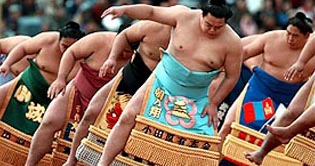
Sumo grand champion Asashoryu, also known as the bad boy sumo top dog, performed a sacred, traditional New Year's rite at a Shinto shrine in Tokyo on Wednesday, stamping powerfully before thousands of sumo fans and visitors.Wearing only a white loin cloth in the depth of winter, the 29-year-old Asashoryu, who holds the highest rank of yokozuna, offered the sacred rites along with another Mongolian yokozuna and his archrival, Hakuho, at the Meiji Jingu shrine in central Tokyo. For many of the people crowded at the shrine, seeing a yokozuna up-close was a rare experience.Coming here and watching them up close made me want to respect sumo more and go watch their actual bouts, said 22-year old Mirai Ozawa, a college student. Another spectator, 22-year-old Yuri Matsumoto, said: I'm impressed that foreign-born sumo wrestlers are helping promote Japan's traditional sport. But Asashoryu's short temper and breaches of protocol have often landed him in trouble.I understand that Asashoryu is helping regain sumo's popularity, but to me, he looks a little too childish, said Tomiko Taguchi, a 63-year-old housewife. Over the past few years, Mongolian-born Asashoryu has been repeatedly criticised and reprimanded for his alleged 'laziness' and 'improper behaviours'. Last year, Asashoryu was in hot water after skipping training because he did not want to risk catching the H1N1 flu on a bus. The Mongolian yokozuna was also criticised for skipping morning training ahead of a recent major tournament amid the break-up of his marriage. The 24-times Emperor's Cup winner insisted an elbow injury made it hard for him to practice on the current provincial sumo tour of Japan. In 2007, Asashoryu was banned from participating in bouts for playing soccer while he was supposed to be out of action with a back injury.That outraged fans of a sport where ritual and respect for tradition is almost as important as who wins the brief bouts between the nearly naked giants in the sumo ring. His suspension triggered a bout of clinical depression, leading Asashoryu to seek solace at a luxury spa resort in his native country.The 150 kg (330 lb) wrestler is the 68th grand champion of Japan's ancient sport, which some historians say dates back 2,000 years. Asashoryu, whose real name is Dolgorsuren Dagvadorj, was promoted to sumo's highest rank of yokozuna in 2003.Sumo has religious roots that remain strong even if its grand champions are no longer Japanese. Professional sumo now has nearly 60 foreign-born wrestlers, like Asashoryu, from more than a dozen countries ranging from Bulgaria to Brazil.Sumo has not had a Japanese yokozuna since 2003.