Updated on
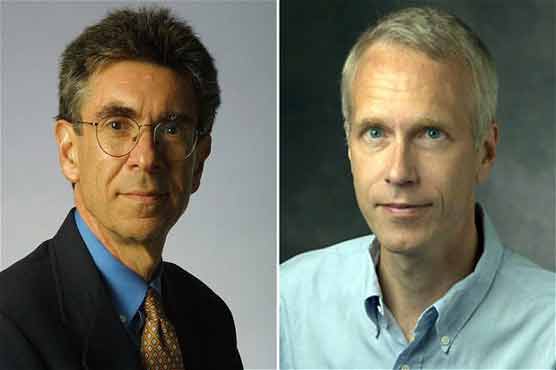
Summary Robert Lefkowitz and Brian Kobilka of the US won the Nobel Prize for Chemistry on Wednesday.
The pair won the prize for identifying a class of cell receptor, yielding vital insights into how the body works at the molecular level.The big beneficiary of this fundamental work is medicine, the Nobel committee declared.The pair were honoured for discovering a key component of cells called G-protein-coupled receptors and mapping how they work.The receptors stud the surface of cells, sensitising them to light, flavour, smells and body chemicals such as adrenaline and enabling cells to communicate with each other.About a thousand of these kinds of receptor are known to exist throughout the body. They are essential not just for physiological processes but also for response to drugs.About half of all medications achieve their effect through G-protein-coupled receptors, the Nobel jury said.Understanding the receptors provides the tools for better drugs with fewer side effects, Nobel committee member Sven Lidin said.Lefkowitz, 69, is a professor of biomedicine and biochemistry at Duke University in North Carolina, while Kobilka, born in 1955, is a professor of molecular and cellular physiology at Stanford University School of Medicine in California.In a teleconference with Swedish journalists, Lefkowitz admitted he had not heard the phone ring with the famous piece of news.Kobilka told Swedish news agency TT he was also awakened in the middle of the night at his home in California.Asked if he would be able to fall back to sleep, he replied: I dont think so.Kobilka said he had not yet decided what he would do with his half of the eight million Swedish kronor ($1.2 million, 930,000 euros) prize.The grandchild of Polish immigrants to the United States, Lefkowitz grew up as an only child in a two-bedroom apartment in New Yorks Bronx.A voracious reader, he devoured his parents books, medical fiction and detective stories, and decided while still at primary school that he wanted to become a physician.He went to medical school at New Yorks Columbia University, where he finished first in his class.Kobilka was born in Little Falls, a small rural community in central Minnesota, where his grandfather and father were bakers and his mother decorated the cakes.He studied biology and chemistry at the University of Minnesota in Duluth, where he met his future wife, and then went to Yale to study medicine.In 1984, he went to Duke University, where he worked as a post-doctoral researcher under Lefkowitz. Together they put together the first genetic sequence of GPCRs.Mark Sansom, a professor of molecular biophysics at the University of Oxford, said the receptors have for a long time been the holy grail for research.They are fundamental to regulation of many physiological processes, from the nervous system to taste and smell, he told the Science Media Centre in London.They are also a major class of drug target and are incredibly important to the pharmaceutical industry.On Monday, Shinya Yamanaka of Japan and John Gurdon of Britain won the Nobel Medicine Prize for work in cell programming, a frontier that has raised dreams of replacement tissue for people crippled by disease.On Tuesday, the physics prize went to Frances Serge Haroche and David Wineland for research in quantum physics that could one day open the way to supercomputers.The literature prize will be announced on Thursday, followed Friday by perhaps the most-watched award, for peace. The economics prize wraps up the Nobel season on Monday.The laureates will receive their prizes at formal ceremonies in Stockholm and Oslo on December 10, the anniversary of prize founder Alfred Nobels death in 1896.