Updated on
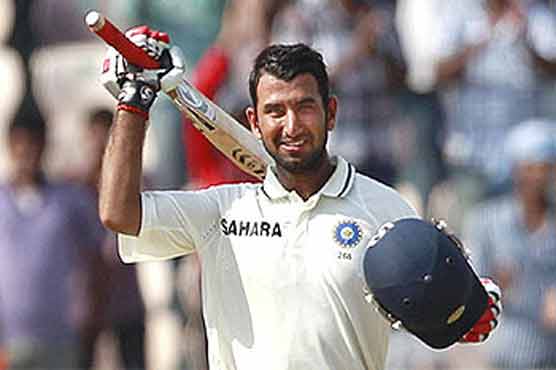
Summary Cheteshwar Pujara acts upon Dravid advice to play his natural game, scores ton against New Zeland.
In his second Test, in 2010 in Durban, Cheteshwar Pujara hastened to play a pull off Lonwabo Tsotsobe even as the ball rushed on to him and kept rising. Mark Boucher caught the top edge and Pujara trudged back, dismissed for 19.Later, when he sat brooding in the dressing room, Rahul Dravid walked up and asked if he normally played such shots. Not really, Pujara said, knowing the ball was not there to be hit, especially since it was outside off stump.[Dravid] told me I should play my natural game rather than playing too many shots, because if you are not good at something, then it is not worth playing that shot, Pujara says. You should play to your strength, which is to hang around and play the shots to a loose ball, and not against a ball that is not there to be hit.Pujara had learned an important lesson. I felt it was not the right place, right time and not even the right format to play such a shot. We were playing on the fast pitches in South Africa, not the slower surfaces in India. I told myself I had to learn to play according to situation. He started to leave the ball more, and that felt natural.At some point this week, Pujara might step into the No. 3 or No. 5 slots now vacant following the retirements of Dravid and VVS Laxman. Virat Kohli will occupy one of the two positions; Pujara will vie with Ajinkya Rahane and S Badrinath for the second. During training on the two days leading up to the first Test against New Zealand in Hyderabad, Pujara batted at No. 3.He wants to make a mark on his return from injury and is unfussy about where he bats. It is a team game, so most of the time you have to see the comfort of the team, not your own.As a batsman I need to be flexible. I am a youngster making a comeback, not someone settled in the batting order. So I should not be demanding. Once I prove myself at a particular position, then I can say I would like to bat at this and this number.Mentally adept and patient, Pujara built his reputation by grinding down opponents in Ranji Trophy cricket for Saurashtra, for whom he bats at No. 4. In his first few years he found himself coming in with the new ball barely having lost its shine, as a weak Saurashtra top order faltered frequently.Although he hasnt had to come to his sides rescue too often in the last two years, Pujara has grown accustomed to the challenges of a top-order batsman.There is not much difference batting at No. 3 or 4, as I found out in my time at Saurashtra, where we used to be two down before ten overs. Pujara is aware of the demands of batting up the order, but he likes it better than the alternative. It is a challenge, but in another way it is good. That is because you are not under pressure when you bat on top.If you are batting lower down, if you are in a good position then it is fine. But if you are 100 for 3 or 4, the bowlers are on top. The pressure is on you to get runs then. But if you are No. 3, you still can play safe and play your natural game, unlike when you are batting at No. 5 or 6, where you are left to bat with the tail.Pujara is the sort of batsman who likes to spend time at the crease, tiring bowlers down and punishing loose deliveries. To him the biggest advantage of batting high up is that he likes to feel bat on ball, which he can do against the new ball.Especially in Indian conditions, the old ball does not come on to the bat on slow surfaces. So if you get in early you can feel the new ball coming nicely on to the bat, and at times you can play strokes.Batting at No. 3 is often nearly the same as being an opener. Having opened and walked in as one-down for Indian Oil Corporation in the Mumbai corporate cricket league, Pujara is confident he has the right skills and mindset.