Summary Fresh collaboration planned across key sectors under national transformation strategy
ISLAMABAD (Dunya News) – Pakistan and Japan have reaffirmed their long-standing development partnership, with both sides expressing commitment to expanding cooperation in infrastructure, digital transformation, human resource development, tourism and sustainable economic growth.
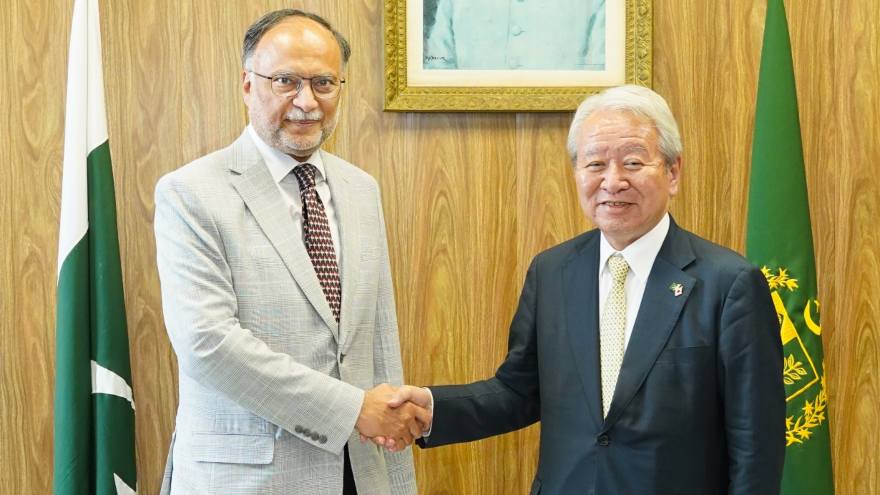
The understanding was reached during a meeting between Japan International Cooperation Agency (JICA) President Dr Tanaka Akihiko and Federal Minister for Planning, Development and Special Initiatives Prof Ahsan Iqbal at the Ministry of Planning in Islamabad.
The discussions centred on aligning future collaboration with Pakistan's URAAN Pakistan initiative and its 5Es Framework, while identifying new opportunities for high-impact projects that could accelerate the country's long-term economic transformation. Both sides also highlighted the importance of maintaining close coordination to ensure faster implementation of development initiatives.
Welcoming the JICA President, Ahsan Iqbal praised Japan's longstanding Official Development Assistance to Pakistan, describing the country as one of Pakistan's most trusted development partners. He acknowledged JICA's contributions across infrastructure, energy, water resources, health, education, agriculture and disaster risk management, saying Japanese support had played a significant role in Pakistan's socio-economic development over several decades.
Economic outlook
Briefing the Japanese delegation on Pakistan's economic progress, the minister said the government had successfully restored macroeconomic stability through prudent financial management and structural reforms implemented under the IMF-supported programme. He noted that Pakistan had overcome significant economic challenges through collective national efforts and had now entered a phase focused on sustainable economic growth.
.jpg)
According to the minister, reforms introduced over the past three years have substantially strengthened public finances, with government revenues doubling during the period. He reaffirmed the government's commitment to maintaining fiscal discipline while pursuing investment-led growth designed to ensure long-term economic stability.
Ahsan Iqbal also outlined the government's broader development vision under URAAN Pakistan, describing the 5Es Framework as the country's medium and long-term roadmap for national transformation. The strategy is built around five priority areas: Exports, E-Pakistan, Environment and Climate Change, Energy and Infrastructure, and Equity and Empowerment.
The minister stressed that export-led growth remains central to Pakistan's economic strategy, arguing that sustainable prosperity depends on strengthening exports rather than relying on consumption-driven growth. He said the government is investing in modern infrastructure and regional connectivity projects to improve Pakistan's export competitiveness and build long-term economic resilience.
Youth & tourism
Highlighting Pakistan's demographic advantage, Ahsan Iqbal said nearly 60 percent of the country's population consists of young people, calling them the nation's greatest asset. He said providing quality education, technical skills, vocational training and dignified employment opportunities for young people remains among the government's highest priorities.
The minister also underscored the importance of women's economic empowerment, describing it as essential for achieving inclusive and sustainable national development.
Among the proposals presented during the meeting was the establishment of a Pakistan-Japan Gandhara Tourism Corridor. Ahsan Iqbal said the initiative could strengthen centuries-old cultural and civilisational ties between the two countries while promoting cultural exchange, religious tourism and greater people-to-people interaction.
He also highlighted Pakistan's recent accession to the Productivity, Quality and Innovation (PQI) initiative, saying it would improve industrial competitiveness and support export-led growth. The minister expressed hope that JICA would provide technical cooperation to help Pakistan implement and expand the initiative in collaboration with the Japan Productivity Center. He further proposed forming a joint working group to identify practical collaborative projects.
Future projects
Speaking during the meeting, JICA President Dr Tanaka Akihiko reaffirmed Japan's commitment to deepening its long-standing development partnership with Pakistan. He welcomed Pakistan's ongoing economic reforms and improving macroeconomic stability, saying they provide a strong foundation for expanding future cooperation.
Dr Tanaka emphasised the need for closer coordination between JICA and the Ministry of Planning to develop projects aligned with the URAAN Pakistan framework. He identified human resource development, infrastructure, disaster risk management, education, small and medium-sized enterprises, digital transformation, tourism, special economic zones, productivity enhancement and the PQI initiative as priority areas for future collaboration.
The JICA President also agreed to establish a dedicated coordination mechanism that will include technical workshops and regular consultations with JICA's Tokyo headquarters. The arrangement aims to identify new collaborative opportunities aligned with the 5Es Framework while accelerating project implementation.
Reaffirming Japan's long-term commitment, Dr Tanaka said JICA is keen to revive the momentum of bilateral cooperation and continue supporting Pakistan's sustainable and inclusive economic development through practical partnerships and high-impact initiatives.