Summary Investors flee bonds and risk assets as Middle East war fuels inflation fears, oil surge, and global stock losses, with markets shifting to cash and defensive positions
(Reuters) - Investors are shifting out of bonds and other assets exposed to inflation as global markets brace for prolonged disruption to energy supplies while war rages in the Middle East.
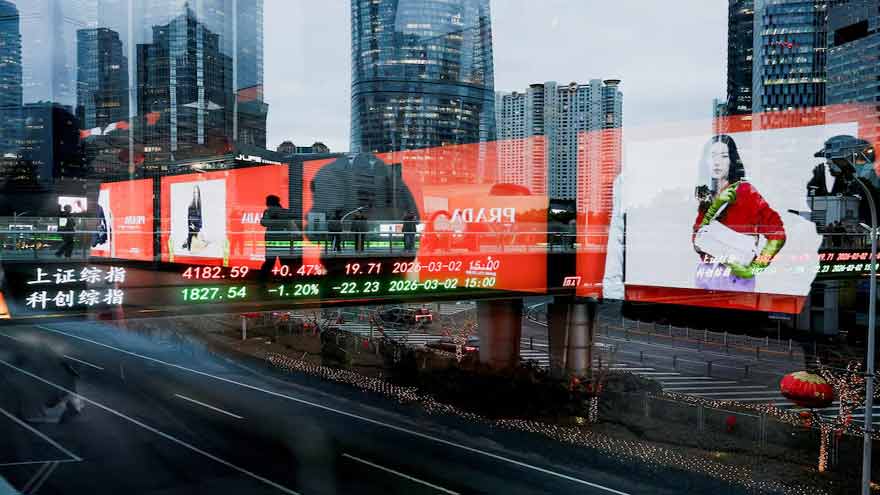
Wall Street indexes fell sharply on Friday and in Asia on Monday, stock markets in Seoul, Shanghai, Tokyo and Sydney suffered losses, dragging MSCI's gauge of global equities to its lowest point since November.
Iran has warned it would strike energy and water infrastructure across the Gulf if U.S. President Donald Trump follows through with his threat to attack its electricity grid.
Here are what investors are saying about the situation:
FRANCIS TAN, CHIEF ASIA STRATEGIST, INDOSUEZ WEALTH MANAGEMENT, SINGAPORE
"This (escalation) is causing investors to realise that we're really not at the end of this whole thing. In fact it looks like it's going to get worse, after Trump's ultimatum plus the two ballistic missiles that Iran showed that it could be wider spread.
"More interesting will be whether the Middle Eastern economies are selling some gold in order to support what they are seeing as much weaker economic growth going forward.
They are also one of the key investors in this AI wave, so ... we may see some of these sovereign wealth funds moving towards cash.
"(Clients) are staying more defensive, taking some profits off the table, locking some of the profits that they have been seeing for the last one year-plus."
KAREN JORRITSMA, HEAD OF AUSTRALIAN EQUITIES, RBC CAPITAL MARKETS, SYDNEY
"There was a huge lack of conviction around valuation on this market rally. And so what we're seeing now is a fairly quick exit to the door. So if you've got no conviction on valuation on the way up, what happens, invariably, is when things get difficult or there's a lack of transparency or poor outcomes, they just exit because they weren't convinced about the prices on the way up. We're definitely seeing the fallout from that.
"Cash balances are going up. We're seeing de-grossing across markets, here, in Asia, the U.S. - across the board. And I think that makes a lot of sense."
AARON COSTELLO, HEAD OF ASIA, CAMBRIDGE ASSOCIATES:
"On Friday, markets broke to new lows and this morning are selling off, because I think the reality is it is going to escalate before it de-escalates ... the longer this goes on, the bigger the risk to the global economy.
"Right now, companies and countries have reserves and stockpiles, but those will eventually be depleted unless this wraps up. So markets are starting to price that."
LORI HEINEL, GLOBAL CHIEF INVESTMENT OFFICER, STATE STREET INVESTMENT MANAGEMENT:
"We haven't seen massive flows out of equities. We've seen a bit of repositioning within equities to more defensive assets like large-cap U.S., where you've got tailwinds to growth.
"We think the combination of the higher interest rates plus a bit of a safe haven mentality amongst investors has led to a little bit more demand for dollar-based assets.
"Before the conflict, we had seen much more repositioning into Asia ... we're not yet seeing that be unwound, but the longer the conflict goes on, the more vulnerability Asia will have because of the dependence on energy."
VASU MENON, MANAGING DIRECTOR OF INVESTMENT STRATEGY, OCBC, SINGAPORE:
"Any strike (on power plants) and a potential Iranian retaliation, such as shutting the Strait of Hormuz indefinitely or targeting U.S. and Israeli energy infrastructure, would escalate tensions sharply and further unsettle markets in the near term.
"Oil prices have already surged more than 80% this year and could climb further if the situation worsens. Financial markets are reacting in advance, with cyclical sectors and companies which are sensitive to higher oil prices coming under pressure.
"Meaningful bargain-hunting will likely require greater stability in the region."
CHARU CHANANA, CHIEF INVESTMENT STRATEGIST, SAXO, SINGAPORE:
"The market is starting to see this as more than just a geopolitical flare-up. Looking at Friday’s bond selloff, with Treasury and European yields jumping as investors repriced inflation and pushed back rate-cut expectations, and the market is beginning to worry about a more durable stagflationary impulse.
"That is a difficult backdrop for both equities and bonds, because it challenges the usual diversification cushion just when investors need it most. It is especially tough for long-duration sectors like tech, where higher yields compress valuations, and for mining, which faces a double whammy of weaker growth expectations hitting demand while tighter financial conditions weigh on cyclical stocks."
MATT SIMPSON, SENIOR MARKET ANALYST, STONEX, BRISBANE:
"Trump's latest deadline has awoken markets from their lull - and served as a timely reminder that things can escalate at the drop of a Truth Social post. Oil is the purest barometer of just how bad things are around the Strait of Hormuz. As nothing has materially changed, neither have oil prices. But what we're seeing today on equities is complacency being punished.
The fact that gold is dropping with stocks suggests it is a move to cash from other markets."