Summary Americans also got more relief at the supermarket last month
WASHINGTON (Reuters) - US consumer prices fell for the first time in more than 2-1/2 years in December as gasoline and motor vehicles prices declined, offering hope that inflation was now on a sustained downward trend, though the labor market remains tight.
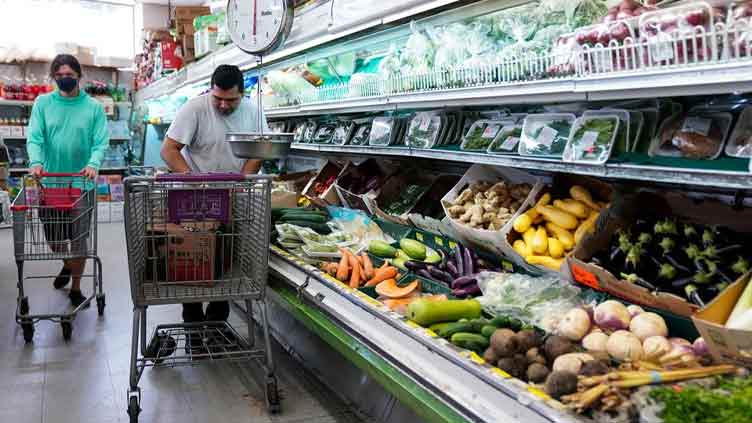
Americans also got more relief at the supermarket last month, with the report from the Labor Department on Thursday showing food prices posting their smallest monthly increase since March 2021. But rents remained very high and utilities were more expensive.
Cooling inflation could allow the Federal Reserve to further scale back the pace of its interest rate increases next month. The U.S. central bank is engaged in its fastest rate hiking cycle since the 1980s. Fed officials welcomed the slowdown, with the Philadelphia Fed s Patrick Harker saying "hikes of 25 basis points will be appropriate going forward," in his view.
"The mountain peak of inflation is behind us but the question is how steep the downhill is," said Sung Won Sohn, finance and economics professor at Loyola Marymount University in Los Angeles. "To be sure, the efforts by the Fed have begun to bear fruit, even though it will be a while before the promised land of a 2% inflation rate is here."
The consumer price index dipped 0.1% last month, the first decline since May 2020, when the economy was reeling from the first wave of COVID-19 cases. The CPI rose 0.1% in November.
Economists polled by Reuters had forecast the CPI unchanged. It was third straight month that the CPI came in below expectations and raised buying power for consumers as well as hopes the economy could avoid a dreaded recession this year.
Excluding food, shelter and energy, prices dropped for a third consecutive month.
"Today s report increases the likelihood of a soft landing," said Sinem Buber, lead economist at ZipRecruiter.
Gasoline prices tumbled 9.4% after dropping 2.0% in November. But the cost of natural gas increased 3.0%, while electricity rose 1.0%.
Food prices climbed 0.3%, the smallest gain in nearly two years, after rising 0.5% in the prior month. The cost of food consumed at home increased 0.2%, also the least since March 2021. Fruit and vegetable prices fell as did those for dairy products, but meat, poultry and fish cost more. Egg prices surged 11.1% because of avian flu.
In the 12 months through December, the CPI increased 6.5%. That was the smallest rise since October 2021 and followed a 7.1% advance in November. The annual CPI peaked at 9.1% in June, which was the biggest increase since November 1981. Inflation remains well above the Fed s 2% target.
President Joe Biden said the disinflationary trend was "giving families some real breathing room," and "proof that my plan is working."
Price pressures are subsiding as higher borrowing costs cool demand, and supply chains ease.
The Fed last year raised its policy rate by 425 basis points from near zero to a 4.25%-4.50% range, the highest since late 2007. In December, it projected at least an additional 75 basis points of hikes in borrowing costs by the end of 2023.
Financial markets have priced in a 25-basis point rate increase at the Fed s Jan. 31-Feb. 1 meeting, according to CME s FedWatch Tool.
Excluding the volatile food and energy components, the CPI climbed 0.3% last month after rising 0.2% in November. In the 12 months through December, the so-called core CPI increased 5.7%. That was the smallest gain since December 2021 and followed a 6.0% advance in November.
Stocks on Wall Street rose. The dollar slipped against a basket of currencies. U.S. Treasury yields fell.