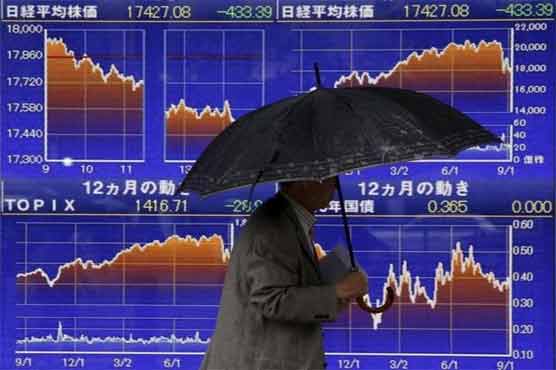
Summary The Asian Development Bank lowered its growth forecast for China to 6.8 percent for 2015.
HONG KONG (Reuters) - Asian stocks looked set for their biggest single-day fall in a month on Wednesday after factory activity in China shrank more than expected, adding to fears of a weakening global economy and sending investors into safer assets such as government bonds.
Financial spreadbetters predicted European markets would follow Asia lower, with Britain s FTSE 100 seen opening down 0.9 percent, Germany s DAX 1 percent and France s CAC 40 0.7 percent.
S&P mini futures fell 1 percent after the weak China report, pointing to a weaker opening on Wall Street.
MSCI s broadest index of Asia-Pacific shares outside Japan fell 2.5 percent, its biggest daily loss since Aug. 24, according to Thomson Reuters data.
China s stocks were among the hardest hit in the region with main indexes down more than 2 percent. Australia fell 2 percent and South Korea shed 1.5 percent. Japanese markets are shut through Wednesday.
"The industrial sector in China remains a concern, indicating that the economy is not out of the woods yet, while the Fed s comments last week indicate a glass half-empty view of the global economy," said Tai Hui, chief Asia markets strategist at JP Morgan Asset Management in Hong Kong.
More evidence of a slowdown in the world s second-biggest economy was evident in the preliminary Caixin/Markit China Manufacturing Purchasing Managers Index (PMI).
Activity in China s factory sector failed to improve in September as expected, and instead shrank for a seventh straight month to its weakest level in 6-1/2 years, the private survey showed.
The findings could add to fears that China s economy is cooling more sharply than earlier expected, though most analysts still believe a gradual albeit bumpy slowdown is more likely.
On Tuesday, the Asian Development Bank lowered its growth forecast for China to 6.8 percent for 2015.
Sentiment at Asia s biggest companies tumbled at a record pace in the third quarter on worries about China and the risks it poses to global growth, a Thomson Reuters/INSEAD survey showed.
Overnight on Wall Street, the Dow Jones industrial average fell 1.09 percent, the S&P 500 lost 1.23 percent, and the Nasdaq Composite fell 1.5 percent to 4,756.72.
Losses in equities prompted investors to plough funds into fixed-income assets. The benchmark two-year U.S. Treasury yield fell to 0.68 percent, nearing a two-week low.
The spread between the 10-year bond and the 2-year bond has narrowed to 146 basis points from 176 basis points in early July, indicating markets were expecting sub-par economic growth.
Risk aversion was rife in currencies with the higher-yielding Australian dollar, down 0.9 percent at more than one-week lows.
The U.S. dollar consolidated most of its overnight gains. It held firm at 96.275 against a basket of six currencies, after rising by 1 percent. The Japanese yen held firm against the dollar at 120.24 as investors shied away from adding risky bets.
U.S. crude futures rose 0.5 percent to $46.16 per barrel, while Brent futures were 0.3 percent firmer at $48.74.
Copper extended losses and neared four-week lows after the China PMI report. Overnight it posted its biggest one-day drop in more than two months as fund and speculative selling pushed prices down. A 19-commodity Thomson Reuters/Core Commodity CRB Index held at two-week lows.
Broader risk aversion failed to lift demand for precious metals with both spot gold and silver nursing big overnight losses.