Summary Eurogroup of finance ministers held conference call to discuss next steps following the Greek vote
FRANKFURT (AFP) - After the Greek bailout cleared parliament in Athens, all eyes turned Thursday to eurozone finance ministers and the ECB to keep the debt-wracked country s economy afloat until the rescue plan is backed by other national legislatures in Europe.
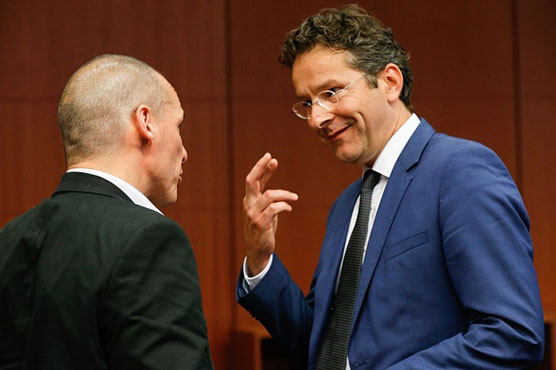
The so-called Eurogroup of finance ministers held a conference call to discuss next steps following the Greek vote, while the ECB s decision-making governing council was holding its regular policy meeting.
Greek Prime Minister Alexis Tsipras overcame a major mutiny in his radical left Syriza party and won parliamentary approval for a series of unpopular reforms demanded by international creditors.
As anti-austerity protesters threw firebombs at police on the streets of Athens, Tsipras was forced to rely on pro-European opposition parties to win approval for the measures that include sweeping changes to taxes, pensions and labour rules.
"I had specific choices before me: one was to accept a deal I disagree with on many points, another was a disorderly default," he said in an impassioned speech to parliament.
Many of Syriza s hardline leftists voted against the measures, including former finance minister Yanis Varoufakis, after a tempestuous debate.
And even his successor Euclid Tsakalotos said his decision to back the bailout terms "will burden me my whole life".
"I don t know if we did the right thing. I do know we did something we felt we had no choice over," he said.
Greek parliamentary backing was a pre-condition for Athens to secure a third EU bailout worth up to 86 billion euros ($94 billion), and means tough talks to finalise the long-awaited deal can soon begin in earnest.
Brussels appeared to be satisfied by the results of the overnight vote.
"The authorities have legally implemented the first set of four measures agreed at the euro summit in a timely and overall satisfactory manner," EU spokeswoman Annika Breidthardt told reporters in Brussels.
European governments are divided over options to help Greece meet its short-term cash needs while it waits for the eurozone bailout deal to be finalised, which will likely take at least four weeks.
- ECB life support -
In the short term, it will likely be up to the Frankfurt-based ECB to keep Greece s banks, and by extension its economy, from immediate collapse.
To stem massive capital flight, Greek banks have been closed for more than two weeks and cash withdrawals limited to 60 euros a day per person.
Greek banks have been hooked up to the ECB s life support, known as the Emergency Liquidity Assistance or ELA, for weeks now, with the aid capped at 89 billion euros since June 26.
With no new monetary policy announcements expected at Thursday s ECB governing council meeting, president Mario Draghi is likely to face a grilling over the ELA lifeline.
Strictly speaking, ELA is only available for banks that are solvent, and the solvency of Greek banks is looking increasingly shaky.
Athens has already failed to make a key debt repayment to the International Monetary Fund, and it must now stump up 4.2 billion euros to the ECB itself by July 20.
Should it miss that deadline, the ECB may find it impossible to justify keeping the ELA taps open.
- No to haircut -
Several other eurozone parliaments are due to vote on the bailout package, hammered out in marathon weekend talks in Brussels.
After France gave its green light on Wednesday, Finnish Prime Minister Juha Sipila will present it to coalition partners Thursday, notably the eurosceptic Finns Party which had been advocating a Grexit, ahead of a possible vote by the parliamentary grand committee.
On Friday, German lawmakers will interrupt their summer holiday to vote on granting the government a mandate to negotiate the modalities of the new aid package.
The vote is unlikely to prove problematic, even if Chancellor Angela Merkel is facing growing disaffection within her conservative CDU/CSU parties over lending more money to the crisis-hit country.
For Germany, the question of a possible "haircut" or write-down of Greece s debt -- which currently amounts to 180 percent of gross domestic product (GDP) -- remains an extremely sensitive issue.
The IMF, one of Greece s creditors alongside the EU and the ECB, caused a stir with a bombshell report criticising the deal and warning that lenders would have to go "far beyond" existing estimates for debt relief.
Debt relief could take the form of an extension of the debt maturity, or a pure and simple writeoff -- an option which the biggest creditor Germany, however, sees as a no-go.
"A real debt haircut is irreconcilable with membership in monetary union," Finance Minister Wolfgang Schaeuble said on Deutschlandfunk public radio.