Summary The German economy effectively ground to a halt in the middle of last year.
Frankfurt (AFP) - The German economy, Europe s biggest, has slipped into higher gear powered by low unemployment, higher wages and the weak euro, the German central bank, or Bundesbank, said on Friday.
After notching up growth of 1.6 percent last year, Germany would see gross domestic product (GDP) expand by 1.7 percent in 2015, 1.8 percent in 2016 and 1.5 percent in 2017, the Bundesbank said in its latest monthly report.
That marked an "appreciable" upgrade from the central bank s previous economic projections in December, when it had pencilled in growth of 1.0 percent for this year and 1.6 percent for next year.
With those growth rates, "the German economy would expand at a faster pace than potential output at an annual rate of 1.2 percent," the Bundesbank wrote.
"Compared with the December projection, GDP growth expectations for 2015 and 2016 have been raised appreciably by 0.7 and 0.2 percentage point, respectively," it said.
The German economy effectively ground to a halt in the middle of last year, but picked up again at year s end to show growth of 0.7 percent in the final quarter and expansion of 0.3 percent in the first three months of this year.
Recovered from lull
"The German economy has recovered from the lull in mid-2014 more quickly than expected and has returned to a path of growth that is supported by both internal and external demand," the Bundesbank said.
On the side of domestic demand, the economy was "reaping the benefits of the favourable labour market situation and substantial income growth," the report said.
This was boosting private consumption and housing construction.
While foreign business was currently burdened by "dampening effects emanating from the global economy ... this is balanced out by the depreciation of the euro and the improving economic recovery in the euro area," it continued.
"Moreover, the global economy is likely to pick up steam again in the near future," the Bundesbank added.
The bright outlook for Germany was reflected in positive sentiment, it continued.
"Enterprises still consider their situation to be exceptionally good," it said.
According to the survey published by the German Chamber of Commerce and Industry (DIHK) in the early summer, nine out of 10 firms were "at least content" with their situation.
Other leading sentiment surveys, such as Ifo and the Centre for European Economic Research, painted a similar picture.
"Firms are also looking to the future with a fair amount of confidence. That said, their sense of optimism is not as pronounced as it was at the beginning of last year," the Bundesbank cautioned.
Concrete data are coming in better than expected.
Orders beat expectations
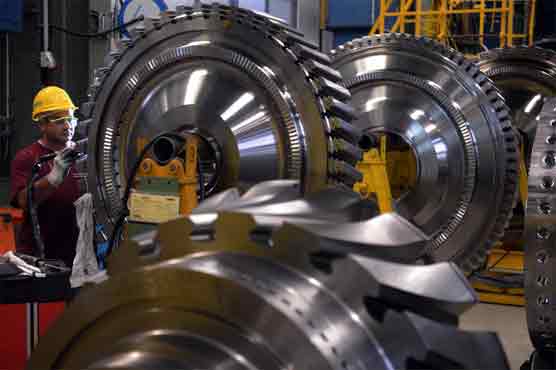
Earlier, the economy ministry in Berlin said that factory orders -- a key measure of demand for German-made goods -- beat analysts expectations in April, rising by 1.4 percent month-on-month.
Despite a dent in domestic orders, "the overall trend remains upwards. Additional impulses can be expected from the recovering economy in the euro area," the ministry said.
Economists were cautiously optimistic.
"For now, the data are only signalling a stabilisation of industrial production. Order intake needs to continue rising in the coming months if production and thus GDP is to grow more strongly again in the second quarter," said Commerzbank economist Ralph Solveen.
UniCredit economist Andreas Rees said the better-than-expected orders data were "the first signs that the improvement in business sentiment in the eurozone translated into higher demand and arrived in Germany."
BayernLB economist Stefan Kipar was also confident.
"Given the ongoing weakness of the euro and the emerging recovery in the United States, we see further upwards potential in the coming months. Domestic demand remains intact and the outlook remains optimstic," he said.