Summary Bangladesh factory-collapse survivors giving up garment work, looking for other jobs.
DHAKA (AFP) - Hundreds of factories which form the hub of Bangladesh s garment industry are to close indefinitely after worker unrest sparked by the death of more than 1,100 colleagues, employees announced Monday.
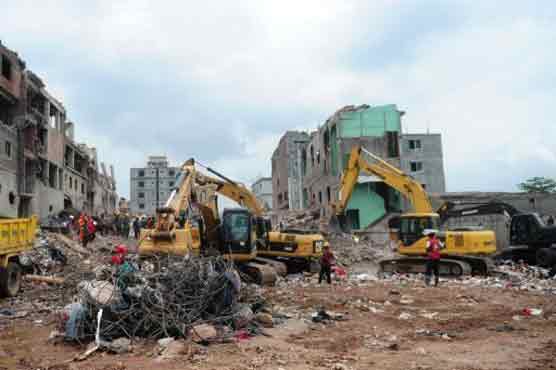
As the search for bodies from last month s collapse of a factory complex wrapped up, the textile industry s main trade body said all operations at the nearby Ashulia industrial zone were being suspended until further notice.
Shahidullah Azim, of the Bangladesh Garment Manufacturers and Exporters Association, said the decision to shut down all the factories at Ashulia, on the outskirts of Dhaka, was made "to ensure the security of our factories".
Local police chief Badrul Alam told AFP that workers in 80 percent of the factories had walked out earlier in the day to demand an increase in salaries as well as the execution of the owner of the collapsed Rana Plaza complex in the town of Savar.
Most of Bangladesh s top garment factories are based at Ashulia and there has been "virtually no work" there since the April 24 Rana Plaza tragedy, Azim said.
Tensions in Ashulia had been further inflamed by the discovery of a dead female garment worker on Sunday. Police said they suspect that the death was a suicide sparked by a "love affair".
The 19-year-old seamstress who spent 17 days trapped in the rubble of a collapsed factory building said Monday that she will never again work in a Bangladesh garment factory.
Reshma Begum was pulled in remarkably good shape from the wreckage of the eight-story Rana Plaza building on Friday. Stunned rescue workers were drawn to the wide pocket under the rubble where she had taken refuge when they heard her banging on a pipe.
Begum was brought in a wheelchair to speak with journalists just outside her room in the intensive care unit of a military hospital. She suffered a head injury in the collapse, and part of her head was covered Monday with a light violet shawl.
Flanked by a nurse a psychiatrist and another doctor, she initially appeared dazed and fragile and spoke in a voice so low it was impossible to hear.
Finally, in a low shaky voice, she recounted her ordeal.
She said she moved to the Dhaka area three years ago and began working. On April 2, she joined a garment factory on the second floor of Rana Plaza, where she earned 4,700 takas ($60) a month.
On the morning of April 24, she heard there were cracks in the building and saw co-workers, mainly men, refusing to enter. The managers reassured them: "There is no problem. You do your work," she said.
Soon after, the building crashed down around her. "When it happened I fell down and was injured in the head heavily. Then I found myself in darkness," she said. She tried to crawl to safety, but could not find a way out, she said.
She survived on four packets of cookies she had with her and some water, she said. "Another person, a man, was near me. He asked for water. I could not help him. He died. He screamed, Save me, but he died," she said. "I can t remember everything that happened."
"I never thought of coming back alive," she said. Brig. Gen. Ashfaq, a psychiatrist at the hospital who uses only one name, said Begum was puzzled and confused when she was rescued.
"She got panicked when someone touched her," he said. "Now she is doing fine, better. We have talked a lot with her."
Begum s survival has been a rare moment of joy amid the morbid task of removing bodies from the disaster site. On Monday, with a death toll of 1,127, the military announced it was ending its search for bodies from the building.
The tragedy has created global pressure for reform in the Bangladeshi garment industry. But Begum said she will not be drawn back into such work. "I will not work in a garment factory again," she said.