Summary Fresh allegations of corrupt payments in Spain's ruling party raised pressure on PM Rajoy.
Corruption allegations of alleged off-the-books payments to high-ranking officials of Spain's governing Popular Party – including Prime Minister Mariano Rajoy – are threatening to destabilize the government and damage its ability to steer the country through its economic crisis.
On 31 January, the Spanish paper El País published several documents showing top leaders of the ruling Popular Party receiving regular payments in cash from the party. The money was illegal donations by top businesses, particularly in the construction and private security sectors.
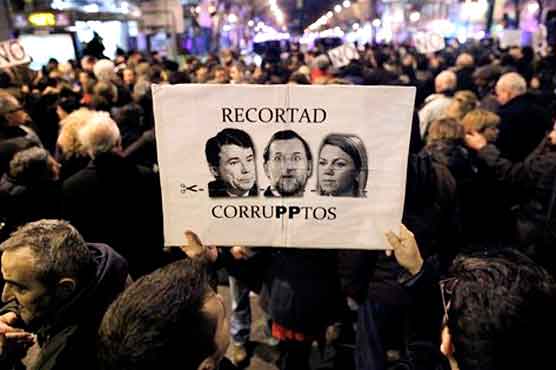
This is the latest in a series of corruption scandals affecting political parties and institutions in Spain and severely damaging the reputation of bourgeois democracy as a whole. As such, it is only adding to the anger amongst the workers, which has been accumulated under the imposition of the austerity measures aimed at making the workers pay for the deep crisis of Spanish capitalism.
The documents published by El País, showing the secret accounting kept by former party treasurer Luís Barcenas, confirms information published previously, by El Mundo newspaper, about PP leaders being paid regular amounts in brown envelopes. This information comes to light as Barcenas is being investigated for tax fraud in relation to secret bank accounts in Switzerland where he held 22 million euro.
To add insult to injury, Barcenas, a long standing PP member, who acted as the party's financial manager for 20 years and then as its treasurer for one year in 2009, was able to repatriate some of that money under a tax amnesty offered by the PP government last March. When this latest scandal broke out, the PP leadership tried to distance themselves from Barcenas, alleging that he no longer played any role in the party. But soon it was revealed he still had an office in the national PP headquarters.
The most recent information published by El País about payments to party leaders involves current president Mariano Rajoy, all the party general secretaries for the period covered in the documents (going back to 1997), the party's deputies for the same period and other prominent leaders like Rodrigo Rato and Jaime Mayor Oreja.
The first reaction of the PP leadership has been to deny everything, energetically protest and threaten all those who are “slandering” them. However, the case is unravelling very fast. Graphology experts have declared that the handwriting in the documents published by El Pais corresponds to that of Luís Barcenas. The president of the Senate, García Escudero (PP), has also admitted having received a “loan” from the party which he then paid back. This should have been the reason for an entry about him in Barcenas bookkeeping published by El País.
Even more interesting than the payments written down in the documents, is perhaps where this money comes from. Important Spanish businessmen, including CEOs of companies in the IBEX35 stock exchange index are listed as having paid hundreds of thousands of euro to the party. Many of these companies benefited from government contracts at different levels, particularly in public works. Those mentioned include Villar Mir, a former CEO of construction group Sacyr Vallehermoso; the marquis of Villar Mir, former Franco regime official and owner of OHL construction group (involved in toll road and highway concessions and also the building of the famous Real Madrid Sports City sky scrapers); José Mayor Oreja, the brother of PP leader Jaime Mayor Oreja and CEO of construction group FCC, also heavily involved in public works and the building of the Real Madrid sky scrapers.
Barcenas bookkeeping also involve payments to the Basta Ya! Group, which later became the UpyD political party. UpyD is a right wing populist group, which presents itself as being “neither right wing nor left wing” but only concerned with “the struggle against corruption”. Also mentioned in the papers as receiving donations from the PP is the vocal extreme right wing internet portal Libertad Digital.
]
This is not the only corruption scandal in the headlines of the Spanish papers. A leading MP from the Catalan bourgeois nationalist CiU party, Xavier Crespo, is being investigated because of allegations, that he received money from the Russian mafia when he was the mayor of Lloret de Mar. A series of former officials in the Catalan government have been tried and charged with diverting unemployed training funding to their own party CDC (part of the CiU coalition). Those involved in this case, known as Pallerols after one of the main accused, were given lenient sentences (which means they will not go to jail) in exchanged for giving back part the money stolen, which was then paid by the party itself. None of the party leaders resigned.
Meanwhile, the investigation into King Juan Carlos son in law, Urdangarin, has seen him accused of using his royal credentials to extract money from public institutions, regional and local governments for the personal enrichment of himself and his associates. The scandal has affected the Monarchy as a whole, which has now deleted Urdangarin from their official website. This has added to the growing questioning of the Monarchy as an institution.
It is not just the corruption scandals and the fact that ever higher up people and institutions are being tainted by them. These are the same people and institutions which are imposing tens of thousands of millions of euro in austerity cuts, privatising health care, destroying state education, bailing out the banks to the tune of tens of thousands of millions of euro … all under the pretext that “we are all in this together” and “we must all make sacrifices” and “tighten our belts”.
While the rich and powerful are never caught, hardly ever charged and if so, almost never end up having to serve jail sentences, another case has also made the headlines in the last few days. An unemployed mother of two, who spent 193 euros buying food and nappies for her daughters with a credit card she found on the street will now have to serve a jail sentence after having already paid a fine of 900 euro. The contrast is stark and reveals clearly that under capitalism there is one law for the rich and another for the poor.