Summary Putin slams increasing control of Russian economy by foreign companies.
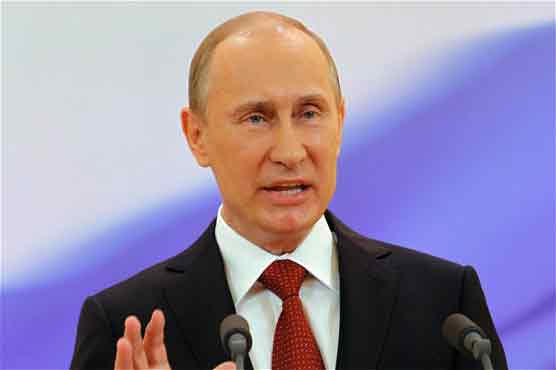
MOSCOW: Russian President Vladimir Putin on Wednesday denounced companies with offshore jurisdiction and ordered the government to end the "offshore-isation" of the Russian economy.
"The offshore character of the Russian economy has become legend," Putin said in his annual state of the nation address, the first since he was sworn in in May.
"Nine out of 10 agreements made by big Russian companies, including companies with state capital, are not regulated by Russian laws."
"We need a whole system of measures to deoffshore-ise Russia s economy," he said, ordering the government to look into the issue.
"We need to strive for transparency of the offshores, for making tax information open," Putin said, adding that Russian laws should be made more friendly to businessmen.
"The best way to make business patriotic is to provide effective guarantees of private property, making Russian jurisdiction attractive," he said.
Some of largest companies in Russia in key sectors of the economy are registered far beyond its borders in places like Cyprus, allowing them to keep much of what they would pay in taxes as profit.
When metals giant Rusal made its documents public before attaining its Hong Kong listing in 2010, Russian media found out that its Jersey registration allows it to keep 90 percent of its profits.
Putin s former adviser Gleb Pavlovsky called the appeal for deoffshore-isation "purely political" and irrelevant to real problems faced by businesses in the country.
"Offshores are a constant tune of the Russian authorities," he said.
"Obviously, the battle will be waged selectively, with businessmen that are a problem for the Kremlin," he said.
Putin also said the government must finalise a new tax on luxury, "including on luxury real estate and, though it may be difficult, on expensive cars."
"What we can do, and what is fair, is to additionally tax the so-called prestige, demonstrative consumption," Putin said.
The luxury tax has been discussed for years in Russia, where flat tax has long been seen as unfair to the vast majority of people with low incomes.
However critics say that the richest of the rich do not spend their money in Russia, making their assets unreachable.
Russia has been plagued by capital flight and foreign investors are put off by issues like the rule of law, corruption, and arbitrary justice, manifested for many by the jailing of oil tycoon Mikhail Khodorkovsky in 2003.
Finance Minister Anton Siluanov said Wednesday that he expects capital flight in 2012 to amount to $65 billion. In 2011, the figure was $80.5.
Russia places low on global rankings like the World Bank s Doing Business report, where it ranked 112th of 185 countries this year.
This month, it was listed 133nd on Transparency International s Corruption Perception Index, out of 176 countries.
Putin has relaunched a war on corruption this year, on Wednesday promising to "continue the assault" on it.
Previously the war on corruption was waged by Putin s predecessor Dmitry Medvedev, who even adopted a "national corruption resistance plan" before he stepped down as president.